seamus dubhghaill

Promoting Irish Culture and History from Little Rock, Arkansas, USA


2 Comments

Birth of Billy Whelan, Irish Footballer

William Augustine Whelan, known as Billy Whelan or Liam Whelan, Irish footballer who plays as an inside-forward, is born at 28 St. Attracta’s Road, Cabra, Dublin, on April 1, 1935. He dies at the age of 22, as one of eight Manchester United players who are killed in the Munich air disaster.

Whelan is the fourth of seven children born to John and Elizabeth Whelan. His father is an accomplished centre half-back for Dublin club Brunswick and is instrumental in winning the FAI Junior Shield in 1924. His mother is an avid Shamrock Rovers supporter. His father dies in 1943 when Whelan is just eight years old.

Whelan plays Gaelic games, winning a medal for St. Peter’s national school in nearby Phibsborough. After leaving school at the age of fourteen, he works in Cassidy’s, an outfitter on South Great George’s Street. He is an accomplished Gaelic footballer and hurler, but association football is his first love.

Whelan begins his career at the age of twelve when he joins Home Farm before joining Manchester United as an 18-year-old in 1953. He is capped four times for the Republic of Ireland national football team, including a surprising 4–1 victory against Holland in Rotterdam in 1956, but does not score. His brother John plays for Shamrock Rovers and Drumcondra and his eldest brother Christy plays for Transport.

Whelan makes his first appearance for Manchester United during the 1954–55 season and quickly becomes a regular first-team player. He goes on to make 98 first-team appearances in four seasons at United, scoring 52 goals. He is United’s top scorer in the 1956–57 season, scoring 26 goals in the First Division and 33 in all competitions as United wins their second successive league title and reaches the semi-finals of the 1957-58 European Cup. He also gives a commanding display in the 1957 FA Cup final despite losing 2–1 to Aston Villa. Such is the strength of the competition in the United first team that he is soon being kept out of the side by Bobby Charlton. He is a traveling reserve for United’s ill-fated European Cup match against Red Star Belgrade in Belgrade on February 6, 1958, and is one of eight players to die in the subsequent air crash that destroys Matt Busby‘s young team and claims twenty-three lives. Fellow Irishman Harry Gregg, United’s goalkeeper and a survivor and hero of the Munich air crash, recalls Whelan’s last words as the plane is attempting take-off for the third and final time as “Well, if this is the time, then I’m ready.”

Thousands attend Whelan’s funeral on February 12 in St. Peter’s Church, Phibsborough, Dublin, and line the streets as the funeral procession makes its way to his burial-place in Glasnevin Cemetery. In December 2006 Dublin Corporation unveils a commemorative plaque on a bridge at Faussagh Road, Cabra, which was renamed Liam Whelan Bridge.

Although of a cheerful disposition, Whelan is also modest and shy by nature, and a quietly devout Catholic. He has a particular dislike of swearing and tends to fix a look of pained disappointment on teammates who use bad language. Nobby Stiles admits that he “would rather be caught swearing by the pope than by Billy Whelan.” His religious devotion regularly fuels rumours that he is considering being a priest, although at the time of his death he is engaged to be married to Ruby McCullough.


Leave a comment

Birth of Karl Mullen, Rugby Union Player & Gynecologist

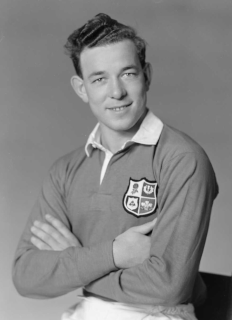
Dr. Karl Daniel Mullen, rugby union player and consultant gynecologist who captains the Irish rugby team and captains the British Lions on their 1950 tour to Australia and New Zealand, is born on November 26, 1926, in Courtown Harbour, County Wexford.

Mullen is one of three sons and seven daughters of Daniel Mullen, an officer of the customs and excise, and his wife Annie (née Hargrove). After his parents move to Home Farm Road, Drumcondra, Dublin, he is educated at the Dominican St. Thomas’s Academy, Eccles Street, the Jesuit Belvedere College, Great Denmark Street, and the Royal College of Surgeons in Ireland (RCSI). He plays rugby and cricket at school, association football with Home Farm F.C., and golf in the summer months. Initially a centre, he becomes a prop on the Belvedere junior cup team and, after injury to a teammate, hooker on the senior cup team, which loses the Leinster Schools Rugby Senior Cup final to Castleknock College in 1944.

On January 25, 1947, Mullen makes his formal Irish debut in a 12–8 loss to France. He plays as hooker, winning 25 caps for Ireland from 1947 to 1952. A year later, on January 31, 1948, he plays his first game for Barbarian F.C. in a 9–6 victory over Australia in Cardiff, Wales. After helping Ireland to victory over France on January 1, 1948, at the age of 21, he captains Ireland for the first time, on February 14, 1948, leading them to an 11–10 victory over England at Twickenham Stadium.

Mullen captains the Irish team to their first Grand Slam in the 1948 Five Nations Championship and is one of eight players from that team who live to see the country’s next Grand Slam in 2009.

Ireland retains the triple crown in 1949 by beating Wales 5–0 in Swansea, ending a run of defeats on Welsh soil lasting fourteen years. The following season Ireland suffers from injuries and loses to both England and Wales, the latter securing the triple crown.

Mullen is selected to captain the 1950 Lions Tour to Australia and New Zealand. After appearing in the first two tests against New Zealand, a 9–9 draw and an 8–0 loss, he sustains an ankle injury in the latter game and concedes his place to Dai Davies of Wales. Returning for the second test against Australia, a resounding 24–3 victory, he also plays in a semi-official “British Isles RFU” team against Ceylon during their return journey in September.

Under Mullen’s captaincy Ireland regains the international championship in 1951. His last cap comes in a 14–3 loss to Wales at Lansdowne Road on March 8, 1952. In twenty-five successive appearances (fifteen as captain), he secured three international championships and two triple crowns for Ireland in four seasons, their most successful haul of the twentieth century.

Mullen’s distinguished rugby career has to be fitted around his medical studies. In 1945, he enters the RCSI, graduating L and LM (RCSI and RCPI) in 1949. Awarded the diploma in obstetrics (1952) and membership of the Royal College of Obstetricians and Gynaecologists (1956), he trains at Sir Patrick Dun’s Hospital, Jervis Street Hospital and the Rotunda hospitals. After serving as senior obstetrics registrar at the Derby City General Hospital (1953–56), he returns to Dublin to become a consultant obstetrician, based at Mount Carmel Community Hospital, Churchtown, Dublin, and develops a considerable private practice. By his retirement in 2002, he is estimated to have delivered over 40,000 babies. A proponent of sex education in schools, he appears on RTÉ‘s 7 Days in December 1970, outlining various methods of birth control and calling for a more honest and realistic approach to artificial contraception.

Mullen marries Doreen Kilbride, an accomplished soprano, on April 30, 1952, in Donnybrook, Dublin, interrupting their honeymoon to play for Old Belvedere R.F.C. in the Leinster Senior Cup final. They have eight children, three boys and five girls. In 1975, they move from Altamount, Dundrum, Dublin, to Tulfarris House, Blessington, County Wicklow, adjacent to Poulaphouca Reservoir, where they farm and bred Irish draught horses. In 1985, he sells the property and much of his art collection and moves to Kilcullen, County Kildare.

Mullen is one of eight surviving members of the 1948 team to witness Ireland’s second grand slam on March 21, 2009. Only weeks later, having suffered from a long illness, he dies on April 27, 2009, at his home, Gilltown Lodge, in Kilcullen.

(Pictured: Karl Mullen, captain of the British Lions rugby union team, 1950)


Leave a comment

Death of Professional Footballer Johnny Carey

john-joseph-carey

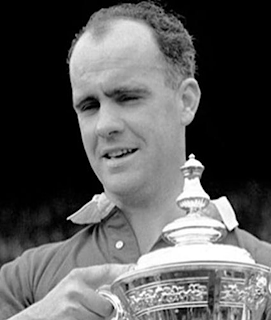
John Joseph “Johnny” Carey, professional footballer, manager and one of Manchester United F.C.’s great captains, dies in Macclesfield, Cheshire, England on August 22, 1995.

Carey is born in Dublin on February 23, 1919. As a schoolboy, he plays football for Home Farm F.C. As a youth, he also plays Gaelic football and is selected to represent Dublin GAA at minor level before he signs for St. James’s Gate F.C. at the start of the 1936–1937 season.

After just two months of League of Ireland football, he is spotted by Billy Behan, a Dublin-based Manchester United scout. In November 1936 United signs him for a then League of Ireland record fee of £250. He makes his debut as an inside left for United on September 23, 1937, against Southampton F.C. During his first season with United, Carey, together with Harry Baird, Jack Rowley, Tommy Bamford, Tommy Breen and Stan Pearson, help United gain promotion to the First Division.

As a player Carey spends most of his career with Manchester United, where he is team captain from 1946 until he retires as a player in 1953. He also plays as a guest for several other clubs including Cardiff City F.C., Manchester City F.C., Everton F.C., Liverpool F.C. and Middlesbrough F.C.

Carey is also a dual internationalist, playing for and captaining both Ireland teams – the FAI XI and the IFA XI. In 1947 he also captains a Europe XI which plays a Great Britain XI at Hampden Park. In 1949 he is voted the Football Writers’ Association Footballer of the Year and in the same year captains the FAI XI that defeats England 2–0 at Goodison Park, becoming the first non-UK team to beat England at home.

Carey is also the first non-UK player and the first Irishman to captain a winning team in both an FA Cup Final and the First Division. Like his contemporary Con Martin, he is an extremely versatile footballer and plays in nine different positions throughout his career. He even plays in goal for United on one occasion.

(Pictured: Manchester United captain Johnny Carey is carried on the shoulders of his teammates, after they win the FA Cup final of 1948 against Blackpool. Date: April 24, 1948)


Leave a comment

Birth of Nicky Byrne, Singer & Songwriter

nicky-byrne

Nicholas Bernard James Adam Byrne, Jr., singer, songwriter, radio presenter, dancer, television presenter and former semi-professional footballer, best known for being a member of Irish music band Westlife, is born in Dublin on October 9, 1978.

Before his music career, Byrne plays professional football, representing Republic of Ireland at several junior levels. He plays for Home Farm F.C. and St. Kevins Boys in North Dublin before becoming a professional player. He joins Leeds United F.C. as a goalkeeper in 1995 and is a squad member of the FA Youth Cup winning team of 1997. He plays for Leeds for two years, leaving when his contract expires in June 1997. He plays in a reserve game for Scarborough F.C. and in a trial game with Cambridge United F.C. before returning to join Dublin club Shelbourne F.C. He then signs for Cobh Ramblers F.C. playing 15 games, then St. Francis F.C., all in Ireland’s League of Ireland.

On May 14, 2009, Byrne is a substitute for a Liverpool F.C. Legends XI that plays against an All Star XI in a Hillsborough Memorial match to mark the 20th anniversary of the Hillsborough disaster. He represented the Republic of Ireland at U15, U16 and U18 levels.

In June 1998, Byrne attends an audition for new Irish boyband, where Boyzone manager Louis Walsh approaches him to join his new venture, Westlife. He joins Westlife along with Kian Egan, Mark Feehily, Shane Filan and Brian McFadden. With Westlife, he has had 25 top ten UK singles, fourteen of which are number one, seven number one albums and has sold in excess of over 45 million records worldwide. He also has a number one single in Ireland in 2002, alongside the Republic of Ireland national football team and Dustin the Turkey with the Irish 2002 FIFA World Cup anthem, “Here Come the Good Times (Ireland).” He also co-writes many of Westlife’s songs.

On September 7, 2012, it is announced that Byrne will be a contestant for the tenth series of Strictly Come Dancing. He is the ninth contestant to be eliminated. He is ranked number two on Ireland’s Sexiest Man of 2014.

In early January 2016, it is rumored that RTÉ had internally chosen Byrne to represent Ireland in the Eurovision Song Contest 2016. On January 13, he is confirmed to be the Irish singer for the 2016 contest in Stockholm with the song, “Sunlight.” He performs it in the second semi-final but fails to advance to the final.

Byrne’s wife Georgina is the daughter of former Taoiseach Bertie Ahern, and they have twin sons, Rocco Bertie Byrne and Jay Nicky Byrne, and a daughter, Gia.


Leave a comment

Birth of Footballer Ronnie Whelan

ronnie-whelan

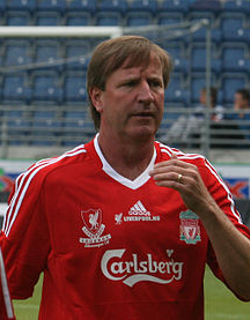
Ronald Andrew Whelan, former Irish association football midfielder and occasional defender, is born in Dublin on September 25, 1961.

Whelan is born into a family of footballers. His father, Ronnie Whelan, Sr., is an Irish international and a key member of the successful St. Patrick’s Athletic F.C. of the late 1950s and early 1960s. His brother, Paul Whelan, plays for Bohemian F.C. and Shamrock Rovers F.C.

Whelan is a skillful and industrious midfield player who, after an unsuccessful trial period for Manchester United F.C., makes his League of Ireland debut for Home Farm F.C. on his 16th birthday at Tolka Park.

Whelan is signed for Liverpool F.C. by Bob Paisley for a bargain £35,000 on September 19, 1979, a few days before his 18th birthday, and makes his debut eighteen months later, on April 3, 1981. He goes on to become an integral part of the dominant Liverpool team of the 1980s. He remains with the club until 1994. In 100 Players Who Shook The Kop, a poll of 110,000 Liverpool fans conducted by the official Liverpool F.C. website, Whelan is in 30th position.

Whelan plays for the Republic of Ireland national football team at one UEFA European Championship (1988) and two FIFA World Cups (1990 and 1994), turning out a total of 53 times for the national side between 1981 and 1995.

Whelan finishes his career at Southend United F.C., where he is also player-manager through the 1996-1997 season. He later manages in Greece and Cyprus, with Panionios G.S.S., Olympiakos Nicosia and Apollon Limassol.

Since retirement Whelan has begun a media career and is a regular contributor to RTÉ Sport in Ireland. He is also Patron of the Myasthenia Gravis Association in Ireland where he is an active fundraiser and works to raise awareness for this rare autoimmune disease.