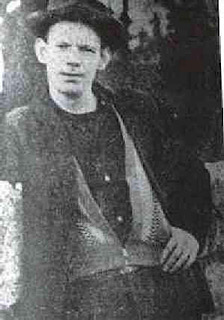
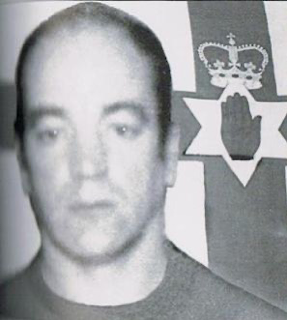
McGladdery is raised by his mother, Cissie McGladdery, a respectable woman who works at the local Damolly Mill to support the family. His father dies prior to this period, leaving Cissie to raise four children alone in modest circumstances. Information on his father remains scarce, and while details about his siblings are limited, he has at least one older brother named Sam.
During his teenage years in the Newry area, McGladdery exhibits patterns of truancy and engages in minor troubles that lead to multiple placements in reform school. Locally in Newry, he earns a reputation as a “well-known bad lad,” particularly noted for predatorial behavior toward women. This perception persists into his early adulthood, marking him as a loner with a violently self-willed disposition, as recalled by his mother. He works sporadically as an agricultural laborer in the Newry region, a common occupation for young men in the area during the late 1950s. By age 25 in 1961, however, he is unemployed and continues to reside with his mother in Damolly.
McGladdery is convicted of the murder of Pearl Gamble, aged 19, whom he had battered, strangled and stabbed to death on January 28, 1961, and whose body is discovered at Upper Damolly, near Newry. It transpires that the murderer and victim are distant cousins. Gamble had gone to a dance at the Henry Thomson Memorial Orange Hall in Newry with three girlfriends. She had been seen dancing with her boyfriend and McGladdery.
The murder investigations lead to McGladdery. When interviewed, he states to have worn a dark blue suit but other people at the dance say he wore a light-coloured one. He is put under surveillance and is discreetly seen going to some undergrowth on February 10, 1961. The following day, the police discover, inside a pillow case in a septic tank, an overcoat, a waistcoat and a handkerchief, all of which are heavily bloodstained. McGladdery is arrested on the same day.
At his trial in Downpatrick, McGladdery pleads his innocence but is found guilty and sentenced to death on October 16, 1961. The evening before his execution he allegedly makes a full confession to the murder. He is hanged, aged 26, at Crumlin Road Gaol in Belfast on December 20, 1961, by executioner Harry Allen.
A BBC Northern Ireland dramatisation of the case, Last Man Hanging, is broadcast on September 8, 2008. McGladdery is portrayed by Michael Condron.
The murder and subsequent execution is the theme of Eoin McNamee‘s 2010 novel, Orchid Blue.
The inaugural 12-person national executive sits at the “top table” under a banner of the 1916 Proclamation’s signatories. Notable members included Nuala Perry, vice-chairperson and former Provisional IRA prisoner, Kevin Murphy, former Real IRA prisoner, Risteard Ó Murchú, former republican prisoner, Sharon Rafferty, Dee Fennell, David Jordan and Mandy Duffy, sister-in-law of Colin Duffy. Other attendees include veteran republican leader Billy McKee, Thomas Ashe Mellon and Issam Hijjawi, Chair of the Association of Palestinian Communities in Scotland.
Saoradh positions itself as a far-left, dissident republican movement advocating a 32-county socialist republic free from British rule and European Union (EU) interference, anti-imperialism, anti-capitalism, and worker ownership of production, rejection of the Good Friday Agreement as a capitulation to British control and grassroots activism, street politics, and campaigns for republican prisoners.
The founding press release emphasizes that Ireland should be governed by the Irish people, with wealth and wealth-producing mechanisms in the people’s ownership, rejecting both British imperialism and capitalist exploitation. The event is marked by a mix of political rhetoric, historical symbolism, and support from prominent dissident figures.
In short, September 24, 2016, marks the official launch of Saoradh as a political front for dissident republicans committed to revolutionary means to achieve Irish unification and national sovereignty.
By mid-1922, the Irish Civil War begins after the Anglo-Irish Treaty splits the IRA into pro- and anti-Treaty factions. The 4th Northern Division, based in counties Armagh, Down, and Louth, is one of the most formidable Anti-Treaty units in the region. Frank Aiken, a veteran IRA commander, has rebuilt this division during the Truce period, using it for guerrilla operations and border raids.
The Free State Army, under the National Army, is consolidating control in southern and midland counties, while Anti-Treaty forces focus on border counties to prevent Free State expansion and to maintain resistance.
The August 16 assault on Dundalk is a border raid aimed at disrupting Free State supply lines and communications, isolating and weakening Free State positions in the Louth area and demonstrating Anti-Treaty strength to other IRA units and the wider population. They use two mines to breach the walls of the barracks and temporarily take over the town.
Seven Free State soldiers are killed and fifteen are wounded. Two republicans are killed, accidentally by one of their own mines, and thirty are wounded. About 240 republican prisoners are freed from the prison and 400 rifles are taken. Aiken, however, does not try to hold the town and, while in possession of it, calls for a truce in a meeting in the town square.
While the attack is significant in symbolic terms, it does not achieve a decisive strategic breakthrough. Free State forces are able to regroup and counterattack, and the operation highlights the challenges Anti-Treaty units face in sustaining large-scale offensives against a better-equipped and more mobile National Army.
The raid exemplifies the “war along the border” strategy, where Anti-Treaty forces target Free State-held border towns and infrastructure. Aiken’s leadership as commander of the 4th Northern Division underscores his reputation as a skilled guerrilla leader. The attack reflects the early Civil War pattern of small-scale, mobile raids by Anti-Treaty forces against Free State-held towns and garrisons.
In summary, the August 16, 1922, Dundalk attack is a notable Anti-Treaty IRA operation that showcases the 4th Northern Division’s capabilities but also the limitations of their conventional-style assaults against the Free State’s growing military presence.
(Pictured: Frank Aiken and the 4th Northern Division of the Irish Republican Army)
Mitchel, a writer for The Nation and founder of his own journal, United Irishman, openly preaches rebellion against England. Convicted of treason in 1848, he is sentenced to fourteen years transportation in Van Diemen’s Land (Tasmania). In 1853, he escapes to the United States, where he publishes his Jail Journal. While in the United States, he is editor of the Richmond Examiner and a strong advocate of Confederate rights and champions slavery. He is imprisoned for several months following the end of the American Civil War.
Mitchel’s return visit to Ireland is prompted by political developments in the Irish Parliamentary Party (IPP), which has nominated him for seats in Cork City and Tipperary without informing him. His well-known skepticism toward constitutional “moral force” agitation makes it uncertain whether he will accept the nomination, but the nomination proceeds anyway.
Mitchel’s return is unexpected, yet is met with public acclaim. Upon arriving in Queenstown (now Cobh, County Cork), he is met by a large crowd, and when he reaches Cork, a procession of ten thousand people escorts him to his hotel. This demonstrates the respect and support he still commands among Irish nationalists, despite his exile in the United States since 1853.
Mitchel then goes to Newry, his native town, where he stays for a few months to recuperate his health and await any opportunity to be elected to Parliament. However, no parliamentary vacancy arises during his stay, and he eventually returns to New York City in October 1872.
Mitchel’s return is part of a pattern of political activity in his later years. In 1875, he is again nominated for Tipperary, elected without opposition, and declared an abstentionistMP — but his election is overturned by the British government on the grounds of his previous felony conviction. He dies in March 1875 in Dromolane, County Down, in the same house where he was born.
In summary, July 25, 1872, marks the beginning of a brief but politically charged visit to Ireland for John Mitchel, a figure remembered for his uncompromising republican stance and his role in the Young Ireland movement.
Parry is born c. 1599 in Madyn Dyswy, Amlwch, Anglesey, Wales, the son of Rhys Parry, a merchant of Newry, County Down. The name of his mother is disputed. His siblings are Arthur, Grace and Magdalen. He is educated in Newry. In 1616, he enrolls as a student of Trinity College Dublin (TCD) where he graduates with a BA in 1620. He obtains his MA there in 1623 and a fellowship on November 24, 1624. In 1630 he graduates as a Doctor of Divinity and later becomes Pro-Vice-Chancellor of the college.
In Anglican politics Parry is regarded as a Laudian. In 1627, he is appointed Prebendary of Tipperkevin, a living belonging to St Patrick’s Cathedral, Dublin. In 1630, he is Incumbent of St. Bride’s Church, Dublin, where several of his children are baptised. In 1634, he is made Treasurer of Christ Church Cathedral, Dublin and chaplain to Lancelot Bulkeley, Archbishop of Dublin. In 1635, he is appointed one of the High Commission for Ecclesiastical Causes. In 1636, he is appointed Prebendary of Stagonyl, another living belonging to St Patrick’s Cathedral, Dublin. By patent dated April 28, he is presented to St. Olave’s in Waterford where he is installed on May 11, but is also licensed to hold his other preferments at the same time. In 1640, he resigns from St. Olave’s and is appointed Dean of Lismore, County Waterford. Some of the Deanery lands had been seized by Richard Boyle, 1st Earl of Cork and Parry tries to get them back but fails. His successor as Dean of Lismore is his first cousin, Robert Parry. In 1643, he is Archdeacon of Glendalough, County Wicklow.
On December 29, 1646, King Charles I of England in a letter states he favours Parry for the See of the Diocese of Killaloe, County Clare. On March 20, 1647, a patent is issued confirming his appointment as Bishop of Killaloe and he is consecrated at Christ Church Cathedral, Dublin, on March 28, 1647, by Lancelot Bulkeley, Archbishop of Dublin, assisted by the Bishops of Kildare and Cloyne. However, as this is in the middle of the Irish Rebellion he was unable to travel to his diocese and remains in Dublin, where he resides in Chichester House, St. Stephen’s Street, which later houses the Parliament of Ireland. In the Hearth Money Rolls the house is assessed for eight hearths so is quite large. On July 9, 1647, he signs the petition of the clergy praying to be allowed the use of the Liturgy, then abolished by order of the commissioners under Oliver Cromwell. On account of his good character and the smallness of the revenues of Killaloe, the King permits him to hold his former preferments in commendam.
Parry marries the daughter of John Price and by her has six children, who are John Parry, Bishop of Ossory, Benjamin Parry, Bishop of Ossory, Edward Parry, Robert Parry, Mary Parry who marries John Bulkeley, and Elinor Parry who is a love and correspondent of John Locke and later marries Richard Hawkshaw.
Parry dies in his house in St. Stephen’s Street on July 20, 1650, at the age of 51, after contracting the plague which rages there, and is buried in St. Audoen’s Church, Dublin. His will dated July 17, 1650, is proved in the Prerogative Court, Dublin. Its terms are: (1) his body is to be interred in St. Audeon’s Church near the doors, with his face to the east, where he also desires the body of his wife to be translated, and laid by his side, (2) he gives to his eldest daughter, Mary Parry, alias Bulkeley, a little silver watch, and her mother’s dear-head ring, (3) to his other daughter “Eleynor Parry” other ornaments that belonged to her mother, (4) to his sister “Madelius Evans” five pounds, (5) to other beneficiaries are given legacies out of the fifty pounds due to him by William Usher, (6) to his cousin, Robert Parry, he leaves his lexicon and other books, (7) to his cousin, Richard Parry, he leaves a gold ring, (8) to his cousin, Mary Parry, wife of Richard, he leaves a money legacy, and (9) he appoints his cousin, Robert Parry, as overseer of his will.
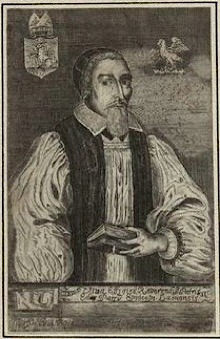
Parry writes a book entitled David restored; or an Antidote against the Prosperity of the Wicked, and the Afflictions of the Just, which is a sermon on the seventy-third Psalm. This is afterward published by his son, John Parry at Oxford in 1660. This work contains an engraved portrait of Edward Parry (above).
(Pictured: An engraved portrait by John Dickson of Dr. Edward Parry, Bishop of Killaloe, from a book authored by the bishop entitled “David restored; or an Antidote against the Prosperity of the Wicked, and the Afflictions of the Just”, published at Oxford in 1660.)
On July 5, 1790, the Irish mail coach service makes its first run from Dublin to Waterford, marking a significant milestone in Ireland’s postal history. This is part of the broader expansion of the General Post Office’s (GPO) mail coach network, which had been introduced in Ireland in 1789.
A twice-weekly mail coach service operates between Dublin and Drogheda to the north, Kilkenny to the south and Athlone to the west as early as 1737 and for a short period from 1740, a Dublin to Belfast mail coach exists. In winter, this route takes three days, with overnight stops at Drogheda and Newry. In summer, travel time is reduced to two days. In 1789, mail coaches begin a scheduled service from Dublin to Belfast. They meet the mail boats coming from Portpatrick in Scotland at Donaghadee, County Down.
The Irish mail coach system is modeled on the successful English service introduced in 1784 by John Palmer, which uses specially built coaches to carry the Royal Mail under contract to independent operators. These coaches are designed for speed and efficiency, stopping only for mail collection and delivery, and are protected by armed guards. The Dublin–Waterford route is one of the early inland services added to the network, complementing other major routes such as London–Norwich, Liverpool–Leeds, and London–Dover.
The July 5, 1790 run from Dublin to Waterford is notable because it is the first scheduled mail coach service on that route, replacing slower and less secure methods like mounted riders or carts. It demonstrates the GPO’s ability to extend its network to key inland towns, improving communication between Dublin and the southeast of Ireland. It also reflects the rapid expansion of the mail coach system in Ireland by 1790, with many towns already having daily mail delivery and collection.
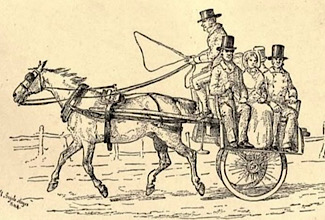
While the primary purpose is to carry the Royal Mail, passengers can also travel at a premium fare. The coaches can carry four seated passengers inside and more standing outside, with the driver and guard occupying the front seats. The journey from Dublin to Waterford is relatively short for the time, but still requires careful scheduling to meet the strict post office timetable.
This first run lays the foundation for a regular mail service that becomes a vital part of Ireland’s transport and communication infrastructure until the advent of railways in the 1830s. By the mid-19th century, most of the mail coaches in Ireland are eventually out-competed by Charles Bianconi’s country-wide network of open carriages, before this system in turn succumbs to the railways. The Dublin–Waterford route, like others, is eventually replaced by the faster rail services, but its role in modernizing Ireland’s postal system is crucial.
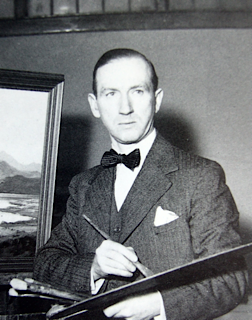
McKelvey is second among six children and second of three sons of William McKelvey, painter and decorator, originally from Roseville, Craigavad, County Down, and his wife Mary, daughter of Frank Baird, farmer, from Ballywee, County Antrim. He is baptised at Saint Matthew’s Parish Church.
McKelvey attends Mayo Street national school in Belfast. When he is sixteen he became a lithographer apprentice to the firm David Allen & Sons. They produce postcards, posters and notices. He enrolls in the Belfast School of Art part-time by attending evening classes until he leaves his employment in 1911 to study full-time. Alfred Rawlings Baker, his art master, has great influence on him during his time at art college. He receives numerous awards for his artwork including the Sir Charles Brett Prize, the Fitzpatrick Prize, and the Taylor Art Competition.
McKelvey returns to David Allen & Sons in 1917 for a short period of time before he begins to focus on painting and opens his own studio in 1920. The studio is located in Rea’s Building, Royal Avenue, Belfast.
By 1918 McKelvey’s work is exhibited at the Royal Hibernian Academy (RHA) and in 1921 he is elected a member of the Belfast Art Society. He is appointed an associate of the RHA in 1923, being granted full membership in 1930. During his career he is considered on a par with Paul Henry and James Humbert Craig, two of the most successful Irish landscape painters of the time. He is elected as one of the first academicians of the Ulster Academy of Arts when it is founded in 1930. He dies in Belfast on June 30, 1974.
Jackson is born on September 27, 1948, in Tullynarry Cottages, Donaghmore, County Tyrone, Northern Ireland, one of seven children of John Jackson, farmhand, and his wife Eileen. As a teenager he participates in Paisleyite demonstrations against the Northern Ireland civil rights movement. He is already a local “hard man” who cultivates an air of menace. After a brief period in Australia, he returns home and serves in the Ulster Defence Regiment (UDR) from 1972 to 1975. He also joins the Ulster Volunteer Force (UVF) and is alleged to have committed his first murders in 1973. He is arrested in 1973 after the doorstep killing of a BanbridgeCatholic who works in the shoe factory that employs Jackson. The victim’s wife identifies Jackson as the murderer, but the charge is withdrawn after she admits to a degree of prompting by the police.
Jackson is a leading member of a UVF gang linked to about 100 murders carried out at random against Catholic civilians between 1973 and 1979, earning for the north Armagh and east Tyrone area the nickname “the murder triangle.” He also allegedly helps to plan the Dublin and Monaghan car bombings of May 17, 1974, killing thirty-three civilians, and orchestrates the attack on the Miami Showband on July 31, 1975. He becomes UVF Mid-Ulster Brigade commander in 1975. Never convicted of any of the numerous murders attributed to him, he is however jailed between 1979 and 1983 for arms possession.
Jackson marries Eileen Maxwell in the late 1960s. They have a son and two daughters. The marriage does not survive his imprisonment and after his release he moves to Donaghcloney, County Down, where he lives with a much younger girlfriend. He remains active in loyalist paramilitarism but takes a less prominent role. He survives several Irish Republican Army (IRA) attempts on his life, including the detonation of a car bomb outside his house. In 1984, the editor of the Belfast edition of the Sunday World is shot and wounded after publishing articles denouncing “the Jackal,” the nickname by which the press calls Jackson during his lifetime.
After the Anglo–Irish Agreement of 1985, Jackson is briefly linked to Ulster Resistance (UR), a paramilitary group founded by associates of Ian Paisley. He allegedly assists the rearming and reorganisation of the Mid-Ulster UVF under Billy Wright after the killing of his brother-in-law and alleged accomplice, Roy Metcalf, by the IRA in 1988. Relations between Wright and Jackson cool after the killing of a Catholic in Donaghcloney by Wright’s men leads to Jackson being called in for questioning, and he supports the UVF leadership in its 1996–97 dispute with Wright. He is also the focus of recurring allegations about collusion between loyalist paramilitaries and elements of the security forces in mid-Ulster, including claims that he operated on behalf of British military intelligence who shielded him from prosecution.
Jackson dies of lung cancer at the age of 49 at his Donaghcloney home on May 30, 1998. He is buried on June 1 in a private ceremony in the St. Bartholomew Church of Ireland churchyard in his native Donaghmore, County Down. His grave, close to that of his parents, is unmarked apart from a steel poppy cross. His father had died in 1985 and his mother outlives him by five years.
Considerable uncertainty surrounds his involvement in many of the crimes attributed to him, but there is no doubt that he is a cold-blooded multiple murderer and one of the most sinister “hard men” of loyalist paramilitarism.
(From: “Jackson, Robin” by Patrick Maume, Dictionary of Irish Biography, http://www.dib.ie, October 2009)
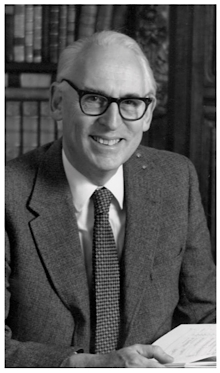
Whyte is born on April 30, 1928, in Penang, Malaysia. His father is manager of a rubber plantation on the mainland. His family leaves Malaysia and returns to Europe when he is three, eventually settling in Rostrevor, County Down, Northern Ireland. The Whytes are a well-known County Down family recorded in the area since at least 1713. The family is said to have come to Ireland from South Wales with Strongbow in 1170 and settled in Leinster. He is educated locally, at Ampleforth College and Oriel College Oxford, from which he takes a degree in Modern History in 1949. Continuing studies some two years later he is awarded a B.Litt degree for further research, which is to form the nebula of his first book which is published in 1958.
Whyte undertakes national service during the 1950s and works as a history teacher in his old school before being appointed lecturer in Modern History at Makerere University, Uganda. In 1962, he returns to Ireland having been appointed first “lecturer in empirical politics” at the then expanding University College Dublin (UCD). In 1966, he weds fellow academic Dr. Jean Murray and moves to Queen’s University Belfast (QUB) to undertake further studies.
In his book, Preventing the Future: Why Was Ireland So Poor for So Long?, Whyte’s successor as Professor of Politics at UCD, Tom Garvin, gives an account as to the clerical politics prevalent at the time at UCD which causes Whyte’s untimely departure:
A little later, in 1966, McQuaid provoked, possibly unintentionally, the resignation of John Whyte, a distinguished Catholic political scientist, from University College Dublin’s Department of Ethics and Politics. This resignation and move to Belfast on Whyte’s part in 1966 almost certainly was the unintended result of an extraordinary piece of clerical interference and bullying that rebounded upon McQuaid and on UCD. Whyte was in the midst of writing his standard history of the Catholic Church in independent Ireland, later published in 1969; at McQuaid’s apparent instigation, his professor and head of Department attempted to forbid him from continuing with this work. The irony was that the resultant scholarly book, finished in Belfast rather than Dublin, deeply underestimated clerical power in the Irish state and gave the Catholic Church a rather easy ride. Another irony was that Whyte, as a Roman Catholic historian and political scientist, was apparently rather favoured by McQuaid. However in 1966 bishops didn’t know they needed friends. Whyte was to come back to UCD and was professor of Ethics and Politics between 1984 and 1990. In a very real sense, McQuaid was the patriarchal and eccentric governor of Dublin Archdiocese, where one-third of the stat’s population lived; he attempted to run an urban society of a million people as though it were a large feudal community.
At Queen’s, Whyte spends seventeen years as lecturer and reader, and from 1982 Professor of Irish Politics during which he seeks to bring together political scientists from across the island and develop an All-Ireland political science fellowship. From 1973 to 1974 he works at as a research fellow at Harvard University’s Centre for International Affairs, and in 1975 he helps lead a team of researchers investigating the Northern Ireland conflict, then at its height. He also works as research fellow at the Netherlands Institute for Advanced Studies during the late 1970s and is elected Member of the Royal Irish Academy (RIA) in 1977, serving as Vice-President from 1989 to 1990.
In 1984, Whyte returns to University College Dublin, then faced with stringent fiscal cuts and wider problems in Irish third-level education. In his second period at UCD, he leads the Department, which he now heads, through a troubled period of financial cuts while supervising a reorganisation of the undergraduate curriculum. In his last years at UCD he completes his seminal work, the widely regarded Interpreting Northern Ireland. He finishes correcting the proofs and compiling the index of this work only a week before his death. While en route to an academic conference at Airley House, Virginia, he collapses at John F. Kennedy International Airport, New York, is taken to a local hospital, and dies there on May 16, 1990. He is survived by his wife, two sons, and one daughter.
Following his death, Whyte’s family, friends, and colleagues set up the John Whyte Trust Fund to continue Whyte’s work, honour his memory and encourage “informed dialogue and interaction at graduate level among people who are likely to be leaders and opinion-shapers.” To date the fund has awarded one fully paid scholarship and a number of part-paid scholarships as well as essay prizes annually. The fund also hosts an annual John Whyte Memorial Lecture. Speakers have included Paul Bew and Brendan O’Leary.
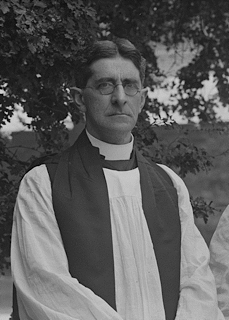
Though Gregg is instinctively conservative, his awareness of contemporary trends make him responsive to demands for change: he supports the resolution for women to hold parochial office and presents a petition to the General Synod in 1914, signed by 1,400 women. Though the motion is lost, he perseveres undaunted, and a bill for the ecclesiastical enfranchisement of women is finally carried in 1920. A unionist, he is also one of three Anglican and seventeen Catholic bishops to sign the declaration against partition in 1917, which is organised by the Catholic Bishop of Derry, Charles McHugh.
From the 1920s the Irish church is dominated by Gregg, first as Archbishop of Dublin (1920–39) and later as Archbishop of Armagh and Primate of All Ireland (1939–59). He provides stability to the church during a turbulent period of political and social change and is outspoken in defence of its interests, pragmatically espousing policies that will lead to the greater integration of the Protestant community into the new Irish state, as in his acceptance of the teaching of compulsory Irish in national schools. Despite a declining Protestant community in the south of Ireland, he maintains the unity of the church, overcoming the political division of the country into two entities. He regrets constitutional change but pledges the loyalty of the church to the Irish Free State. While recognising that the Protestant ethos is different from that of the majority of Irishmen, he maintains that “whatever our religious or political outlook may be, here is our home, and we have a right to be here.” He is elected to the first Irish Free State senate, and is subsequently consulted by Éamon de Valera, who later describes him as “a most learned and kindly gentleman, and . . . a highly valued friend,” in framing the text of the 1937 constitution. In 1949, he adapts, albeit with sadness, the state prayers to fit the republican form of government, observing that “the republic is a fact” and that “in our prayers, above all, there must be reality.”
Gregg is an able administrator, and his courage and integrity in facing difficult situations and his scholarship and devotion to the church earn him respect in the councils of the wider Anglican communion. He is known as “the churchman’s bishop” for his emphasis on doctrinal orthodoxy, ecclesiastical discipline, and loyalty to the clergy. Though conservative in his approach to church unity, he seeks closer relations between the Christian churches and frequently visits the reformed churches of the Iberian Peninsula, where a portrait plaque is unveiled in 1950 in St. John’s Church, Vila Nova de Gaia, Portugal. A baptistry in St. Paul’s Cathedral, Lisbon, is dedicated to his memory. Well known in England as a writer and preacher, he is appointed select preacher at the University of Cambridge (1916, 1930, 1936) and the University of Oxford (1946, 1947) and supports the institution of annual theological lectures at Queen’s University Belfast (QUB). His publications include Epistle of St. Clement of Rome (1899) and The Primitive Faith and Roman Catholic Developments (1909) – a minor classic which is used as a textbook for ordinands of the Church of England. He writes the introduction and notes to the revised version of the Wisdom of Solomon for the Cambridge Bible for Schools (1909) and publishes sermons and articles in religious journals. Elected Member of the Royal Irish Academy (MRIA) in 1914, he is elected to honorary fellowship in 1934 by Christ’s College, Cambridge, is awarded an honorary Doctor of Divinity (DD) in 1949 by QUB, and is created Order of the Companions of Honour (CH) in 1957.
A commanding figure, tall, thin, with raven-black hair, piercing eyes, and fine features, Gregg has an air of sacerdotal austerity, lightened on occasion by his dry sense of humour. He maintains a well regulated daily timetable and keeps a diary, writing his most personal thoughts in Greek. He makes time for recreation, a daily walk of two miles, tennis, and (from 1929) sailing, and holidays in Ireland and on the Continent. He has a great love of English literature and church music. In 1959, he retires to the Woodhouse, Rostrevor, County Down. Though incapacitated by blindness, deafness, and lameness, he never complains, and according to his wife, his life of prayer is enriched. He dies on May 2, 1961, at his home and is buried in Enniskerry, County Wicklow, beside his first wife and son.
Gregg marries Anna Alicia Jennings on November 26, 1902. They have two sons and two daughters. Anna dies in 1945. On January 22, 1947, he marries secondly Leslie Alexandra, daughter of the Rev. T. J. McEndoo, dean of Armagh, who officiates at the marriage of his daughter and of his archbishop.
(From: “Gregg, John Allen Fitzgerald” by Helen Andrews, Dictionary of Irish Biography, http://www.dib.ie, October 2009)