seamus dubhghaill

Promoting Irish Culture and History from Little Rock, Arkansas, USA


Leave a comment

The Battle of Glenmalure

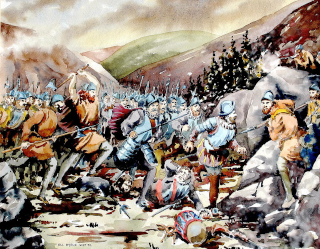
The Battle of Glenmalure (Irish: Cath Ghleann Molúra) takes place in Glenmalure, a steep U-shaped glacial valley in County Wicklow that is surrounded by forests and bogs, on August 25, 1580, during the Desmond Rebellions. A Catholic army of united Irish clans from the Wicklow Mountains led by Fiach MacHugh O’Byrne and James Eustace, 3rd Viscount Baltinglass of the Pale, defeat an English army under Arthur Grey, 14th Baron Grey de Wilton, at Clan O’Byrne‘s mountain stronghold of Glenmalure.

Grey had landed in Ireland with reinforcements from England to put down the rebellion. His strategy is to meet O’Byrne’s threat to the English heartland of Dublin and the Pale by attacking through the highlands to the south of the city. Against the advice of veteran commanders, he chooses to lead his army (around 3,000 strong) through lowland Kildare and into the Wicklow Mountains, with the aim of taking the fastness at Balinacor in the Glenmalure Valley.

While climbing the steep slopes of the valley, the inexperienced English soldiers are ambushed by the Irish who were hiding in the woods. The English are sniped at for a long period of time before their discipline collapses and they turn and flee down the valley. It is at this point that most of their casualties occur, as the Irish leave their cover and fall upon the English with swords, spears, and axes. Hundreds of English soldiers are cut down by the pursuing Irish as they try to escape the field. The remaining English have to fight a rearguard action for several miles until they reach the town of Rathdrum.

Irish sources state that around 800 English soldiers are killed, though the English put their losses at 360 dead. Among those killed is Peter Carew, cousin of his namesake colonist who had made claims to, and won, large tracts of land in southern Ireland. The remainder of the English force retreat to lowland Wicklow and from there to Dublin. However, the following year, when offered terms, most of the Irish soldiers, including O’Byrne, come in and surrender. The exception is Baltinglass, who flees to France.

The battle is commemorated in the folk song “Follow Me Up to Carlow.”

(Pictured: “Battle of Glenmalure 1580 Wicklow,” painting by Val Byrne)


Leave a comment

The Siege of Smerwick

smerwick-massacre-memorial

Following a three-day siege, the English Army beheads over 600 Papal soldiers and civilians at Dún an Óir, County Kerry on November 10, 1580.

On November 5, a naval force led by Admiral Sir William Wynter arrives at Smerwick Harbour, replenishing the supplies of Arthur Grey, 14th Baron Grey de Wilton, who is camped at Dingle, and landing eight artillery pieces. On November 7, Lord Grey de Wilton lays siege to the Smerwick garrison. The invading forces are geographically isolated on the tip of the narrow Dingle Peninsula, cut off by Mount Brandon, one of the highest mountains in Ireland, on one side and the much larger English force on the other. The English forces begin the artillery barrage on Dún an Óir on the morning of the November 8, which rapidly breaks down the improvised defences of the fort.

After a three-day siege, the commander Sebastiano di San Giuseppe surrenders on November 10. Accounts vary on whether they had been granted quarter. Grey de Wilton orders the summary executions, sparing only the commanders. Grey has also heard that the main Irish rebel army of 4,000 are somewhere in the hills to his east, looking to be rearmed and supplied by Di San Giuseppe, and they might in turn surround his army, but this army never appears.

According to Grey de Wilton’s account, contained in a despatch to Queen Elizabeth I dated November 11, 1580, he rejects an approach made by the besieged Spanish and Italian forces to agree to terms of a conditional surrender in which they would cede the fort and leave. Lord Grey de Wilton claims that he insisted that they surrender without preconditions and put themselves at his mercy, and that he subsequently rejects a request for a ceasefire. An agreement is finally made for an unconditional surrender the next morning, with hostages being taken by English forces to ensure compliance. The following morning, an English force enters the fort to secure and guard armaments and supplies.

Local historian Margaret Anna Cusack notes in 1871 that there is a degree of controversy about Lord Grey de Wilton’s version of events to Elizabeth, and identifies three other contemporary accounts, by O’Daly, O’Sullivan Beare and Russell, which contradict it. According to these versions, Grey de Wilton promises the garrison their lives in return for their surrender, a promise which he breaks. Like Grey himself, none of these commentators can be described as neutral, as they are all either serving the state or opposed to it. Cusack’s interpretation of the events cannot be described as unbiased, given her position as a Catholic nun and fervent Irish nationalist at the time.

According to Cusack, the few that are spared suffer a worse fate. They are offered life if they renounce their Catholic faith. On refusal, their arms and legs are broken in three places by an ironsmith. They are left in agony for a day and night and then hanged.

According to the folklore of the area, the execution of the captives takes two days, with many of the captives being beheaded in a field known locally in Irish as Gort a Ghearradh (the Field of the Cutting). Their bodies are later thrown into the sea. Archaeologists have not yet discovered human remains at the site, although a nearby field is known as Gort na gCeann (the Field of the Heads) and local folklore recalls the massacre.

(Pictured: A memorial to the victims of the massacre at Dún an Óir)