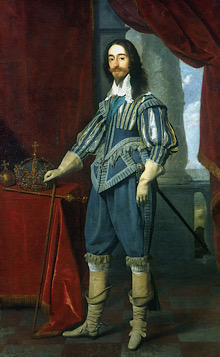
On September 22, 1626, Charles I, king of England, Scotland, and Ireland agrees to offer twenty-six concessions — later expanded to fifty-one articles— to Irish Catholics and landlords in return for £120,000 sterling in subsidies to help fund his army. These concessions become known as “The Graces.”
After the Anglo-Spanish War (1625–1630), Charles needs to maintain troops in Ireland to defend against a possible Spanish invasion. Many Irish Catholics, who had been marginalized under the English Reformation, hope the new Catholic-leaning king will relax anti-Catholic laws. Wealthy Catholic and some Protestant Irish nobles form a committee to petition for reform.
In 1628, at Whitehall, Charles and an Irish delegation (including figures like Luke Plunket, Sir William Talbot, and Sir Lucas Dillon) negotiate fifty-one articles of “Matters of Grace and Bounty.” Key provisions included:
The subsidies are to be paid in three yearly installments. The Graces are intended to secure loyalty from Irish Catholics and landlords by restoring their legal and public rights, while also funding Charles’s military needs.
Although the Graces are proclaimed and the first payment made, Lord Deputy of IrelandThomas Wentworth (appointed 1632) and later Lord Falkland (1629–1633) refuse to summon the Irish Parliament to ratify them. This means the concessions are never formally confirmed, leaving Catholics hopeful but without legal security. The unratified Graces contribute to later unrest, including the Irish Rebellion of 1641.
In summary, the September 22, 1626, agreement is a pivotal moment in Irish–English relations, offering significant religious and property concessions in exchange for military funding — but its failure to secure parliamentary ratification leaves its benefits unenforced.
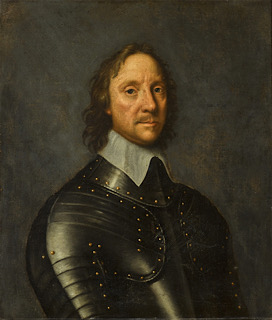
Cromwell’s death is the result of a painful urinary tract infection that leads to blood poisoning. He has been in declining health for some time, and his final days are marked by illness and discomfort. His death comes just over nine years after the Siege of Drogheda in Ireland, which begins in August 1649 and becomes one of the most infamous episodes of his military career.
The Siege of Drogheda, in which Cromwell’s forces execute thousands of Irish defenders, remains a major point of controversy in his legacy. His death in 1658 is met with celebration by many in England, as it paves the way for the restoration of the monarchy under Charles II in 1660. After his death, his body is exhumed in 1661 and publicly hanged in chains before being thrown into a pit to ensure he is dead.
Cromwell is remembered as a decisive military leader who helps restore England’s status as a leading European power, but also as a controversial figure whose actions in Ireland leave a lasting scar on Anglo-Irish relations. His death on September 3, 1658, thus marks both the end of his political and military influence and a turning point in the post-Civil War period in Britain.
Oliver Cromwell, English statesman, farmer and soldier, sets sail from Milford Haven, Pembrokeshire, Wales, on August 13, 1649, with a fleet of about 35 ships, accompanied by a second and third flotilla that arrives days later. The invasion marks the beginning of the Cromwellian conquest of Ireland, a brutal four-year campaign (1649–1653) that reshapes the island’s political and demographic landscape.
Cromwell’s landing at Dublin is swift but not without hardship—seasickness plagues him during the voyage. He lands with around 9,000–20,000 troops, stores, and £20,000 in cash. His early actions include the Siege of Drogheda (September 10, 1649) where, following a prolonged cannonade, his forces breach the town’s defenses. On September 11, the entire garrison—about 8,000 men, including English troops, Irish soldiers, and civilians—is massacred, including commander Sir Arthur Aston. Early actions also include the Sack of Wexford (October 1649). Despite Cromwell’s public justification for the slaughter, Wexford’s garrison and civilians are killed in a similar manner.
Over the next four years, Cromwell’s forces defeat the Irish Confederacy by late 1650, engage in widespread plunder, executions, and displacement of Catholic populations, confiscate large tracts of Catholic land for Protestant settlers under the Cromwellian Plantation, and introduce the Act for the Settlement of Ireland 1652, barring Catholics from most public offices and redistributing land.
Modern estimates suggest 15–40% of Ireland’s pre-1641 population perishes due to warfare, famine, and disease. The campaign entrenches Protestant dominance in Ireland and leaves deep scars in Irish memory.
Cromwell’s invasion is remembered in Ireland as a symbol of English conquest and sectarian violence. While some historians argue his actions are within contemporary military norms, many see them as part of a broader pattern of colonial subjugation. The detailed land surveys he orders—mapping every parish and barony—become a tool for land redistribution, shaping Ireland’s political and economic structure for centuries.
In short, August 13, 1649, is the start of a campaign that not only ends Irish Catholic political power but also alters the island’s demographic and cultural fabric for generations.
Molly Malone’s baptism is often cited as having taken place on July 27, 1669, although it is part of a later legend rather than a confirmed historical fact. The story goes that a woman named Molly Malone, a fishmonger in Dublin, is baptized at St. Werburgh’s Church and later dies young of a fever. This narrative becomes part of the folklore surrounding the song Cockles and Mussels, which celebrates her as a street fishwife.
The legend goes that the baptism date and the claim that Molly Malone is a real 17th‑century figure were popularized in the late 20th century, especially during the Dublin Millennium celebrations in 1988. At that time, the Dublin Millennium Commission endorsed a claim that a Mary Malone had been baptized on July 27, 1669, and buried on June 13, 1699, in St. John’s Graveyard. This led to June 13 being declared Molly Malone Day.
However, no verifiable evidence links these baptism and burial records to the Molly Malone of the song. The name “Molly” is a common diminutive for Mary or Margaret, and many such women lived in Dublin over the centuries. The baptism record in question (Mary Malone, baptized July 27, 1669) and the burial record (Mary Malone, died June 13, 1699) are published in church registers, but there is no proof these refer to the same person as the ballad’s heroine.
The ballad “Cockles and Mussels” (also called “In Dublin’s Fair City”) is written in the late 19th century by James Yorkston of Edinburgh, Scotland. It is a fictional tale of a fishwife who sells cockles and mussels and dies young. While the song may have been inspired by older street ballads, it is not based on a confirmed historical Molly Malone.
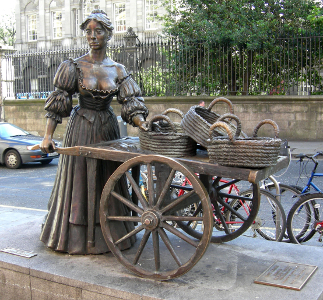
Despite the lack of solid historical proof, the legend has become a symbol of Dublin. A bronze statue of Molly Malone, “The Tart with the Cart,” (pictured above) stands on Suffolk Street, commemorating her as a cultural icon. The story continues to be celebrated in song, pub culture, and local tradition.
In short, July 27, 1669, is part of the folklore of Molly Malone’s baptism, but it is not confirmed by reliable historical records. The figure remains a fictionalized symbol of Dublin’s street life, immortalized in song and statue.
Parry is born c. 1599 in Madyn Dyswy, Amlwch, Anglesey, Wales, the son of Rhys Parry, a merchant of Newry, County Down. The name of his mother is disputed. His siblings are Arthur, Grace and Magdalen. He is educated in Newry. In 1616, he enrolls as a student of Trinity College Dublin (TCD) where he graduates with a BA in 1620. He obtains his MA there in 1623 and a fellowship on November 24, 1624. In 1630 he graduates as a Doctor of Divinity and later becomes Pro-Vice-Chancellor of the college.
In Anglican politics Parry is regarded as a Laudian. In 1627, he is appointed Prebendary of Tipperkevin, a living belonging to St Patrick’s Cathedral, Dublin. In 1630, he is Incumbent of St. Bride’s Church, Dublin, where several of his children are baptised. In 1634, he is made Treasurer of Christ Church Cathedral, Dublin and chaplain to Lancelot Bulkeley, Archbishop of Dublin. In 1635, he is appointed one of the High Commission for Ecclesiastical Causes. In 1636, he is appointed Prebendary of Stagonyl, another living belonging to St Patrick’s Cathedral, Dublin. By patent dated April 28, he is presented to St. Olave’s in Waterford where he is installed on May 11, but is also licensed to hold his other preferments at the same time. In 1640, he resigns from St. Olave’s and is appointed Dean of Lismore, County Waterford. Some of the Deanery lands had been seized by Richard Boyle, 1st Earl of Cork and Parry tries to get them back but fails. His successor as Dean of Lismore is his first cousin, Robert Parry. In 1643, he is Archdeacon of Glendalough, County Wicklow.
On December 29, 1646, King Charles I of England in a letter states he favours Parry for the See of the Diocese of Killaloe, County Clare. On March 20, 1647, a patent is issued confirming his appointment as Bishop of Killaloe and he is consecrated at Christ Church Cathedral, Dublin, on March 28, 1647, by Lancelot Bulkeley, Archbishop of Dublin, assisted by the Bishops of Kildare and Cloyne. However, as this is in the middle of the Irish Rebellion he was unable to travel to his diocese and remains in Dublin, where he resides in Chichester House, St. Stephen’s Street, which later houses the Parliament of Ireland. In the Hearth Money Rolls the house is assessed for eight hearths so is quite large. On July 9, 1647, he signs the petition of the clergy praying to be allowed the use of the Liturgy, then abolished by order of the commissioners under Oliver Cromwell. On account of his good character and the smallness of the revenues of Killaloe, the King permits him to hold his former preferments in commendam.
Parry marries the daughter of John Price and by her has six children, who are John Parry, Bishop of Ossory, Benjamin Parry, Bishop of Ossory, Edward Parry, Robert Parry, Mary Parry who marries John Bulkeley, and Elinor Parry who is a love and correspondent of John Locke and later marries Richard Hawkshaw.
Parry dies in his house in St. Stephen’s Street on July 20, 1650, at the age of 51, after contracting the plague which rages there, and is buried in St. Audoen’s Church, Dublin. His will dated July 17, 1650, is proved in the Prerogative Court, Dublin. Its terms are: (1) his body is to be interred in St. Audeon’s Church near the doors, with his face to the east, where he also desires the body of his wife to be translated, and laid by his side, (2) he gives to his eldest daughter, Mary Parry, alias Bulkeley, a little silver watch, and her mother’s dear-head ring, (3) to his other daughter “Eleynor Parry” other ornaments that belonged to her mother, (4) to his sister “Madelius Evans” five pounds, (5) to other beneficiaries are given legacies out of the fifty pounds due to him by William Usher, (6) to his cousin, Robert Parry, he leaves his lexicon and other books, (7) to his cousin, Richard Parry, he leaves a gold ring, (8) to his cousin, Mary Parry, wife of Richard, he leaves a money legacy, and (9) he appoints his cousin, Robert Parry, as overseer of his will.
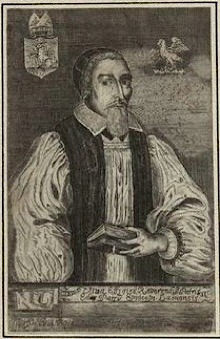
Parry writes a book entitled David restored; or an Antidote against the Prosperity of the Wicked, and the Afflictions of the Just, which is a sermon on the seventy-third Psalm. This is afterward published by his son, John Parry at Oxford in 1660. This work contains an engraved portrait of Edward Parry (above).
(Pictured: An engraved portrait by John Dickson of Dr. Edward Parry, Bishop of Killaloe, from a book authored by the bishop entitled “David restored; or an Antidote against the Prosperity of the Wicked, and the Afflictions of the Just”, published at Oxford in 1660.)
The Siege of Athlone beginning on July 17, 1690, is a week-long Williamite assault against Jacobite-held Athlone, ending in a Jacobite victory due to effective defense of the city and the destruction of the connecting bridge over the River Shannon.
The siege occurs during the Williamite War in Ireland (1689–1691), in which supporters of King James II, known as the Jacobites, fight against the Williamite forces of King William of Orange. Athlone, a strategic town on the River Shannon, serves as a key defensive position for the Jacobites after the Williamite victory at the Battle of the Boyne earlier in July 1690.
On July 17, 1690, Williamite Lieutenant GeneralJames Douglas approaches Athlone with 12,000 soldiers, consisting of ten regiments of foot and five regiments of horse. The Jacobite garrison, commanded by ColonelRichard Grace, comprises approximately 4,500 men with three regiments of foot and eleven troops of horse.
Prior to the Williamite arrival, Jacobite troops destroy the bridge over the River Shannon, separating the eastern and western parts of the city and greatly strengthening the defense.
General Douglas demands the city’s surrender, but Colonel Grace famously refuses, shooting over the messenger’s head and declaring he will defend the city until his provisions are exhausted. The Williamites begin a bombardment utilizing twelve cannon and two mortars, while the Athlone defenders return fire.
Efforts to ford the River Shannon by the Williamite army after two days are repelled with significant losses, and ongoing artillery engagement continues throughout the week. Rumors of the approaching Jacobite cavalry under Patrick Sarsfield contributes to Douglas’s decision to retire. The Williamites suffer about 400 casualties and eventually retreat on July 24, 1690, marking a Jacobite victory.
Although the first siege ends in failure for the Williamites, it showcases the resilience of the town’s defenses and the leadership of Colonel Richard Grace. Athlone later falls in June 1691 during the second siege, where Grace dies defending the city. The 1690 siege is notable for its strategic defensive measures, including the destruction of the bridge and strong resistance against a superior attacking force, which temporarily blocks Williamite advances in central Ireland.
The first Siege of Athlone demonstrates the effectiveness of prepared urban defenses in 17th-century warfare and has implications for subsequent engagements during the Williamite War, setting the stage for the eventual fall of Athlone and other key territories in 1691.
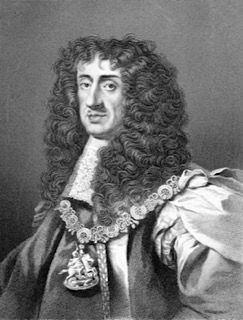
Charles is the eldest surviving son of Charles I and Henrietta Maria of France. His early years are unremarkable, but before he is twenty his conventional education has been completely overshadowed by the harsh lessons of defeat in the English Civil War against the Puritans and subsequent isolation and poverty. Thus he emerges into precocious maturity, cynical, self-indulgent, skilled in the sort of moral evasions that make life comfortable even in adversity.
Though the early years of tawdry dissipation tarnish the romance of Charles’s adventures, not all his actions are discreditable. He tries to fight his father’s battles in the west of England in 1645. He resists the attempts of his mother and his sister Henrietta Anne to convert him to Catholicism and remains openly loyal to his Protestant faith. In 1648, he makes strenuous efforts to save his father, and when, after Charles I’s execution in 1649, he is proclaimed Charles II by the Scots in defiance of the English republic. He is prepared to go to Scotland and swallow the stringently anti-Catholic and anti-Anglican Presbyterian Covenant as the price for alliance. But the sacrifice of friends and principles was futile and leaves him deeply embittered. The Scottish army is routed by the English under Oliver Cromwell at Dunbar in September 1650, and in 1651 Charles’s invasion of England ends in defeat at Worcester. The young king becomes a fugitive, hunted through England for forty days but protected by a handful of his loyal subjects until he escapes to France in October 1651.
Charles’s safety is comfortless, however. He is destitute and friendless, unable to bring pressure against an increasingly powerful England. France and the Dutch Republic are closed to him by Cromwell’s diplomacy, and he turns to Spain, with whom he concludes a treaty in April 1656. He persuades his brother James to relinquish his command in the French army and gives him some regiments of Anglo-Irish troops in Spanish service, but poverty dooms this nucleus of a royalist army to impotence. European princes take little interest in Charles and his cause, and his proffers of marriage are declined. Even Cromwell’s death does little to improve his prospects. But George Monck, one of Cromwell’s leading generals, realized that under Cromwell’s successors the country is in danger of being torn apart and with his formidable army creates the situation favourable to Charles’s restoration in 1660.
Most Englishmen now favour a return to a stable and legitimate monarchy, and, although more is known of Charles II’s vices than his virtues, he has, under the steadying influence of Edward Hyde, his chief adviser, avoided any damaging compromise of his religion or constitutional principles. With Hyde’s help, Charles issues in April 1660 his Declaration of Breda, expressing his personal desire for a general amnesty, liberty of conscience, an equitable settlement of land disputes, and full payment of arrears to the army. The actual terms are left to a free parliament, and on this provisional basis Charles is proclaimed king in May 1660. Landing at Dover on May 25, he reaches a rejoicing London on his 30th birthday.
The unconditional nature of the settlement that takes shape between 1660 and 1662 owes little to Charles’s intervention and likely exceeds his expectations. He is bound by the concessions made by his father in 1640 and 1641, but the Parliament elected in 1661 is determined on an uncompromising Anglican and royalist settlement. The Militia Act of 1661 gives Charles unprecedented authority to maintain a standing army, and the Corporation Act 1661 allows him to purge the boroughs of dissident officials. Other legislation places strict limits on the press and on public assembly, and the Act of Uniformity 1662 creates controls of education. An exclusive body of Anglican clergy and a well-armed landed gentry are the principal beneficiaries of Charles II’s restoration.
But within this narrow structure of upper-class loyalism there are irksome limitations on Charles’s independence. His efforts to extend religious toleration to his Nonconformist and Roman Catholic subjects are sharply rebuffed in 1663, and throughout his reign the House of Commons thwarts the more generous impulses of his religious policy. A more pervasive and damaging limitation is on his financial independence. Although the Parliament votes the king an estimated annual income of £1,200,000, Charles has to wait many years before his revenues produce such a sum, and by then the damage of debt and discredit is irreparable. He is incapable of thrift and finds it painful to refuse petitioners. With the expensive disasters of the Second Anglo-Dutch War of 1665–67 the reputation of the restored king sinks to its lowest level. His vigorous attempts to save London during the Great Fire of September 1666 cannot make up for the negligence and maladministration that leads to England’s naval defeat in June 1667.
Charles clears himself by dismissing his old adviser, Edward Hyde, and tries to assert himself through a more adventurous foreign policy. So far, his reign has made only modest contributions to England’s commercial advancement. The Navigation Acts of 1660 and 1663, which are prompted by the threat to British shipping by the rise of the Dutch carrying trade, are valuable extensions of Cromwellian policies, and the capture of New York in 1664 is one of his few gains from the Dutch. Although marriage to Princess Catherine of Braganza of Portugal in 1662 brings him the possession of Tangier and Bombay, they are of less strategic value than Dunkirk, which he sells to Louis XIV in 1662. He Is, however, prepared to sacrifice much for the alliance of his young cousin. Through his sister Henrietta Anne, Duchess of Orléans, he has direct contact with the French court, and it is through her that he negotiates the startling reversal of the Protestant Triple Alliance (England, the Dutch Republic, Sweden) of 1668. By the terms of the so-called Secret Treaty of Dover of May 1670, not only does England and France join in an offensive alliance against the Dutch, but Charles promises to announce his conversion to Roman Catholicism. If this provokes trouble from his subjects, he is assured of French military and financial support. He sees to it that the conversion clause of the treaty is not made public.
This clause, which is the most controversial act of Charles II’s reign, can be explained as a shortsighted bid for Louis XIV’s confidence. In this, however, it fails. Louis neither welcomes Charles’s intentions nor believes in them, and, in the event, it is only upon his deathbed that Charles is received into the Roman Catholic Church. But he has now fatally compromised himself. Although he subsequently attempts to pursue policies independent of Louis, he remains bound to him by inclination as well as by the fear of blackmail. More seriously, he has lost the confidence of his subjects, who deplore the French alliance and distrust the whole tendency of his policies.
Other circumstances deepen Englishmen’s discontent with their king. By the 1670s the miscarriages of the queen have reduced hopes that Charles will have a legitimate heir, and in 1673 the second marriage of his brother James, Duke of York, to Mary of Modena, increases the possibility of the Catholic line of succession, for James’s conversion to the Roman church is well known. But it is for his autocratic character as much as for his religion that James is feared as his brother is not, and it is on his brother’s behalf that Charles eventually has to face the severest political storm of his reign.
The Popish Plot of 1678 is an elaborate tissue of fictions built around a skeleton of even stranger truths. The allegations of Titus Oates, a former Anglican cleric who has been expelled from a Jesuit seminary, that Roman Catholics plan to murder Charles to make James king, seem to be confirmed by scraps of evidence of which Charles is justifiably skeptical. But he is obliged to bow before the gusts of national hysteria that seek to bar his brother from the line of succession. Between 1679 and 1681, Charles very nearly loses control of his government. Deprived of his chief minister, the Earl of Danby, who has been compromised by his negotiations with France, he has to allow Anthony Ashley-Cooper, 2nd Earl of Shaftesbury, and his Whig supporters, who uphold the power of the Parliament—men whom he detests—to occupy positions of power in central and local government. Three general elections produce three equally unmanageable parliaments, and, although Charles publicly denies the legitimacy of his first son, the Protestant Duke of Monmouth, he has to send his Catholic brother James out of the country and offer a plan of limitations that will bind James if he comes to the throne. The plan proves to be unacceptable both to the Whigs and to James, and, when Charles falls seriously ill in the summer of 1679, there is real danger of civil conflict.
But Charles keeps his nerve. He defends his queen against slanders, dismisses the intractable parliaments, and recovers control of his government. His subjects’ dread of republican anarchy proves stronger than their suspicion of James, and from March 1681, when he dissolves his last Parliament, Charles enjoys a nationwide surge of loyalty almost as fervent as that of 1660. He has made yet another secret treaty with France and in addition to a French subsidy can now count upon a healthy public revenue. Reforms at the Treasury, which he inaugurates in 1667, provide the crown with a firm basis of administrative control that is among Charles II’s most valuable legacies to English government.
As a result of these actions, Charles, who dies on February 6, 1685, at Whitehall in London, is able to end his reign in the kind of tranquil prosperity he has always sought.
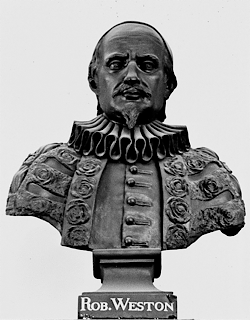
From 1546 to 1549, Weston is a principal of Broadgates Hall (afterwards Pembroke College), and at the same time deputy reader in civil law at the university, under Dr. John Story. He is not a clergyman, and his later appointment to two lucrative deaneries greatly troubles his conscience.
On January 12, 1559, Weston is created Dean of the Arches and is a commissioner for administering the oaths required of ecclesiastics under the Act of Uniformity 1558. He is consulted in regard to the Queen’s Commission issued on December 6, 1559, for confirming Matthew Parker as Archbishop of Canterbury and is included in a commission issued on November 8, 1564, to inquire into complaints of piratical depredations committed at sea on the subjects of the King of Spain.
The Lord Deputy of Ireland, Sir Henry Sidney, requests that Weston be nominated for the post of Lord Chancellor of Ireland in succession to Hugh Curwen, Archbishop of Dublin, in April 1566. After a year, on June 10, 1567, Queen Elizabeth I tells Sidney that after good deliberation she has made the “choice for the supply of room of Chancellor by naming thereunnto our trusty well-beloved Doctor Weston, dean of the arches here, a man for his learning and approved integrity thoroughly qualified to receive and possess the same” and “that for some increase of his living whilst he remaineth in our service there she was pleased to give unto him the Deanery of St. Patrick’s, whereof the Bishop of Armagh, Adam Loftus, is now dean and yet to leave it at our order, as we know he will.”
Weston arrives in Dublin early in August and is sworn into office on August 8, 1567. He is conscientious in performing his duties, and greatly respected for his integrity, although ill-health (he is plagued by gout and gallstones) hampers his effectiveness. He is appalled by the laziness and inefficiency of many of the Irish judges and urges Elizabeth I to replace them with Englishmen wherever possible. He is equally shocked at the poverty and ignorance of many of the Protestant clergy in Ireland. His zeal for reform leads him, though a layman, to become an effective leader of the Church of Ireland for a few years. He cooperates with Adam Loftus, now Archbishop of Dublin, in purging the Archdiocese of Dublin of crypto-Catholics, but is opposed to the persecution of the Roman Catholic majority, or any efforts to forcibly convert them.
Weston dies on May 20, 1573, and is buried beneath the altar in St. Patrick’s Cathedral, Dublin, “leaving behind him an excellent character for uprightness, judgment, learning, courtesy, and piety.”
Weston marries Alice Jenyngs, daughter of Richard Jenyngs of Great Barr, Staffordshire. They have a son, John, and three daughters, of whom most of known of Alice, who marries firstly Hugh Brady, Bishop of Meath, by whom she has numerous children including Luke and Nicholas, and secondly Sir Geoffrey Fenton, by whom she is the mother of Catherine, who marries Richard Boyle, 1st Earl of Cork, and of Sir William Fenton.
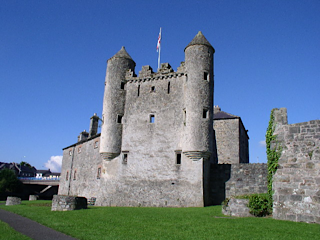
The siege of Enniskillen takes place at Enniskillen in Fermanagh, in present day Northern Ireland, in 1594 and 1595, during the Nine Years’ War. In February 1594, the English capture Enniskillen Castle from the Irish following a waterborne assault and massacre the defenders after they surrender. From May 1594, an Irish army under Hugh Maguire and Cormac MacBaron O’Neill besiege the English garrison in the castle, and in August they defeat an English relief force in the Battle of the Ford of the Biscuits. A second relief force is allowed to resupply the garrison, but the castle remains cut off. Eventually, in May 1595, the English garrison surrenders to the Irish and are then massacred.
Enniskillen Castle sits on the River Erne and commands the strategic bottleneck between Upper and Lower Lough Erne. On January 25, 1594, English Captain John Dowdall arrives at Enniskillen by boat with three infantry companies. They dig trenches in which they place light cannons and musketeers, but the cannons are too small to make much of an impact on the castle walls. On January 30, Captain George Bingham arrives with 300 men.
They launch a waterborne assault on the castle. While musketeers in boats and artillery on land fire at the castle, a large boat holding 67 men anchors at a vulnerable part of the walls. They make a breach in the wall with pickaxes, forcing the Irish to take shelter in the keep. Dowdall threatens to destroy the castle with gunpowder if the garrison does not surrender. An Irish witness claims there are 36 fighting men and 40 women and children in the castle, while Dowdall claims there are 200. After they surrender, Dowdall has them put to the sword and claims to have killed 150. Captain Thomas Lee, who is present, describes this as a great dishonor to the Queen as the defenders had surrendered “uppon composicion, And your majesties worde being past to the poore beggars that kept it, they were all notwithstandinge dishonourably putt to the sworde in a most miserable state.”
Dowdall writes on February 2 to the Lord Deputy of Ireland that he has captured the castle from the “rebel” Hugh Maguire. An English garrison is left in place. A detailed coloured illustration of the siege is made shortly after.
On May 17, 1594, now acting with the covert support of Hugh O’Neill, Earl of Tyrone, Hugh Maguire and Cormac MacBaron O’Neill lay siege to Enniskillen which is now isolated in hostile country. Their army consists of 1,400 foot soldiers and 600 horsemen. It quickly grows with support arriving from Hugh Roe O’Donnell. The English commander, James Eccarsall, has only 50 foot soldiers and 24 horsemen to defend the castle, along with some light artillery. Eccarsall launches a sortie by boat but has to retreat under heavy fire. Irish fortifications cut off access by river and the castle is attacked nightly. Many of the garrison fall sick due to food shortages and exhaustion brought on by incessant skirmishing with the Irish.
On August 7, Maguire and his allies defeat an English relief force for Enniskillen at the Battle of the Ford of the Biscuits. A second relief force commanded by the Lord Deputy of Ireland, William Russell, is sent by another route. Although it is not attacked by the Irish, none of Russell’s scouts or messengers reach the castle nor return. Russell relieves the beleaguered garrison by August 30 with six months supplies, then withdraws. Following this, there is a truce, but “subterfuge and deception were the hallmarks of this stage of the war.”
Maguire raises the clan and the castle is again attacked in January 1595 (Third Siege of Enniskillen). This time, forty selected men dressed in chain mail and armed with Lochaber axes attack at night. His men overrun the outer defences but the garrison holds out in the tower. The Irish withdraw but take with them the garrison’s three boats, preventing the English from patrolling the Erne and cutting them off.
The garrison’s plight is not lost on the authorities in Dublin, but the Crown does not have enough troops for a relief force, and Lord Deputy Russell considers withdrawing the garrison. A report to the Lord Deputy of Ireland suggests that Clan Maguire plans to bring down the walls with gunpowder. In May 1595, the garrison agrees to surrender Enniskillen to the Irish in exchange for their lives. However, the entire garrison is then massacred. Russell claims that the garrison had surrendered on terms to Cormac MacBaron O’Neill, who then reneged upon his word and had the surrendered garrison executed en masse. This is inconsistent with the treatment of other English garrisons, such as the Blackwater Fort, who are granted liberal terms to leave their position in February 1595. However, the Enniskillen garrison may also have been slain as retaliation for Dowdall’s similar violation of the surrender terms and massacre of Clan Maguire’s defenders of the castle and their families in the year before.
Fiach mac Aodha Ó Broin (anglicised as Feagh or Fiach MacHugh O’Byrne), the son of the chief of the O’Byrnes of the Gabhail Raghnaill, is executed in Farranerin, County Wicklow, on May 8, 1597.
His sept, a minor one, claims descent from the 11th century King of Leinster, Bran Mac Máel Mórda, and is centered at Ballinacor North in Glenmalure, a steep valley in the fastness of the Wicklow Mountains. Their chiefs style themselves as Lords of Ranalagh. The territory of the Gabhail Rabhnaill stretches from Glendalough south to the Forest of Shillelagh in Wexford and west to the borders of present-day County Carlow, an area of some 150,000 acres.
By the time of his death in 1579, O’Byrne’s father, Hugh MacShane O’Byrne, has brought his sept to prominence much to the discomfort of the senior branch of the clan, the Crioch Branagh. The Gabhaill Rabhaill has allied themselves to several leading clans in Leinster and are related by blood and marriage to the Kavanaghs, O’ Tooles, O’Connors and the O’Moores.
O’Byrne makes a name for himself as an enemy of the English. Resenting the greed and cruelty of the Elizabethan adventurers and settlers, he raids their villages and kills them or drives them out. He is appalled at the ruthless cruelty of the seneschals (Stewarts) Thomas Masterson and Sir Henry Harrington and in 1580 goes into open rebellion when Masterson summarily execute many Kavanagh clansmen.
Other clans join with O’Byrne and when James Eustace, 3rd Viscount Baltinglass, angered by the treatment of the CatholicOld English also rebells, O’Byrne joins with him. The English are appalled at this, already Munster is in turmoil as the Earl of Desmond is in rebellion and in the north the O’ Neills are moving also against the English.
An army of 3,000 men is sent into the Wicklow Mountains but O’Byrne and Eustace are waiting for them in Glenmalure. Over 800 English lose their lives at the Battle of Glenmalure and the rest flee back to Dublin. The following year the English offer terms, Eustace refuses and flees to Spain but O’Byrne and the other clan chiefs accept the terms and are pardoned.
In the following years, O’Byrne keeps a low profile. He makes no overt moves against the English, instead of holding them at bay and even giving them hostages.
In 1592, Hugh Roe O’Donnell, with brothers Art and Henry MacShane O’Neill, escapes from Dublin Castle. The breakout has been planned with the help of Hugh O’Neill, Earl of Tyrone, and the escapees fled to the safety of Glenmalure. It is a severe winter and Art dies from exposure and is buried in O’Byrne land but O’Byrne is able to transport Hugh Roe and Henry away to safety.
In January 1594, the English decide to move against O’Byrne, claiming that he is involved in treason. The Lord Deputy of Ireland Sir William Russell manages to take Ballinacor but O’Byrne and his wife Rose escape.
The English spend a long time collecting heads and plundering, they spare few. In April, Russell again goes hunting for O’Byrne who once again escapes. His wife, however, is captured and sentenced to be burned to death. The sentence is not carried out.
O’Byrne is once again forced to seek terms which he is granted for renewable 3 monthly terms. He stays quiet until September 1596 when his son successfully attacks a munitions transport and is able to overrun the English garrison that had been placed in Ballinacor.
Lord Deputy Russell spends the next year unsuccessfully scouring the country for O’Byrne. However O’ Byrne’s luck eventually runs out. A traitor in his camp gives information to Russell that O’Byrne will be in Ballinacorr on May 8, 1597. The Lord Deputy is able to surprise him and capture him in a cave. There he is hacked to death and decapitated with his own sword.
The head of O’Bryne is put on a spike at Dublin Castle then later sent to London to Queen Elizabeth. Angry that it would be even sent to England, she disdains to accept the head of such a base “Robin Hood.”
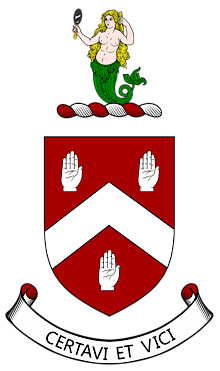
(From: “Feagh MacHugh O’Byrne 1543-1597” by Pádraig Mac Donnchadha, YourIrish.com, http://www.yourirish.com | Pictured: The armorial achievements (coat of arms, crest and motto) recorded by the Chief Herald of Ireland and the Ulster King of Arms as being awarded to Fiach MacHugh O’Byrne)