seamus dubhghaill

Promoting Irish Culture and History from Little Rock, Arkansas, USA


Leave a comment

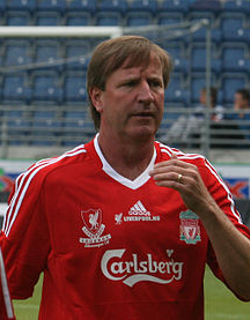
Birth of Footballer Ronnie Whelan

ronnie-whelan

Ronald Andrew Whelan, former Irish association football midfielder and occasional defender, is born in Dublin on September 25, 1961.

Whelan is born into a family of footballers. His father, Ronnie Whelan, Sr., is an Irish international and a key member of the successful St. Patrick’s Athletic F.C. of the late 1950s and early 1960s. His brother, Paul Whelan, plays for Bohemian F.C. and Shamrock Rovers F.C.

Whelan is a skillful and industrious midfield player who, after an unsuccessful trial period for Manchester United F.C., makes his League of Ireland debut for Home Farm F.C. on his 16th birthday at Tolka Park.

Whelan is signed for Liverpool F.C. by Bob Paisley for a bargain £35,000 on September 19, 1979, a few days before his 18th birthday, and makes his debut eighteen months later, on April 3, 1981. He goes on to become an integral part of the dominant Liverpool team of the 1980s. He remains with the club until 1994. In 100 Players Who Shook The Kop, a poll of 110,000 Liverpool fans conducted by the official Liverpool F.C. website, Whelan is in 30th position.

Whelan plays for the Republic of Ireland national football team at one UEFA European Championship (1988) and two FIFA World Cups (1990 and 1994), turning out a total of 53 times for the national side between 1981 and 1995.

Whelan finishes his career at Southend United F.C., where he is also player-manager through the 1996-1997 season. He later manages in Greece and Cyprus, with Panionios G.S.S., Olympiakos Nicosia and Apollon Limassol.

Since retirement Whelan has begun a media career and is a regular contributor to RTÉ Sport in Ireland. He is also Patron of the Myasthenia Gravis Association in Ireland where he is an active fundraiser and works to raise awareness for this rare autoimmune disease.


Leave a comment

Ireland’s First Ever Win in International Soccer

ifa-original-badgeIreland wins its first ever match in international soccer on February 19, 1887, beating Wales 4-1 in Belfast. Prior to 1921 and the partition of the country, all of Ireland is represented by a single side, the Ireland national football team, organised by the Irish Football Association (IFA).

On February 18, 1882, fifteen months after the founding of the Irish FA, Ireland makes its international debut against England, losing 13–0 in a friendly played at Bloomfield in Belfast. This remains the largest ever defeat for the team, and is also England’s largest winning margin.

Ireland competes in the inaugural British Home Championship in 1884 and loses all three games. Ireland finally wins its first game on February 19, 1887, with a 4–1 win over Wales in Belfast. Between their 1882 debut and this game, the Ireland team has a run of 14 defeats and 1 draw, the longest run without a win in the 1800s. Despite the end of the losing streak, heavy defeats continue. In March 1888 they lose 11–0 to Wales and 10–2 to Scotland. Further heavy defeats come in March 1890 when they lose 9–1 to England, in 1899 when they lose 13–2 to England, and in February 1901 when they lose 11–0 to Scotland.

Ireland is partitioned into Northern Ireland and Southern Ireland in 1920. Southern Ireland gains independence in 1922 as the Irish Free State, later to become a republic under the name of Ireland. Amid these political upheavals, a rival football association, the Football Association of Ireland, emerges in Dublin in 1921 and organises a separate league and international team. In 1923, at a time when the home nations have withdrawn from the Fédération Internationale de Football Association (FIFA), the FAI is recognised by FIFA as the governing body of the Irish Free State on the condition that it changes its name to the Football Association of the Irish Free State. The IFA continues to organise its national team on an all-Ireland basis.

Between 1928 and 1946 the IFA is not affiliated to FIFA and the two Ireland teams co-exist, never competing in the same competition. However, on March 8, 1950, in a 0–0 draw with Wales at the Racecourse Ground in Wrexham, North Wales in a World Cup qualifier, the IFA fields a team that includes four players who were born in the Irish Free State. All four players have previously played for the FAI in their qualifiers and as a result have played for two different associations in the same FIFA World Cup tournament.

After complaints from the FAI, FIFA intervenes and restricts players’ eligibility based on the political border. In 1953, FIFA rules that neither team can be referred to as Ireland, decreeing that the FAI team officially be designated as the Republic of Ireland, while the IFA team is to become Northern Ireland.