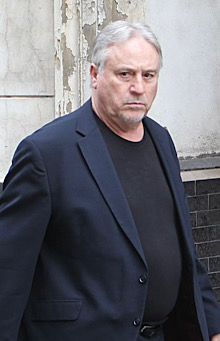
Mitchell starts as a driver for Jacob’s but gets involved in robberies with associates of Martin Cahill.
In 1988, Mitchell is convicted of stealing a large amount of cattle drench and is jailed for five years. While in prison he becomes interested in the illegal drug trade and within a few years of his release he is the largest supplier of illicit drugs in the country.
In the 1990s Mitchell is arrested in Luton, Bedfordshire, England, by British police while in the possession of £575,000, a downpayment for drugs. The money is seized but he is released. In 1995, the Garda drug squad raids a house in Lucan, Dublin, and discovers an ecstasy processing plant believed to have been set up by Mitchell. In 1996, his associate, Johnny Doran, is caught with £500,000 worth of cannabis at M50 at Castleknock, Dublin. His gunman, Michael Boyle, is caught after a botched murder attempt in London, leaving him feeling vulnerable. Concerned that the Gardaí are focusing on him, he moves the centre of his operations to Amsterdam. Rumors surface that he had fled the country after being placed on an Irish Republican Army (IRA) death list, though this claim is later refuted.
Mitchell is arrested by Dutch police on March 5, 1998, after £5 million worth of computer equipment originating from Hewlett Packard in Kildare, County Kildare, is stolen from a lorry near Schiphol Airport. He is later sentenced to 30 months in prison after Dutch authorities rule he is the ringleader in the robbery. He claims in court that he is the victim of a “set up” by Irish police, who had tipped off Dutch authorities about the robbery, after he had refused to become an informant.
In 2015, Mitchell approaches Herman-Johan Xennt about setting up an encrypted phone business. He has known Xennt since at least 1998, when he was arrested for handling the stolen computer parts. Xennt had been accused of buying stolen computer parts from Mitchell. It is also claimed during a 2020 German court case that Mitchell loaned Xennt the equivalent of €700,000 in 1995 to buy a 20,000-square-foot former NATObunker on the outskirts of the southern Netherlands town of Kloetinge, which was then used to host the CyberBunkerInternet service provider (ISP).
Edward “Ned” Kelly, Australian bushranger, outlaw, gang leader and convicted police murderer, is hanged at Old Melbourne Jail in Australia on November 11, 1880. One of the last bushrangers, and by far the most famous, he is best known for wearing a suit of bulletproof armour during his final shootout with the police.
Kelly is born in the British colony of Victoria as the third of eight children to John “Red” Kelly (born 1820 in County Tipperary), and Ellen (née Quinn). The exact date of his birth is not known, but a number of lines of evidence, including a 1963 interview with family descendants Paddy and Charles Griffiths, a record from his mother, and a note from a school inspector, all suggest his birth was in December 1854. He is baptised by an Augustinian priest, Charles O’Hea, who also administers last rites to Kelly before his execution. His father, a transported convict, dies shortly after serving a six-month prison sentence, leaving Kelly, then aged 12, as the eldest male of the household. The Kellys are a poor selector family who see themselves as downtrodden by the Squattocracy and as victims of police persecution.
While a teenager, Kelly is arrested for associating with bushranger Harry Power and serves two prison terms for a variety of offences, the longest stretch being from 1871 to 1874 on a conviction of receiving a stolen horse. He later joins the “Greta mob”, a group of bushlarrikins known for stock theft. A violent confrontation with a policeman occurs at the Kelly family’s home in 1878, and he is indicted of attempted murder. Fleeing to the bush, he vows to avenge his mother, who is imprisoned for her role in the incident. After he, his brother Dan, and two associates, Joe Byrne and Steve Hart, fatally shoot three policemen, the Government of Victoria proclaims them outlaws.
Kelly and his gang elude the police for two years, thanks in part to the support of an extensive network of sympathisers. The gang’s crime spree includes armed bank robberies at Euroa and Jerilderie, and the killing of Aaron Sherritt, a sympathiser turned police informer. In a manifesto letter, Kelly, denouncing the police, the Victorian government and the British Empire, sets down his own account of the events leading up to his outlawry. Demanding justice for his family and the rural poor, he threatens dire consequences against those who defy him.
In 1880, when Kelly’s attempt to derail and ambush a police train fails, he and his gang, dressed in armour fashioned from stolen plough mouldboards, engage in a final gun battle with the police at Glenrowan. Kelly, the only survivor, is severely wounded by police fire and is captured. Despite thousands of supporters attending rallies and signing a petition for his reprieve, he stands trial on October 19, 1880, in Melbourne before Sir Redmond Barry. The trial is adjourned to October 28, when Kelly is presented on the charge of the murder of the three policemen, the various bank robberies, the murder of Sherritt, resisting arrest at Glenrowan and a long list of minor charges. He is convicted of the willful murder of one of the officers and sentenced to death by hanging. After handing down the sentence, Barry concludes with the customary words, “May God have mercy on your soul,” to which Kelly replies, “I will go a little further than that, and say I will see you there where I go.”
On November 3, the Executive Council of Victoria decides that Kelly is to be hanged eight days later, November 11, at the Melbourne Gaol. In the week leading up to the execution, thousands turn out at street rallies across Melbourne demanding a reprieve for Kelly. On November 8, a petition for clemency with over 32,000 signatures is presented to the governor’s private secretary. The Executive Council announces soon after that the hanging would proceed as scheduled.
The day before his execution, Kelly has his photographic portrait taken as a keepsake for his family and is granted farewell interviews with relatives. The following morning, John Castieau, the Governor of the Gaol, informs him that the hour of execution has been fixed at 10:00 AM. His leg irons are removed, and, after a short time, he is marched out. He is submissive on the way, and when passing the gaol’s flower beds, remarks, “What a nice little garden,” but says nothing further until reaching the Press room, where he remains until the arrival of chaplain Dean Donaghy. His last words are famously reported to have been, “Such is life.”
Historian Geoffrey Serle calls Kelly and his gang “the last expression of the lawless frontier in what was becoming a highly organised and educated society, the last protest of the mighty bush now tethered with iron rails to Melbourne and the world.” In the century after his death, Kelly becomes a cultural icon, inspiring countless works in the arts, and is the subject of more biographies than any other Australian. He continues to cause division in his homeland as some celebrate him as Australia’s equivalent of Robin Hood while others regard him as a murderous villain undeserving of his folk hero status. Journalist Martin Flanagan writes, “What makes Ned a legend is not that everyone sees him the same—it’s that everyone sees him. Like a bushfire on the horizon casting its red glow into the night.”