

Seán Allis Treacy, one of the leaders of the Third Tipperary Brigade of the Irish Republican Army during the Irish War of Independence, is born on February 14, 1895, in Soloheadbeg, County Tipperary.
Treacy leaves school at the age of 14 and works as farmer while also developing deep patriotic convictions. He is a member of the Gaelic League, and of the Irish Republican Brotherhood (IRB) from 1911 and the Irish Volunteers from 1913.
He is picked up in the mass arrests following the Easter Rising in 1916. He spends much of the following two years in prison, where he goes on hunger strike on several occasions.
In 1918, Treacy is appointed Vice Officer-Commanding of the 3rd Tipperary Brigade of the Irish Volunteers, which becomes the Irish Republican Army in 1919.
On January 21, 1919, Treacy and Dan Breen, together with Seán Hogan, Séamus Robinson, and five other volunteers, help to ignite the conflict that is to become the Irish War of Independence. They ambush and shoot dead Constables Patrick MacDonnell and James O’Connell of the Royal Irish Constabulary (RIC), who are guarding a transport of gelignite explosives, during the Soloheadbeg Ambush near Treacy’s home. Treacy leads the planning of the ambush and briefs the brigade’s OC Robinson on his return from prison in late 1918. Robinson supports the plans and agrees they will not go to GHQ for permission to undertake the attack.
As a result of the Soloheadbeg Ambush, South Tipperary is placed under martial law and declared a Special Military Area under the Defence of the Realm Act. After Soloheadbeg ambush party member Seán Hogan is arrested on May 12, 1919, Treacy, Breen, and Séamus Robinson are joined by five men from the IRA’s East Limerick Brigade to organise Hogan’s rescue. Hogan is brought to the train which is intended to take him from Thurles to Cork city on May 13, 1919. As the train steams across the Tipperary border and into County Limerick, the IRA party boards the train in Knocklong. A close-range struggle ensues on the train. Treacy and Breen are seriously wounded in the gunfight and two RIC men die, but Hogan is rescued. His rescuers rush him into the village of Knocklong where a butcher cuts off his handcuffs using a cleaver.
A search for Treacy and the others is mounted across Ireland. Treacy leaves Tipperary for Dublin to avoid capture. In Dublin, Michael Collins employs Treacy on assassination operations with “the Squad“. In the summer of 1920, he returns to Tipperary and organises several attacks on RIC barracks before again moving his base of operations to Dublin.
By spring 1920 the political police of both the Crimes Special Branch of the Royal Irish Constabulary (RIC) and G-Division (Special Branch) of the Dublin Metropolitan Police (DMP) have been effectively neutalised by IRA counterintelligence operatives working for Michael Collins. The British thoroughly reorganise their administration at Dublin Castle and begin to import dozens of professional secret service agents from all parts of the British Empire into Ireland to track down IRA operatives and Sinn Féin leaders.
On October 11, 1920, Treacy and Breen are holed up in a safe house on the north side of Dublin when it is raided by a police unit. In the ensuing shootout, two senior British officers are wounded and die the next day while Treacy and Breen are wounded, Breen seriously. Treacy and Breen manage to escape through a window and shoot their way through the police cordon.
Treacy is discovered at the Republican Outfitters shop at 94 Talbot Street on October 14 a British Secret Service surveillance team led by Major Carew and Lt. Gilbert Price. They were stalking him in hopes that he would lead them to Collins or to other high-value IRA targets. Treacy realises that he is being followed and runs for his bicycle but grabs the wrong bike, taking one that is far too big for him, and falls. Price draws his pistol and closes in on Treacy. Treacy draws his parabellum automatic pistol and shoots Price and another British agent before he is hit in the head, dying instantly.
Treacy is buried at Kilfeacle graveyard where, despite a large presence of British military personnel, a volley of shots is fired over the grave.


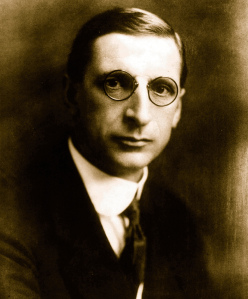 The Anglo-Irish Treaty is introduced to replace the Republic with a dominion of the British Commonwealth with the King represented by a Governor-General of the Irish Free State. The Treaty is finally signed on December 6, 1921.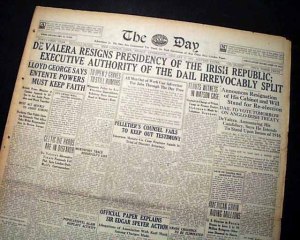
 Daniel “Dan” Keating is born in Castlemaine, County Kerry, on January 2, 1902. Keating is a life-long Irish republican and patron of Republican Sinn Féin.
 seamus dubhghaill