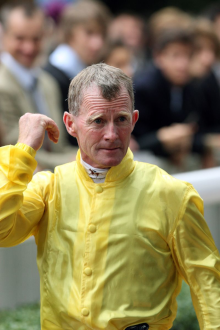
Kinane first comes to prominence as the stable jockey to Liam Browne, winning the 1982 Irish 2000 Guineas and St. James’s Palace Stakes at Ascot Racecourse, both on Dara Monarch, and finishing second in the 1983 Epsom Derby on Carlingford Castle, before moving to Dermot Weld. He is later retained by John Magnier and Aidan O’Brien as stable jockey at Ballydoyle for many years prior to joining leading Irish flat trainer John Oxx. He becomes one of the world’s elite jockeys and excels on the big occasions at Longchamp Racecourse and Epsom Downs Racecourse and is regarded as one of the leading professionals of his sport.
Kinane retires at the end of 2009, a season which is highlighted by his association with Sea The Stars, regarded as one of the greatest racehorses of all time. He breeds the 2007 Epsom Derby winner Authorized.
Kinane is current working for Hong Kong Jockey Club in Europe to select horses suitable for running in Hong Kong. Those horses are resold by Hong Kong Jockey Club in an auction.
The Derrynaflan Chalice, an 8th- or 9th-century chalice, is found as part of the Derrynaflan Hoard of five liturgical vessels on February 17, 1980 near Killenaule, County Tipperary. According to art historian Michael Ryan the hoard “represents the most complex and sumptuous expression of the ecclesiastical art-style of early-medieval Ireland as we know it in its eighth- and ninth-century maturity.” The group is among the most important surviving examples of Insular metalwork.
The hoard is probably secreted during the turbulent 10th to 12th centuries, when Viking raids and dynastic turmoil create many occasions when valuables are hidden. The early and later 10th century is marked by a particular concentration of hoarding in Ireland.
Derrynaflan, the site of an early Irish abbey, is a small island of dry land situated in a surrounding area of peat bogs, in the townland of Lurgoe, County Tipperary, northeast of Cashel. The monastery is an important foundation in the period preceding the Viking raids. The present modest ruins of a small Cistercian nave-and-chancel abbey church there, however, date from a later period.
The Derrynaflan Hoard is discovered on February 17, 1980 by Michael Webb from Clonmel and his son, also Michael, while they are exploring the ancient monastic site of Derrynaflan with a metal detector. They have permission of the owners of the land on which the ruins stand to visit the site but they have no permission to dig on the lands. A preservation order had been made in respect of the ruin under the National Monuments Act, 1930, so that it is an offence to injure or to interfere with the site. The discovery is initially kept secret for three weeks.
The behaviour of the Webbs, and nearly seven years of litigation, culminating in the Supreme Court action where they unsuccessfully seek over £5,000,000 for the find, leads to the replacement of Irish laws of treasure trove by the law in the National Monuments (Amendment) Act, 1994, with a new Section 2 being included in the legislation.
The Ardagh Chalice dates from around the same period, perhaps a century earlier, of the Derrynaflan Hoard and is found close by in neighbouring County Limerick. At the time, the ruling dynasty in Tipperary and most of Munster are the Eóganachta, while their longtime allies and possible cousins the Uí Fidgenti rule in the Limerick area. Feidlimid mac Cremthanin, king-bishop of Cashel, who becomes King of Munster in 821 and dies in 847, is a patron of the monastic foundation at Derrynaflan and has been suggested as a possible patron of the chalice.
As a masterpiece of Insular art, the Derrynaflan chalice is included in the exhibition “The Work of Angels: Masterpieces of Celtic Metalwork, 6th–9th Centuries AD” (London, 1989). The Derrynaflan Hoard is donated to the Irish State and the items are now on display in the National Museum of Ireland.
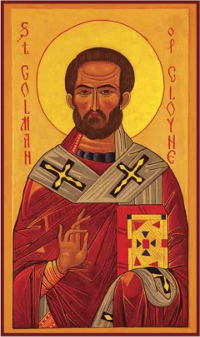
Saint Colmán of Cloyne, also known as Colmán mac Léníne, monk, founder, and patron of Cluain Uama, now Cloyne, County Cork, and one of the earliest known Irish poets to write in the vernacular, dies on November 24, 600.
Colmán is remembered as the founder of the monastery at Cluain Uama in Munster, which lay in the kingdom of the Uí Liatháin and the Uí Meic Caille, a sept of the former. The origin legend Conall Corc and the Corco Loígde claims that the land for the foundation is not given by the local king, but by Coirpre Cromm mac Crimthainn, who is king of Munster from the Eóganacht Glendamnach.
Cloyne appears to be his earliest settlement. The cathedral and round tower are situated on a limestone eminence in the midst of the valley, surrounded by rich meadows. In the rock is the cave extending in various branches underground to a great distance, from which the town derives its name. Here it is believed that Colmán took up his abode as a place of security. Colmán is also believed to have founded a monastery at what would become Killagha Abbey in County Kerry.
Colmán is credited with extraordinary poetic powers, being styled by his contemporaries “royal poet of Munster.” Several of his Irish poems are still extant, notably a metrical panegyric on Saint Brendan.
It is unclear whether Colmán is brought up as a Christian, but what is certain is that he is educated and becomes a bard or file, which requires a special education. As a member of the class of filí, he becomes attached to the court of Cashel where he remains until about the age of 48 years. In 570, he and Saint Brendan of Clonfert are said to have settled a dispute between rivals to the throne of Cashel and Aodh Caomh is acknowledged as king, the first Christian king of Cashel. The King is installed by Saint Brendan. During the time of the coronation Colmán and some others discover the lost shrine of Ailbhe of Emly. Brendan says that it is not right that the hands which have held this sacred relic should be defiled henceforth, thus it is that the son of Leinin offers himself to God. Brendan blesses him and gives him the name Colmán, which is a diminutive of Colm.
Colmán then goes to the school of Saint Iarlaithe of Tuam and after his studies he is next mentioned as preaching to the heathen population in the east of County Cork. He is described as a “religious and holy presbyter, who afterwards became a famous bishop.” The Prince of Déise, in the present county of Waterford, presents his child to Colmán for baptism. Colmán baptizes him Declán and urges his parents to educate him well in his faith. This child becomes Saint Declán of Ardmore.
Colmán is given churches in Erry and Killenaule by Coirpre Cromm mac Crimthainn, King of Munster (Cashel), as well as lands in Cloyne, County Cork. It may well be that the lands in Cloyne are conquered lands and to prevent the possibility of reconquest are given to the church. The Cloyne estate is large and contains some of the best land in the area.
After the king’s death (c. 580) Colmán somehow becomes involved in factional strife between Coirpre’s descendants in which some of them persecute him while others, the ancestors of the later dominant line, protect him.
His surviving verses date from the period 565 and 604, and are among the earliest examples of Irish writing in the Latin alphabet. He is commonly thought to have composed Luin oc laib, a poem in praise of Domnall mac Muirchertaig, king of Tara, and another poem on the death of Áed Sláine, king of the UÍ Néill. The latter poem has not survived complete.
Colmán dies on November 24, 600, and is likely buried is Cloyne, where he may have left a school of poetry in existence. The calendars are unanimous in dating his death on November 24, now his feast day.


 seamus dubhghaill