
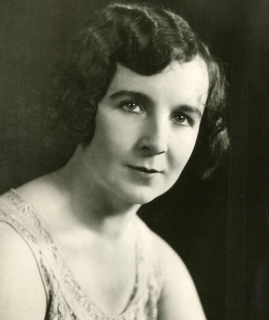
Eileen Aice Izabella Crowe, Irish actress, is born at Carlingford Terrace in Drumcondra, Dublin, on March 2, 1899.
Born Alice Izabella, she is one of ten children born to grocer Moses Crowe and Therese Eglinton. From an early age, she shows an interest in the theatre, and regularly attends productions in both the Gaiety and Abbey theatres. Having completed her education, she joins a convent but soon after abandons the idea of becoming a nun. In October 1921, she enters the Abbey School of Acting. She has a career with the Abbey Theatre from 1921 to 1970.
Upon her entry to the Abbey School of Acting, Crowe makes her debut in 1921 in the play The Revolutionist, taking the lead role of Nora Mangan. She plays her last role of Miss Hatty in Grogan and the Ferret, after which she retires. During nearly five decades, she stars in many plays, some of which include The Marriage of Columbine (1921) and Juno and the Paycock (1924). Between 1931 and 1953, she appears in the Abbey Theatre productions of plays by Irish playwright Teresa Deevy including A Disciple (1931), Katie Roche (1936, 1937, 1949, 1953), Temporal Powers (1932, 1937) and The Reapers (1930).
Following her film debut in 1925 in The Land of Her Fathers, Crowe appears in many films between 1936 and 1964 including The Plough and the Stars (1937), The Quiet Man (1952), Home is the Hero (1959) and Girl with Green Eyes (1964), her last film appearance.
Also in 1964, Crowe appears in the Aldwych Theatre‘s production of Juno and the Paycock in London. She works in the Abbey for the vast majority of her career, except for when she is on a six-month tour for Peg O’ My Heart, touring Northern Ireland and England.
In 1924, when the play Grasshopper is being produced, Crowe meets her husband, Peter Judge, also known as F. J. McCormick. They are married in 1925 and the marriage produces a daughter and a son.
Crowe dies at her home in Upper Rathmines Road, Dublin, on May 8, 1978, at the age of 79. She is buried beside her husband in Dean’s Grange Cemetery in Deansgrange, Dún Laoghaire–Rathdown, County Dublin.

 seamus dubhghaill
February 20, 2025 at 7:07 AM
Hi Jim, I’m trying to find out why Eileen Crowe refused to play the disreputable busybody, Mrs Gogan, in Sean O’Casey’s 1916 play, The Plough and the Stars, yet she took the part of a prostitute instead! O’Casey gave to his disreputable stage characters names of living people he disliked; why does Crowe’s refusal seem to be defending the surname of a republican rebel — one L. S. Gogan?
Here is an extract from my proposed book: “His name-choices for his characters in the Plough illustrate the way he indulged personal enmities. The assistant secretary of the Irish Volunteers, L.S. Gogan – who, as MacNeill’s secretary was one of those who opposed O’Casey’s attempt to state the Volunteers favoured the better-off over the workers25 — became O’Casey’s interfering busybody and looter, Mrs. Gogan.”
But was there a deeper reason? Did Crowe respect the Gogan name too much to degrade it? Did she have rebel sympathies? Perhaps the question is unanswerable but I’d be very grateful if you could throw some more light on Crowe. As penance for sins past, I’m now writing a terrible book on O’Casey’s Plough, titled The Dream and the Shame.
Le gach uile dea-ghuí/With each and every good wish,
Brian Devine/ Ó Daimhín, MA, DPhil
P.S. Jim, you might be interested that I once wrote a book in 2006 titled Yeats, the Master of Sound showing Yeats’s debt to the Irish language’s impact on the rhythms of his poetry. Its theme was that Irish or Gaeilge is a quantitative tongue wholly different from the German-rooted stresses of English and Gaeilge’s musical sound-effect may be defined as “runs of short syllables interspersed by single vowels or groups of long vowels.”) You can hear that pure Irish rhythm in “The old brown thorn trees break in two high over Cummen Strand . . .” — from ‘Red Hanrahan’s Song about Ireland.’
LikeLike
February 21, 2025 at 7:56 AM
Hello, Brian! Thank you for visiting my site and for the interesting questions! I am going to see if I can locate a copy of your 2006 book on Yeats! Best wishes!
LikeLike