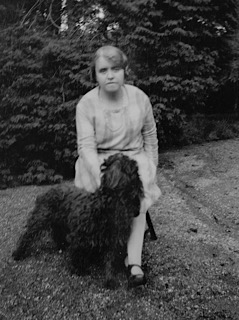
MacCormack (sometimes spelled McCormack) is born in 1892, the daughter of Constance MacCormack, and niece of Evelyn Gleeson. Following the death of her father in 1902, the family lives with Gleeson at her home, at Runnemede, Sandyford Road, Dublin, with her mother and siblings, Grace (1898–1982) and Edward (1889–1906). With her sister, she works in the Dun Emer Guild from a young age, particularly after the Yeats sisters, Lily and Elizabeth, leave Dun Emer to form Cuala Industries.
MacCormack also does some acting, theatre set design and is an author. She appears in Joseph Plunkett‘s 1912 play The Dance of Osiris at the Hardwicke Theatre, and designs the sets. She often acts under the name Catia or Caitia Nic Cormac. She also designs sets for the Irish National Theatre Society, Theatre Company of Ireland and the Dublin Drama League.[5]
Some of MacCormack’s most notable works are the tapestries for the Honan Chapel, Cork, in 1917, the vestments for St. Patrick’s Catholic Church, San Francisco in 1923, and a carpet presented to Pope Pius XI in 1931. The carpet is commissioned in an effort by Ireland’s ambassador to the Vatican, Charles Bewley, to secure Ireland as the host of the 31st International Eucharistic Congress. It is designed by MacCormack and takes workers in the Guild almost four months to hand weave at a cost of £450. As “The Pope’s Carpet” it is exhibited in Clerys department store on O’Connell Street in Dublin from January 19 to 30, 1931.
MacCormack designs the poster for the 1927 “Grand Pageant of Dublin History.” She also develops a set of designs for judicial robes for W. T. Cosgrave in 1924, drawing on the Brehon style sketches of which are held in University College Dublin Archives. In 1911 and 1920, she exhibits at the Oireachtas Art Exhibitions, and with the Water Colour Society of Ireland throughout the 1920s. She is also an illustrator, beginning with Christmas card designs for Dun Emer in the 1910s. She illustrates John Hackett Pollock’s 1919 The wisdom of the world: A book of wonder-tales, published by Colm Ó Lochlainn‘s Candle Press under Pollock’s pseudonym An Philibín. She edits a volume for Ó Lochlainn in 1920, The Book of St Ultan; a collection of pictures and poems by Irish artists and writers, proceeds of which go to Saint Ultan’s Hospital. As well as editing, she contributes illustrations and two poems to the volume.
After her aunt’s death in 1944, MacCormack continues to run Dun Emer Guild until its store on Harcourt Street closes around 1964.
MacCormack dies on June 26, 1975. A large collection of theatre ephemera collected by MacCormack is sold in 2008. The Kitty MacCormack Archive is held by the Jackie Clarke Archive, and the National Library of Ireland also holds a collection of her theatre ephemera and letters. A dress designed by MacCormack for Clare Kennedy, the wife of Hugh Kennedy, is on display as part of The Way We Wore, an exhibition in National Museum of Ireland at Collins Barracks, Dublin.
John Dudley Digges, Irish stage actor, director, and producer as well as a film actor, is born in Ranelagh, Dublin, on June 9, 1879. Although he gains his initial theatre training and acting experience in Ireland, the vast majority of his career is spent in the United States, where over the span of 43 years he works in hundreds of stage productions and performs in over 50 films.
Digges is the child of James Digges and Catherine Forsythe. He becomes acquainted with theatre directors William and Frank Fay and takes an interest in acting. He joins W. G. Fay’s Irish National Dramatic Company, along with others including Máire Nic Shiubhlaigh, James H. Cousins, Frederick Ryan and Maire Quinn (who becomes his wife). Their first production, Cathleen Ni Houlihan, with Maud Gonne in the lead role, and Déirdre, is on April 2, 1902. The company, which has no funds to speak of, acquires a couple of bare rooms at 34 Lower Camden Street, which with the help of friends from Irish-revival societies they turn into a small theatre. However, this proves too small for the plays they are planning to stage. They rehearse at the Coffee Palace in Westmoreland Street and also use the Molesworth Hall for productions.
In 1903, the playwrights and most of the actors and staff from these productions go on to form the Irish National Theatre Society, which has its registered offices in Camden Street. The society founds the Abbey Theatre.
Digges goes to the United States with a group of fellow-actors in 1904, and becomes successful as both actor and producer. He is stage manager for a time to both Charles Frohman and George Arliss, and by the 1920s he has become a notable performer on Broadway. One of his best-known roles there is as Ficsur in the original 1921 production of Ferenc Molnár‘s Liliom (later adapted into the musical Carousel by Rodgers and Hammerstein). In 1924, in Woodstock, New York, he founds the Maverick Theater with the assistance of Hervey White, who had established the Maverick Arts Colony. He is also artistic director of a company that includes Helen Hayes and Edward G. Robinson.
Digges expands his career into films by 1929, and over nearly two decades he performs in more than 50 films, including the original pre-Hays Code adaptation of The Maltese Falcon (1931). He Is cast in that feature as Casper Gutman, the character later portrayed by Sydney Greenstreet in the 1941 version. In The Invisible Man (1933) he plays the Chief Detective who plots to capture the title character, opposite the unseen Claude Rains. He plays the role of the Heavenly Examiner in both the original Broadway production and the 1930 screen version of Sutton Vane‘s Outward Bound. He also works as a director on Broadway.
Digges marries only once, to Irish actress Maire Quinn. The couple wed on August 27, 1907, in New York City and remain together until Maire’s death in August 1947. On October 24, 1947, just two months after his wife’s death, he dies of a stroke in his Manhattan apartment at 1 West 64th Street. He is survived by three siblings, all living in Ireland: a sister, Mrs. Mai Gannen, and two brothers, James and Ernst. Following a requiem mass at Blessed Sacrament Roman Catholic Church on October 28, he is buried next to his wife at Gate of Heaven Cemetery in Hawthorne, New York.
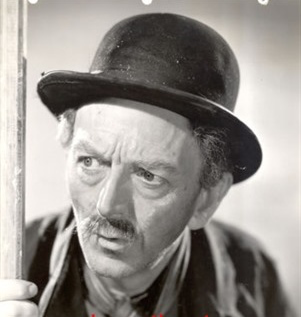
(Pictured: Digges as Boss Mangan in the 1920 Broadway production Heartbreak House, which he also directs)
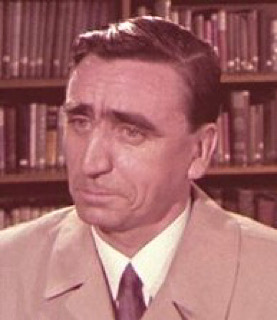
F. J. McCormick (real name Peter Christopher Judge), an Irish actor who becomes known for his work at Dublin‘s Abbey Theatre, is born in Skerries, County Dublin, on June 1, 1890. He acquires the stage name “F.J. McCormick” to disguise his identity from his current and future employers, and to avoid parental disapproval. He joins the Abbey at age 19, and acts in some 500 productions there. He is especially remembered for his work in the plays of Seán O’Casey.
After living in Skerries in his early years, at age ten McCormick moves to Dublin and proceeds to live there for the majority of the duration of his life. He is educated locally in Skerries. His father, Michael Judge, is a maltser and later becomes a brewery manager. He is of medium height, with “expressive eyes” and thick brown hair. As a young man, he begins writing by contributing articles to the press. He works briefly as a post office clerk in London but returns to Dublin to work as a junior clerk in the Civil Service. He resigns from his public service career in 1918 and decides to embrace acting as a full-time career as a member of the Abbey Theatre at age 19.
McCormick’s mother dies when he is 2 years old. He and his family move to Dublin when he is 10 or 12 years old. He is raised in Skerries and attends the Holy Faith Convent for primary education. He describes his childhood in Skerries “as a very happy one.” He marries Eileen Crowe on December 2, 1925, in Rathdown. They meet at the Abbey where Crowe is also an actor. In describing their performances together, Seamus De Burca writes, “F. J. McCormick and Eileen Crowe lived a life together of perfect bliss.” The couple has two children, a son, David, and a daughter, Marie.
After moving briefly to London, McCormick returns to Dublin, where he works in the Civil Service. He also takes acting roles in the Workmen’s Club on York Street, and for the first time under the pseudonym by which he becomes known for roles with the Queen’s Theatre, Dublin. By May 1919, he has a leading role in an independent production of The Curate of St. Chad’s by Constance Powell Anderson at the Abbey Theatre. An attack on Irish acting by Edward Martyn is answered by McCormick in the pages of the journal Banba in June 1921.
McCormick acts in over 500 plays at the Abbey Theatre, becoming particularly associated with the plays of Sean O’Casey staged there. From 1923 to 1925, he is also stage manager at the Abbey. Of his performance as Seumus Sheilds in The Shadow of a Gunman, O’Casey says that the actor created a character greater than that which he had written. He plays Capt. Brennan in the filmed version of O’Casey’s The Plough and the Stars but it is his return to film in Carol Reed‘s Odd Man Out (1947) that sees him singled out for praise in contemporaneous reviews. The Irish Times writes that “the acting of the Irish players was unremittingly professional, and, in the case of F. J. McCormick, as Shell, a weak-minded and elderly corner-boy, quite outstanding.” The Times of London finds “it is Mr. F. J. McCormick as a sly, bird-like creature, who stops just the right side of informing, who catches most surely at the imagination.”
In their review of the film Hungry Hill (1947), The New York Times writes, “As the butler who served John Brodrick, his sons, and their sons in turn, the late F. J. McCormick is truly magnificent, giving an even more subtle portrayal of Irish character than he did as the wily tramp in Odd Man Out.”
In the last five years of McCormick’s life he continues to work in the Abbey where he acts in over 70 plays before his death. He only stars in one play in the theatre in the final year of his life, the play They Got What They Wanted playing the role of Bartley Murnaghan. He secures more leading roles in the film industry. He dies in Dublin at the age of 56 from a brain tumour on April 24, 1947. He is buried in Dean’s Grange Cemetery, Deansgrange, County Dublin. He continues to work right up until his death.
It is said that people regarded McCormick as one of the greatest actors in his era. This comes from his work in 500 plays and 4 films over his career. A year after his death, Barry Fitzgerald says he only knew of two actors with the gift that McCormick had and they were Charles Laughton and Charlie Chaplin.
There are many popular plays and films that McCormick is part of which are still remembered to this day by many, some of them include the original The Plough and the Stars in 1926 where he originates the role of Commandant Jack Clitheroe. He also plays the role of Captain Brennan in the John Ford film version of the play in 1936. In his appreciation for McCormick, Gabriel Fallon remembers him as both a great actor and a great man.
It is said that McCormick was one of the most versatile actors of his generation, his early death was a huge loss to the Irish arts and more specifically the Abbey Theatre where he carried most of his work.
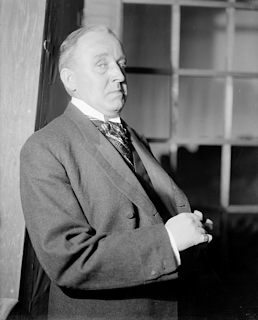
O’Riordan is the youngest child among two sons and three daughters of Daniel O’Connell O’Riordan, a barrister and justice of the peace (JP), and Katharine O’Riordan (née O’Neil), who is her husband’s first cousin. At age of four he witnesses his mother’s death in a carriage accident. His formal education, firstly as a day student at Belvedere College, Dublin (1881–85), and secondly as a boarder at Clongowes Wood College, County Kildare (1887–88), is interrupted by ill health and periods of self-education at home, marked by omnivorous reading in his father’s library.
While engaged in military studies in Bonn, Germany (March–September 1890), preparatory to entering Royal Military Academy Sandhurst in Great Britain, he falls from a horse during riding lessons, suffering a back injury that results in permanent spinal damage, thus precluding a military career.
Left with limited means after his father’s death, O’Riordan moves to London in 1891, where, after attempting suicide, he finds work as a stage actor with the Independent Theatre Society of J. T. Grein and other companies, both in London and touring the provinces, and is noted for his interpretations of Henrik Ibsen. Active in the Irish Literary Society, where he meets W. B. Yeats, he writes fiction under the pseudonym “F. Norreys Connell,” which he also adopts for his stage work.
O’Riordan’s early publications include In the Green Park (1894), a collection of connected short stories, The House of the Strange Woman (1895), a provocative novel of sexual promiscuity in upper-class London bohemia, boycotted by some booksellers as being “morally tainted,” and several books reflecting his deep interest in all things military, most notably The pity of war (1906), a collection of Kiplingesque short stories. Largely abandoning fiction for some years to concentrate on writing for the stage, he returns to Dublin for the first time in fourteen years to direct his controversial one-act play The Piper, which opens at the Abbey Theatre on February 13, 1908. It is jeered as a slander on Irish patriots in disturbances mildly reminiscent of the “Playboy” riots thirteen months previously. The audience on the third night is placated by Yeats, who in a speech from the stage interprets the play – in which a party of rebels in the 1798 rising disdain to set sentries as they argue interminably and discursively, only to be surprised and slaughtered by yeomanry – as a satirical allegory on the fruitless debate that followed the Parnellite split. The work can more usefully be read as a meditation on the propensity of democracy to disintegrate at moments of crisis into ineffectual and dillusory demagoguery. The Piper weathers the controversy to become a frequently performed staple of the Abbey Theatre repertoire during the 1910s.
After the death of John Millington Synge, O’Riordan serves briefly as managing director of the Abbey Theatre from March 25 to July 2, 1909, during which time he produces and directs two of his own one-act plays – Time on April 1, in which he also acts, and An Imaginary Conversation on May 13 – as well as the first revival of Synge’s The Playboy of the Western World on May 27. Wearied by the repeated interferences in the theatre’s affairs by its financial backer, Annie Horniman, he resigns abruptly during her fit of pique when the actress Sara Allgood recites poetry at a private gathering of suffragettes.
O’Riordan scores a major triumph on the London stage with Captain Hannibal (1909), his adaptation of a novel by Stanley Weyman, on the proceeds of which he lives for many years. Settling permanently in London, in 1910 he purchases a house at 106 Meadvale Road, Ealing, his home for the rest of his life. Rejected by the British Army at the outset of World War I owing to his disability, after several failed attempts to secure war work he eventually goes to the front in 1918 in charge of YMCA rest huts at Étaples railway junction, where he befriends the doomed soldier poet Wilfred Owen.
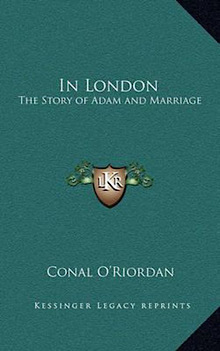
O’Riordan achieves his most accomplished writing within a cycle of twelve novels, published under his own name, chronicling the experiences of several inter-connected Irish and English families from the Napoleonic Wars to the 1920s. First of the series to appear was Adam of Dublin (1920), a combined Bildungsroman and roman-à-clef of the literary revival, with vignettes of Dublin slum life, Belvedere College, and the early years of the Abbey Theatre. He follows his protagonist, Adam Quinn, through the sexual turmoil of adolescence, an itinerant acting career, and an unhappy marriage in three sequels: Adam and Caroline (1921), In London (1922), and Married life (1924). These four novels chronologically conclude the narrative of the completed cycle. The narrative commences with the “Soldier” tetralogy – Soldier Born (1927), Soldier of Waterloo (1928), Soldier’s Wife (1935), and Soldier’s End (1938) – a picaresque treatment of the multifarious and farflung experiences of David Quinn, a forebear of Adam, from an Irish childhood and English education, to the Battle of Waterloo, where he suffers horrible facial mutilation, through the Irish famine and the American Civil War, to his death at the hands of Versaillais troops during the suppression of the Paris commune. Judith Quinn (1939) and Judith’s Love (1940), about the disappointments in love and marriage of a late-Victorian Dublin woman, link the narratives of the “Adam” and “Soldier” tetralogies, while The Age of Miracles(1925) and Young Lady Dazincourt (1926) are chronologically contemporaneous with the latter “Adam” novels. Inconsistent in intention, and uneven in execution, the cycle is strongest in its evocative descriptions of Dublin, London, and other cities, with their varied social strata, in different historical periods, in the sharp-edged, witty dialogue, and in the juxtaposition of dazzling comedy and an ironic sense of tragedy.
O’Riordan continues to write successful, if lightweight, stage plays. His 1928 production of Napoleon’s Josephine features a stellar cast including Edith Evans. Among his published plays are Shakespeare’s End, and Other Irish Plays (1912), Rope Enough (1914), His Majesty’s Pleasure (1925), The King’s Wooing (1929), and Captain Falstaff and Other Plays (1935). The historical commentary Napoleon Passes (1933) reflects his abiding interest in the French emperor. President of the Irish Literary Society from 1937 to 1939, he resigns after failing to persuade his colleagues to repudiate Ireland’s wartime neutrality. Despite age, disability, and increasing reclusivity, throughout World War II he serves as an air raid warden from 1940 to 1945. Elected a fellow of the Royal Society of Literature (1945–48), he represents the society on the council of the newly formed National Book League, and is the society’s Tredegar lecturer in 1946. Charming and convivial, a witty and erudite conversationalist, he cultivates numerous literary friendships, and is an inveterate womaniser, enjoying countless intimate relationships, both sexual and platonic.
O’Riordan marries firstly Florence Derby in 1903, a nurse eight years his senior, with whom he has one son. They are estranged by the time of her death in 1923. In 1924, he marries secondly Olga Buckley, his lover since 1920, and secretary to the wife of G. K. Chesterton. They have two sons (both born before the marriage) and one daughter. Despite considerable contemporary celebrity and critical acclaim, his work compared to that of Charles Dickens and Honoré de Balzac, he has been ignored by posterity. The best of his writing, especially the “Adam” and “Soldier” novels, merit rediscovery.
O’Riordan dies at his London home on June 18, 1948, the anniversary of the Battle of Waterloo. A special O’Riordan number of the Journal of Irish Literature (September 1985), edited by his daughter Judith, includes a portrait photograph, the text of The Piper, and a detailed chronology.
(From: “O’Riordan, Conal Holmes O’Connell (‘Norreys Connell’)” by Lawrence William White and Aideen Foley, Dictionary of Irish Biography, http://www.dib.ie, October 2009)
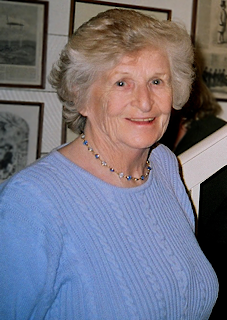
Ronnie Masterson, one of the best-known Irish stage actors of her generation from the 1940s to the 1970s, dies at the age of 87 in Rush, County Dublin, on February 10, 2014. Following her stage career she builds a solid film and television career with RTÉ, and independent directors including Peter Kosminsky, Alan Parker and Neil Jordan.
Masterson is born in Dublin on April 4, 1926. She trains at the Abbey Theatre and first appears on stage there in 1944. At the Abbey, she meets and then marries actor Ray McAnally in 1951, and they remain married until his death in 1989, although they reside in different homes; her husband with Irish actress Britta Smith. McAnally and Masterson have four children: Conor, Aonghus, Máire and Niamh.
Kennedy’s Children nearly bankrupts the company, having to be pulled early in a 14-week run, when playgoers in Dublin mistake its title as an adverse comment on the children of assassinated and revered U.S. presidentJohn F. Kennedy, whereas the play is actually a series of monologues exploratory of U.S. society in the Vietnam War era. They are rescued by two giants of Irish independent theatre, Phyllis Ryan of Gemini Productions – whose Eblana Theatre the couple had hired- and John B. Keane, who has just published Letters of a Matchmaker , a novel written as a series of letters between a rural matchmaker and his clients.
Masterson’s best film work is probably as a memorable Grandma Sheehan in Alan Parker’s screen version of Frank McCourt‘s Angela’s Ashesin 1999, where, in her own words in an interview with her grandson, Aonghus Óg McAnally, she says, “Without doubt I had the best script.”
Other notable film roles include Fools of Fortune, The Real Charlotte and Kosminsky’s dramatisation of the events which led to the Stalker inquiry in Northern Ireland, Shoot to Kill, where she plays Mrs. Tighe opposite her old Abbey colleague Peadar Lamb, as Mr. Tighe.
Speaking to The Irish Times , Lamb remarks how, as a young actor at the Abbey in 1949, Masterson had been a “striking” Kathleen Ní Houlihan in W. B. Yeats‘s play, her height, green eyes and vivid red hair perfect for the part.
Lamb, who serves for many years with Masterson on the committee of Irish Actors’ Equity Association, pays tribute also to her work for other actors: “She didn’t waste words, but spoke very strongly when she did speak.” RTÉ producer Laurence Foster also pays a tribute to this aspect of Masterson’s career on the SIPTU website.
In November 2005, Masterson is in the United States again, this time to take the lead role in The Sea Captain, a short film directed by her son, veteran television producer Conor McAnally.
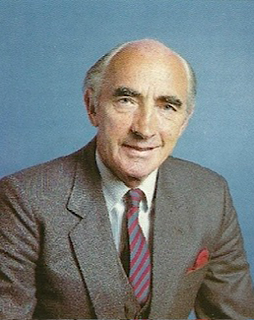
After lecturing at St. Patrick’s College, Dublin, from 1941 to 1944, Slevin enters the civil service. Despite no prior interest in heraldry, he is selected via competition to assist the newly installed Chief Herald, Dr. Edward MacLysaght, in the genealogical office, Bedford Tower, Dublin Castle. After serving as Deputy Chief Herald (1944–54), he succeeds MacLysaght as Chief Herald of Ireland, becoming the longest-serving occupant of the office (1954–81).
One of three national heralds named to a vexillogical committee to devise a common emblem for the Council of Europe, Slevin persuades his colleagues to eschew religious iconography, such as the Christian cross, as inappropriate. His own design of a circle of twelve golden stars on an azure field is selected by the committee in 1954, and formally accepted by the council in December 1955. With blue chosen as a colour common to the flags of many European countries, the twelve stars represent not individual states but such associations as the zodiac and a clock face, suggesting ideals of universality, harmony, and evolution through time. Adopted in 1985 for the flag of the European Community (latterly the European Union), his design attracts wide acclaim in heraldic circles, leading to his being awarded membership of the Académie Internationale d’Héraldique.
During Slevin’s tenure as Chief Herald, several hundred patents of arms are issued to Irish public bodies, including civic and municipal authorities, and to individuals of Irish descent worldwide. On behalf of the Irish government, he confirms the Irish connections of such notables as United StatespresidentsKennedy, Nixon, and Reagan, French president Charles de Gaulle, and Princess Grace of Monaco. His coat of arms for President Kennedy, combining the ancient arms of the Kennedy and Fitzgerald families, wins renown as a masterpiece of heraldic design. While possessing a keen sense of graphic impact, he is not a great draughtsman, and he employs the noted heraldic painter Myra Maguire to execute the designs that he creates. He oversees expansion of genealogical office services, instituting an advisory service and team of research assistants for the growing numbers – especially within emigrant communities abroad – seeking to trace Irish ancestry. He establishes a committee to catalogue churchyard memorial inscriptions as an archival resource, meant to redress the loss of state records in the 1922 Four Courts fire.
Slevin wins first prize in successive years in the 1950s for entries in the Oireachteas drama competition, both plays being subsequently produced at the Abbey Theatre. He writes a detective novel in Irish, and contributes numerous articles to learned journals, chiefly on medieval heraldry and Anglo-Irish families. Erudite and possessed of great presence, courtesy, and wit, he is an engaging speaker.
Resident in south County Dublin, Slevin is active in amateur dramatics, local history societies, and the ecumenical movement. His recreation is long country walks. He marries Millicent Nolan in 1950 and they have three sons. He dies on January 18, 1997.
(From: “Slevin, (John) Gerard” by Lawrence William White, Dictionary of Irish Biography, http://www.dib.ie, October 2009 (last revised February 2025))
A snappy dresser who earns the nickname “the yellow rose of Finglas,” Tunney is sometimes seen as pompous, a perception possibly attributable to his acting background, which once leads to an audition at Dublin’s Abbey Theatre.
In 1963 Tunney joins Fianna Fáil, and stands for the party at the 1965 Irish general election but is not elected. He is elected to Dáil Éireann as a Fianna Fáil TD for the Dublin North-West constituency at the 1969 Irish general election. He serves continuously in the Dáil until losing his seat at the 1992 Irish general election, having been a TD for Dublin Finglas from 1977 to 1981 when Dublin constituencies are reconfigured as 3-seaters, before being returned for Dublin North-West in 1981.
During this period Tunney serves as Parliamentary Secretary to the Minister for Education (after 1978, Minister of State at the Department of Education) in three governments. He serves as Leas-Ceann Comhairle of Dáil Éireann from 1981 to 1982, and from 1987 to 1993. He is also chair of the Fianna Fáil parliamentary party for ten years. He is a member of Dublin City Council, and serves as Lord Mayor of Dublin from 1984 to 1985.
Following Tunney’s death, TaoiseachBertie Ahern describes him as “a parliamentarian and a gentleman who was passionately committed to serving his country.” Ahern adds, “he was not only a man of substance but one of style. From the flower that was always in his buttonhole to the elegance of his language in both Irish and English he had a commanding and stylish presence.”
Fine Gael leader Michael Noonan says Tunney had gained “the widespread affection and respect of colleagues of all political parties.”
Leader of the Labour PartyRuairi Quinn describes Tunney as a “thoughtful and courteous colleague” who carried out his duties with “fairness but also with wit and style.”
O’Hegarty is born to John and Katherine (née Hallahan) Hegarty. His parents’ families emigrate to the United States after the Great Famine, and his parents are married in Boston, Massachusetts. His father is a member of the Irish Republican Brotherhood (IRB).
O’Hegarty is educated at North Monastery CBS, where he forms an enduring friendship with Terence MacSwiney. In 1888, his father dies of tuberculosis at the age of 42. Left destitute, his mother pawns her wedding ring to pay for an advertisement looking for work, and eventually becomes a cook.
O’Hegarty serves at the main Postal Sorting Office in Mount Pleasant, London, from 1902 to 1913. Along with J. J. Walsh, he spends three years at King’s College London, studying for the Secretary’s Office. While he succeeds in his studies, Walsh does not and returns to Ireland. O’Hegarty becomes the IRB representative for South East England and joins the Gaelic League and Sinn Féin and becomes a strong advocate of the Irish language. In 1905, he is elected secretary of the local Dungannon Club, which draws in as members Robert Lynd, Herbert Hughes and George Cavan. In 1907, as Sinn Féin’s London Secretary, he approves and signs the membership card of Michael Collins, later becoming friend and mentor to Collins.
O’Hegarty has to return to Ireland for a break due to overwork in 1909 and gives up some of his work for the Gaelic League. However, he takes over as editor of the IRB publication, Irish Freedom. It is in this publication that he famously writes, concerning the visit of King George V to Ireland in 1911: “Damn your concessions, England: we want our country!” In 1912, at the height of the Playboy riots, he writes four articles entitled “Art and the Nation” in Irish Freedom, which take a very liberal and inclusionist approach to Anglo-Irish literature and art in general but invokes the wrath of many of the paper’s readers.
In 1913, he is re-posted to Queenstown (present-day Cobh) as postmaster. He continues editing nationalist newspapers such as Irish Freedom (founded in 1910 and suppressed in December 1914 on account of its seditious content) and An tÉireannach and joins the Irish Volunteers. At the outbreak of war he is moved to Shrewsbury, probably on account of his political activities. In 1915, he marries Wilhelmina “Mina” Smyth, a schoolteacher and suffragist, and is then moved to Welshpool, Montgomeryshire. In the aftermath of the 1916 Easter Rising, he is opposed to physical force. In 1918, he refuses to take the British Oath of Allegiance and resigns his position in the Post Office.
O’Hegarty feels that the Abbey Theatre is “doing good for Ireland” and supports W. B. Yeats against attacks from Arthur Griffith and like-minded Nationalists. He opposes the extremist views of D. P. Moran, who seeks a Roman Catholic Irish-speaking Ireland.
O’Hegarty is Secretary of the Irish Department of Post and Telegraphs from 1922 to 1945. He is elected a member of the Irish Academy of Letters in 1954.
O’Hegarty’s son, Seán Ó hÉigeartaigh, is a founder of the Irish-language publishing house Sáirséal agus Dill. His daughter Gráinne, a harpist, marries Senator Michael Yeats, son of W. B. Yeats.
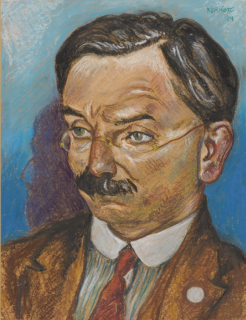
Clery is the son of Arthur Clery (who also uses the names Arthur Patrick O’Clery and Arthur Ua Cléirigh), a barrister, and Catherine Moylan. His father, who practises in India, publishes books on early Irish history.
Clery’s principal themes include the difficulties of Roman Catholic graduates seeking professional employment, dramatic criticism (he hails Lady Gregory‘s play Kincora as the Abbey Theatre‘s first masterpiece but is repulsed by the works of John Millington Synge), Catholic-Protestant rivalry, tension within the Dublin professional class, and the vagaries of the Gaelic revival movement.
Clery advocates partition on the basis of a two nations theory, first advanced in 1904–1905, possibly in response to William O’Brien‘s advocacy of securing Home Rule through compromise with moderate Unionists. Several of his articles on the subject are reprinted in his 1907 essay collection, The Idea of a Nation.
Clery derives this unusual view for a nationalist from several motives, including a belief that arguments for Irish nationalists’ right to self-determination can be used to justify Ulster Unionists’ right to secede from Ireland, fear that it might be impossible to obtain Home Rule unless Ulster is excluded, and distaste for both Ulster Protestants and Ulster Catholics, whom he sees as deplorably anglicised. He remains a partitionist for the rest of his life. He is not particularly successful as a barrister, but on the establishment of University College Dublin (UCD) in 1909, he is appointed to the part-time post of Professor of the Law of Property.
Clery does not take his seat and does not contest the September 1927 Irish general election since new legislation obliges candidates to pledge in advance that they will take their seat. He is one of the lawyers who advises Éamon de Valera that the Irish Free State is not legally obliged to pay the Land Annuities which had been agreed in the Anglo-Irish Treaty of 1922.
Clery was a close friend of Tom Kettle, with whom he founds a dining club, the “Cui Bono.” Hugh Kennedy is also a lifelong friend. As Auditor of the L & H, he tries to prevent James Joyce from reading a paper praising Henrik Ibsen, asserting that “the effect of Henrik Ibsen is evil,” but Joyce succeeds in reading it after he argues his case with the college president. The principal influence on Clery is the Irish Ireland editor D. P. Moran, to whose weekly paper, The Leader, Clery becomes a frequent contributor. In addition to The Idea of a Nation, he publishes Dublin Essays (1920) and (as Arthur Synan) The coming of the king.
Manahan’s career begins when, as a young woman, she is recruited by the legendary Irish impresarios and theatrical directorsMicheál Mac Liammóir and Hilton Edwards. She later marries stage director Colm O’Kelly, who dies not long afterward of polio, which he contracts after swimming in the Nile during a theatre tour of Egypt. They have no children and she never remarries. She is known professionally by her maiden name. In 1946 she appears in a production by Irish playwrightTeresa Deevy, The Wild Goose, where she plays the part of Eileen Connolly. This is performed by Equity Productions in the Theatre Royal, Waterford.
In 1957, Manahan plays Serafina in the first Irish production of Tennessee Williams‘s The Rose Tattoo and achieves unexpected notoriety when she and several other members of the cast are arrested for the possession of a condom on stage.
Manahan plays a minor role in the Irish cultsoap operaThe Riordans (1960s), and as Mrs. Mary Kenefick in the TV comedy Me Mammy (1970s). She also plays the lead in the Irish comedy series, Leave It To Mrs O’Brien (1980s) and Mrs. Cadogan in The Irish R.M. (1980s). Most recently she plays Ursula in Fair City, for which her niece, Michele Manahan (daughter of Michael Manahan), is a writer.
Manahan has an extensive theatre portfolio having played at theatres throughout Ireland including the Abbey Theatre, the United Kingdom, continental Europe, the United States and Australia. She wins the Tony Award for Best Featured Actress in a Play for her role as Mag in Martin McDonagh’s The Beauty Queen of Leenane on Broadway. She previously receives a Tony nomination in 1969 for Brian Friel’s Lovers.
The Irish playwright John B. Keane writes the play Big Maggie specifically for Manahan. In 2001 she stars in Keane’s The Matchmaker with veteran Irish actor Des Keogh. In 2005 she stars in Sisters, a new play by Declan Hassett that is also written for her and for which she is nominated for a Drama Desk Award in the category of Outstanding Solo Performance. The production tours Ireland and is staged at the International Festival of World Theatre in Colorado and also plays at the 59E59 Theater in New York City in 2006.
In 2004 Manahan starts to play the role of Ursula in Fair City. All About Anna (2005), a documentary on her life and work is made by Charlie Mc Carthy/Icebox Films for RTÉ Television. In 2008, she becomes the first ever patron of the Active Retirement Ireland organization.
Manahan dies of multiple organ failure on March 8, 2009 in Waterford. She had suffered from a longterm illness.
Her funeral is held on March 11, officiated by her “longtime friend” the psychoanalyst, poet, and priest Bernard Kennedy. “As the final curtain falls, the lights dim, the auditorium becomes silent, we remember her” he says. Describing her as a woman of faith (who “sought to bring the word of God alive”), he says she had brought everyone together to be present at “her last great exit from this great stage of life,” saying her life’s work had drawn people from all over the world. “Anna believed in the empty tomb of the Resurrection and she believed the empty tomb could be filled by hearing the word take the place of the emptiness,” he says. “She knew the bedsits which preceded the Tony nomination.”