
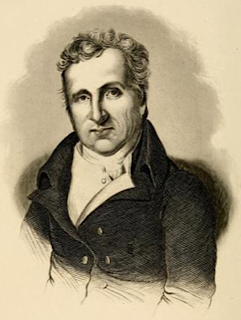
Sir Jonah Barrington, KC, Irish lawyer, judge and politician, dies at Versailles, France, on April 8, 1834. He is most notable for his amusing and popular memoirs of life in late 18th-century Ireland, for his opposition to the Act of Union 1800, and for his removal from the judiciary by both Houses of Parliament in 1830, still a unique event.
Barrington is born in 1756 or 1757 in Knapton, Abbeyleix, Queen’s County (now County Laois), the third son of John Barrington, an impoverished Protestant gentleman landowner in Queens’s County and his wife Sibella French of Peterswell, County Galway. He is raised and schooled by his grandparents in Dublin and enters Trinity College Dublin (TCD) in 1773, aged 16, but leaves TCD without a degree.
Barrington joins the Irish Volunteers and supports the Irish Patriot Party in the early 1780s. His father raises and commands two Corps: the Cullenagh Rangers and the Ballyroan Light Infantry.
Barrington’s elder brother commands both the Kilkenny Horse and the Durrow Light Dragoons. Through his correspondence with General Hunt Walsh, Barrington’s father secures him a commission in Walsh’s regiment. Upon learning that the regiment is to be sent to America to fight in the American Revolution, and fearful of dying on some foreign battlefield, he writes to Walsh asking him to present the commission to another candidate instead, claiming that he himself is too tender to be of any real use. His fears prove well founded when his replacement, the only child of one of Walsh’s friends, is killed in his first engagement.
Barrington is called to the Irish bar in 1788 and in 1789 he marries Catherine, daughter of Dublin mercer, Edward Grogan. They ultimately have seven children. The following year he enters by the purchase of the seat the pre-1801 Parliament of Ireland as MP for Tuam. He accepts a sinecure post in 1793 at the Dublin customhouse worth £1,000 p.a. generally supporting Henry Grattan and he takes silk the same year. He is a member of the Kildare Street Club in Dublin. Appointed an Admiralty court judge in 1798, he re-enters parliament the same year as member for Clogher and votes against the Act of Union in 1799–1800, rejecting John FitzGibbon, 1st Earl of Clare‘s offer of the solicitor-generalship in 1799. In 1802, he unsuccessfully contests a seat for Dublin City in the Parliament of the United Kingdom.
Barrington’s comments on the Act of Union has a continuing resonance with the Young Ireland, Fenian and Irish Parliamentary Party movements, which hope to re-establish “Grattan’s Parliament” in some way. In particular, his Rise and Fall of the Irish Nation (1833) provides the basis for this romantic idealisation of Grattan’s Parliament adopted by the Irish Parliamentary Party from the 1880s.
Appointed an Admiralty court judge in 1798 at a salary of £500, Barrington finds there is little work to be done and his lack of a degree restricts other opportunities to support extravagant tastes. His award of a knighthood in 1807 brings no increased income. His court orders the sale of two derelict vessels and he gives instructions that the proceeds are to go to his own bank account. In 1810 or 1811 he takes his wife and family to England and from that time on his work in Ireland is carried out by surrogates. Still retaining his judgeship and salary, he moves to France in 1814 to escape his creditors and never returns to Ireland.
In 1828, commissioners learn of Barrington’s financial irregularities. He crosses the channel to London and protests that he is innocent but does not answer the charges based on the documentary evidence produced by the commissioners. In 1830, a parliamentary commission recommends that he be removed from office, finding misappropriations of court funds in 1805, 1806 and 1810. Pursuant to a provision of the Act of Settlement 1701, which seeks to protect the independence of the judiciary, both Houses of the Parliament of the United Kingdom vote for an Address to King William IV praying for his removal, and the King duly dismisses Barrington from office. By then, Barrington’s first 1827 volume of memoirs has sold successfully, and they are republished and expanded. He is the first judge removed from office under the Act of Settlement, and to this day, is the only judge in the United Kingdom to be so removed.
According to one of Barrington’s sometimes spurious personal memoirs, on March 20, 1780, he travels to Donnybrook, Dublin, to duel with Richard Daly. Daly has fought 16 duels in three years – three with swords and thirteen with pistols. Remarkably, he, and his opponents, have always escaped serious injury. Barrington has no pistols so he and his second, Richard Crosbie, spend the previous night constructing a pair “from old locks, stocks and barrels.” At Donnybrook, Daly’s second, Jack Patterson, a nephew of the Chief Justice, approaches Crosbie, explains that it is all a mistake and asks that the two shake hands. Barrington is in favour, but Crosbie has none of it. Taking out a duelling handbook, he points to rule No.7 – “No apology can be received after the parties meet, without a fire.”
Taking up their positions, Barrington loses no time in pressing the trigger and Daly staggers back, puts his hand to his chest, and cries, “I’m hit, Sir.” The ball does not penetrate but does drive part of a brooch slightly into his breastbone. Barrington only then thinks to inquire why the duel is even taking place. This time the rule book notes: “If a party challenged accepts the challenge without asking the reason for it, the challenger is never bound to divulge it afterwards.”
Barrington is most notable today for his memoirs which include scathing but humorous thumbnail portraits of contemporary Irish lawyers, judges and politicians during the last years of the Protestant Ascendancy. Personal sketches also includes vignettes on Irish people from every background. His works are reprinted with frequent additions and renamings.
Since his death, Barrington’s work has been quoted by a wide selection of editors, primarily following two themes: the political drama surrounding the Act of Union and the colourful nature of life in 1700s Ireland.

 seamus dubhghaill