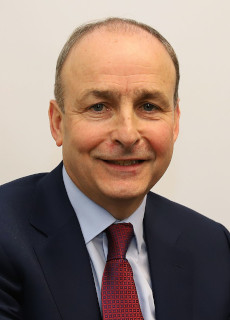
While Martin is Minister for Health and Children in 2004, he introduces a ban on tobacco smoking in all Irish workplaces and establishes the Health Service Executive (HSE). Ireland is the first country to introduce a full workplace smoking ban. As Foreign Minister, in 2009, he travels to Latin America for the first time and makes the first official visit to Cuba by an Irish Minister. That same year, he travels to Khartoum following the kidnapping of Sharon Commins and Hilda Kawuki. In 2010, he becomes the first Western foreign minister to visit Gaza since Hamas took control there in 2007.
In January 2011, Martin resigns as Minister for Foreign Affairs and is subsequently elected as the eighth leader of Fianna Fáil following Cowen’s resignation as party leader. In the 2011 Irish general election, he leads the party to its worst showing in its 85-year history, with a loss of 57 seats and a drop in its share of the popular vote to 17.4%. In the 2016 Irish general election, Fianna Fáil’s performance improves significantly, more than doubling their Dáil representation from 20 to 44 seats. In the 2020 Irish general election, Fianna Fáil becomes the largest party, attaining the most seats at 38, one seat ahead of Sinn Féin with 37 seats. He is appointed Taoiseach on June 27, 2020, leading a grand coalition with longtime rival Fine Gael and the Green Party as part of a historic deal. Under the terms of the agreement, Martin’s predecessor, Leo Varadkar, becomes Tánaiste, and will swap roles with Martin in December 2022.
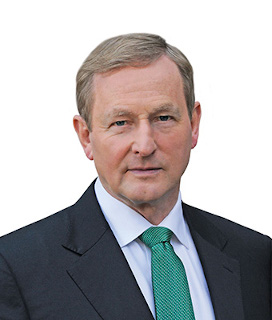
Kenny turns to politics in 1975 upon the death of his father, Henry Kenny, a long-serving member of the Dáil Éireann, representing Mayo. He wins a comfortable victory in a special election to fill his father’s seat, and at age 24 he is the youngest member of the Dáil. He spends much of his early political career on the backbench, focusing on local issues. In 1994 he is appointed Minister for Tourism and Trade in the “rainbow coalition” government of Fine Gael Taoiseach John Bruton.
With the collapse of Bruton’s coalition in 1997, Kenny loses his portfolio, but his stature rises as the party itself declines. Weeks after the 2002 Irish general election, which sees Fine Gael win just 31 seats, he is elected party leader. He immediately sets to restoring the party’s fortunes, and Fine Gael makes an impressive showing in the 2007 Irish general election, capturing 51 seats.
Fine Gael’s momentum continues to build as Fianna Fáil Taoiseach Brian Cowen, beset with a banking crisis and a soaring national deficit, is obliged to accept a bailout package of more than $100 billion from the International Monetary Fund and the European Union. The Green Party withdraws from Cowen’s coalition, and the government collapses, forcing early elections in February 2011. Capitalizing on widespread voter dissatisfaction, Fine Gael wins more than 70 seats, ending 14 years of Fianna Fáil rule, and Kenny begins discussions with the Labour Party about the formation of a coalition government. After more than a week of negotiations, the details of the coalition are settled and Kenny is formally elected Taoiseach by the Dáil on March 9, 2011, by an unprecedented 90 votes.
Kenny oversees a strong rebound by the Irish economy over the next five years, but the perception by many that the recovery has not been shared equally is reflected in the results of the 2016 Irish general election, when the electorate punishes the ruling coalition by ending its majority. In particular, voters appear to be disenchanted by the government’s pledge to end the Universal Social Charge — a graduated tax on all income over €13,000 — despite austerity-mandated cuts to social services. In the event, Fine Gael remains the largest party in the Dáil, but its share of the seats falls from the 76 it ultimately had secured in 2011 to 50, while coalition partner Labour plummets from 37 seats to seven. Meanwhile, Fianna Fáil, Fine Gael’s traditional rival for power, which had appeared politically moribund after the last general election, bounces back forcefully to add 24 seats to its 2011 count, reaching a total of 44 deputies.
With no party holding a majority and no quick path to coalition rule evident, a hung parliament ensues. Ten weeks of negotiations follow as Kenny seeks to form a government. Even the unheard-of possibility of grand coalition rule with Fianna Fáil is on the table. Finally, in early May, after much policy-related horse trading, an agreement is reached whereby Kenny and Fine Gael will continue to lead the government, supported by independent deputies and with a promise by Fianna Fáil that it will abstain on key votes until 2018. With Fianna Fáil abstaining, Kenny captures 59 votes on May 6, 2016, enough to return to power. In the process he becomes the first Fine Gael Taoiseach to be reelected.
A scandal involving the public smearing of a police whistleblower nearly topples the government in February 2017, and Kenny narrowly survives a vote of confidence, 57 to 52, with Fianna Fáil abstaining. Under pressure from the opposition as well as from members of his own party, Kenny stands down as Fine Gael leader in May 2017. The following month the party chooses Kenny’s Minister for Social Protection, Leo Varadkar, to succeed him as leader of Fine Gael. Kenny resigns as Taoiseach on June 13, 2017, and Varadkar is elected Taoiseach the following day.
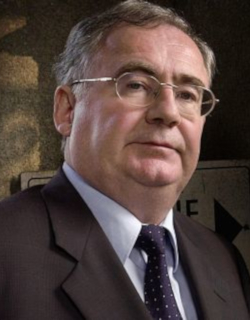
Rabbitte becomes involved in electoral politics for the first time in late 1982, when he unsuccessfully contests Dublin South-West for the Workers’ Party (WP) at the November general election. He is elected to Dublin County Council in 1985. He enters Dáil Éireann as a Workers’ Party Teachta Dála (TD) for Dublin South-West at the 1989 election. He retains his seat at every election until 2016.
After Tomás Mac Giolla‘s retirement as President of the Workers’ Party in 1988, Rabbitte is seen as one of those who wants to move the party away from its hard left position. In 1992, he plays a prominent role with Proinsias De Rossa in an attempt to jettison some of the party’s harder left positions. This eventually splits the Workers’ Party.
In 1994, a new ‘Rainbow Coalition’ government of Fine Gael, the Labour Party and Democratic Left comes to power. Rabbitte is a member of the junior ministerial team, serving as Minister of State to the Government, as well as Minister for State at the Department of Enterprise and Employment with responsibility for Commerce, Science and Technology.
Following the 1997 general election the Rainbow Coalition loses power. The following year sees a merger between the Labour Party and Democratic Left, with Rabbitte participating in the negotiations. In October 2002 he succeeds Ruairi Quinn as the new leader of the Labour Party. Under his leadership the party makes some gains in the local elections of 2004.
The Labour Party agrees to enter a pre-election pact, commonly known as ‘The Mullingar Accord,’ with Fine Gael in an attempt to offer the electorate an alternative coalition government at the 2007 general election. This move causes some tension in the parliamentary party, as some members prefer not to be aligned with any party in advance of an election.
Following the disappointing result in the election for Labour, Rabbitte announces he is stepping down as leader on August 23, 2007. He is succeeded as party leader by Eamon Gilmore. Rabbitte is re-elected on the first count in the 2011 general election. His running mate Eamonn Maloney is also elected. On March 9, 2011, he is appointed as Minister for Communications, Energy and Natural Resources.
In July 2014, Rabbitte is replaced by Alex White as part of a reshuffle of the cabinet. He does not contest the 2016 general election.

 seamus dubhghaill