seamus dubhghaill

Promoting Irish Culture and History from Little Rock, Arkansas, USA


Leave a comment

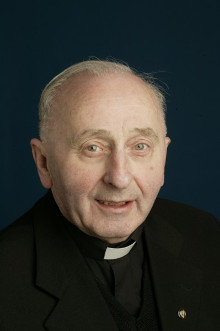
Death of James McLoughlin, Bishop of Galway & Kilmacduagh

James McLoughlin, the Roman Catholic Bishop of Galway and Kilmacduagh and Apostolic Administrator of Kilfenora for twelve years from 1993 to 2005, dies on November 25, 2005.

McLoughlin is born in Cross Street in the centre of Galway on April 9, 1929. His parents run a small wholesale grocery business. He attends the Patrician Brothers primary school in Nuns’ Island and St. Mary’s College, Galway. He studies for the priesthood at Maynooth and is ordained on June 20, 1954.

After ordination McLoughlin is appointed to the teaching staff of St. Mary’s College, Galway where he develops interests in basketball and amateur dramatics. He is appointed diocesan secretary in September 1965, bringing to that role a reserved dedication to duty, meticulous planning and financial acumen. He leaves full-time teaching in 1983 and is appointed parish priest of Galway Cathedral.

On February 10, 1993, the year after the sensational resignation of Bishop Eamon Casey, McLoughlin is appointed by Pope John Paul II as Bishop of Galway and Kilmacduagh. His consecration takes place in Galway Cathedral on March 28, 1993. After his death one obituary notes that McLouglhin’s “quiet demeanour…intimate knowledge of Galway and his being a native son, made him the ideal man to assume responsibility for the diocese when Bishop Eamonn Casey resigned.”

McLoughlin serves as chairman of the finance and general planning committee of the Irish Catholic Bishops’ Conference. In 2003 he is one of the first Irish bishops to announce the clustering of parishes in recognition of the falling number of priests, his diocese having had very few vocations or ordinations in the decade up to 2003.

McLoughlin announces his retirement on May 23, 2005, and on July 3 is succeeded as bishop of Galway and Kilmacduagh by Martin Drennan. He lives in Claregalway during his retirement, and dies on November 25, 2005, in Galway Clinic. His funeral is held in Galway Cathedral, and he is interred in the crypt beneath the cathedral.

McLoughlin’s successor, Bishop Martin Drennan, says he is deeply saddened and shocked by the news of McLoughlin’s death and that the late bishop was deeply loved and admired by the people and priests of his native city and diocese.

Dr. Seán Brady, Archbishop of Armagh and Primate of All Ireland, also pays tribute to the late bishop. He says Bishop McLoughlin was a gentle and humble man who radiated great joy, friendship and happiness to all whom he met.

Leave a comment

The Battle of Knockdoe

battle-of-knockdoe

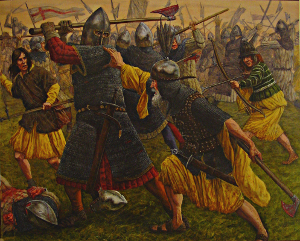
The Battle of Knockdoe, a battle between the forces of two Anglo-Irish lords — Gerald FitzGerald, Earl of Kildare, the Lord Deputy of Ireland, and Ulick Fionn Burke, lord of Clanricarde, takes place on August 19, 1504, at Knockdoe, County Galway.

Gerald FitzGerald becomes concerned that Ulick Burke’s attempt to gain supremacy in Connacht could simultaneously threaten the Crown’s interests in that province and his claim to be the paramount magnate in Ireland. He tries to persuade Ulick to acknowledge his authority by giving him his daughter Estacia in marriage. Ulick Burke, however, resists all attempts to have his power subordinated by the Earl of Kildare, forming an alliance with O’Brien of Thomond and the magnates of Munster. The Burkes of Mayo, on the other hand, join forces with Kildare with the aim of suppressing their dangerous neighbour.

In 1503, Ulick Burke attacks and destroys the castles of O’Kelly, Lord of Hymany, at Monivea, Garbally, and Castleblakeney. O’Kelly complains of this to the Lord Deputy.

For political and possibly for personal reasons, the Lord Deputy is eager to help O’Kelly weaken the prestige of Clanrickarde. Both sides gather a large contingent of lesser magnates and their armies. The Lord Deputy’s forces include contingents from Leinster, Ulster, and Connacht, among which are the armies of Red Hugh O’Donnell and Art Óg Ó Néill, the McDermotts and Morrisroes of Connacht, and a contingent provided by O’Kelly. Facing them are the forces of Burke and his allies – the O’Briens of Thomond, the McNamaras, the O’Kennedys, and the O’Carrolls.

The armies meet on the slopes of Knockdoe, almost a mile to the north of Lackagh Parish Church, with heavily armed Gallowglass playing a large part on both sides. It is said that firearms are employed in the course of the battle, an early instance of their use in Ireland. The battle apparently lasts all day, with the heaviest fighting taking place along the River Clare in the townland of Ballybrone. The precise number of casualties is unknown, though contemporary observers are impressed by the extent of the slaughter. Around the summit of Knockdoe are many cairns where the dead are said to have been buried, with one in particular being pointed out as the resting place of the two sons of O’Brien of Thomond.

The Lord Deputy, though victorious, has many among the slain. His army remains the night on the field as a token of victory, then marches to Galway, looting Claregalway castle en route and taking as prisoners the two sons and daughter of Ulick Burke. They remain in Galway for a few days and then travel to Athenry.

The Clanrickarde Burkes fade into obscurity for some decades, with their rivals, the Mayo Burkes, gaining influence as a consequence.