seamus dubhghaill

Promoting Irish Culture and History from Little Rock, Arkansas, USA


Leave a comment

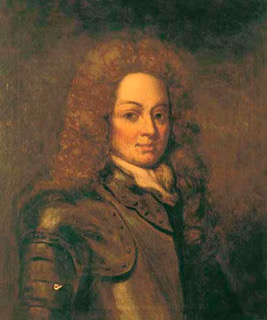
Birth of Sir Arthur Rawdon, Soldier & Horticulturist

Sir Arthur Rawdon, 2nd Baronet, soldier, and horticulturalist, is born on October 17, 1662. He builds a large part of Moira, County Down in the seventeenth century. Known as the “Father of Irish Gardening” and “The Cock of the North,” he is a keen botanist, and brings over 400 different species of plants to Moira from Jamaica.

Rawdon plays an active role in the Williamite War in Ireland. Following the Glorious Revolution he is involved in the raising of the Army of the North, a Protestant force opposed to the Jacobite Irish Army.

Rawdon’s father is Sir George Rawdon, 1st Baronet. His mother is George’s second wife, Dorothy, daughter of Edward Conway, 2nd Viscount Conway. He is a Member of Parliament for County Down, and a general in the army of King William III of England. Besieged at Derry, he falls ill, but manages to escape, though his military career is at an end.

Rawdon marries Ellen Graham, daughter of Sir James Graham of Congleton in Cheshire. They have at least two children, John and Isabella.

Rawdon inherits the lands at Moira after his father dies. He rebuilds a mansion, surrounded by trees, sheep and huge gardens. On this estate, he builds the first hothouse in Europe.

Rawdon is a botanist and imports 400 plant species from Jamaica, earning the name “Father of Irish Gardening.” His garden has a labyrinth, ponds, and canals. The trees include the “Locust of Virginia” which is 30 feet high and has a trunk of at least a foot and a half in diameter. For two generations the garden is maintained.

Rawdon dies on October 17, 1695, his thirty-third birthday, and John succeeds to the baronetcy and estate as a minor. The plant collections, perhaps inevitably, decline after his death, though his wife and sisters share his interest in natural history. Some of his plant specimens are still preserved in Hans Sloane‘s herbarium in the Natural History Museum, London.

Today in Moira many places are named after Sir Arthur Rawdon, including Rawdon Court, off Main Street. Off Meeting Street there is Rawdon Place which is a housing street. Parts of the remains of his mansion are still visible.


1 Comment

Death of Arthur Hill, 2nd Marquess of Downshire

Arthur Hill, 2nd Marquess of Downshire PC, FRS, British peer and MP styled Viscount Fairford until 1789 and Earl of Hillsborough from 1789 to 1793, dies by suicide on September 7, 1801.

Hill is born on March 3, 1753, the eldest son of Wills Hill, 1st Earl of Hillsborough (later Marquess of Downshire). He matriculates at Magdalen College, Oxford, in 1771, and receives his MA in 1773.

Hill sits as a Tory for the rotten borough of Lostwithiel from 1774 to 1780, and then for Malmesbury until 1784. He also represents County Down in the Irish House of Commons from 1776 until succeeding to the peerage in 1793.

Hill enjoys a number of civil and military appointments in both England and Ireland during this period. He is commissioned a captain in the Hertfordshire Militia on March 22, 1775, and a lieutenant colonel in the regiment on May 4, 1787, resigning his commission on June 4, 1794. Appointed the deputy governor of County Down on August 6, 1779, he is picked as High Sheriff of Down in 1785. He is chosen a Fellow of the Royal Society on January 22, 1790, and a deputy lieutenant of Berkshire on May 12, 1792.

Upon the death of his father on October 7, 1793, Hill succeeds him as Marquess of Downshire, in the Peerage of Ireland, as well as in his other subsidiary titles, including that of Earl of Hillsborough in the Peerage of Great Britain. He also succeeds his father as Hereditary Constable of Hillsborough Fort, and as Custos Rotulorum of County Down (October 16) and Governor of Down (October 17). On November 7, he is appointed to the Privy Council of Ireland.

Hill vigorously exerts himself against the Union of Great Britain and Ireland in 1800 and is punished by the Government for his opposition by being dismissed from the Governorship of Down and the colonelcy of the Downshire Militia and struck off the roll of the Privy Council on February 12, 1800.

On June 29, 1786, Hill marries Mary Sandys, by whom he has seven children:

Hill’s last son, Lord George Hill, is born posthumously, as he dies by suicide on September 7, 1801. His widow, Mary, feels his early death is in part due to his humiliation by the Government, and thereafter is a bitter enemy to Robert Stewart, Viscount Castlereagh. She is the heiress of her uncle, Edwin Sandys, 2nd Baron Sandys, and to the estates of her grandfather, William Trumbull, including Easthampstead Park. In 1802, after Hill’s death, she is created Baroness Sandys, with a special remainder to her younger sons and their male heirs in succession and then to her eldest son and his male heirs.

Hill also has a son, William Arthur Dore-Hill, born in 1778, with his mistress Sarah Dore (who later marries William Garrow).