seamus dubhghaill

Promoting Irish Culture and History from Little Rock, Arkansas, USA


7 Comments

The Last Execution in the Republic of Ireland

michael-manning

Michael Manning, Irish murderer, becomes the twenty-ninth and last person to be executed in the Republic of Ireland on April 20, 1954.

Manning, a 25-year-old carter from Johnsgate in Limerick, County Limerick, is found guilty of the rape and murder of Catherine Cooper, a 65-year-old nurse who works at Barrington’s Hospital in the city, in February 1954. Nurse Cooper’s body is discovered on November 18, 1953, in the quarry under the New Castle, Dublin Road, Castletroy. She is found to have choked on grass stuffed into her mouth to keep her from screaming during the committal of the crime.

Manning expresses remorse at the crime which he does not deny. By his own account, he is making his way home on foot after a day’s drinking in The Black Swan, Annacotty when he sees a woman he does not recognise walking alone. “I suddenly lost my head and jumped on the woman and remember no more until the lights of a car shone on me.” He flees at this point but is arrested within hours, after his distinctive hat is found at the scene of the crime.

Although Manning makes an impassioned plea for clemency in a letter to Minister for Justice Gerald Boland, his request is denied despite it also being supported by Nurse Cooper’s family. The execution by hanging is duly carried out on April 20, 1954, in Mountjoy Prison, Dublin by Albert Pierrepoint, who has traveled from Britain where he is one of three Senior Executioners.

Frank Prendergast, subsequently Teachta Dála (TD) for Limerick East who knew Manning well, recalls later, “Friends of mine who worked with me, I was serving my time at the time, went up to visit him on the Sunday before he was hanged. And they went to Mass and Holy Communion together and they played a game of handball that day. He couldn’t have been more normal.”

Manning leaves a wife who is pregnant at the time of the murder. His body is buried in an unmarked grave in a yard at Mountjoy Prison.

The death penalty is abolished in 1964 for all but the murder of gardaí, diplomats and prison officers. It is abolished by statute for these remaining offences in 1990 and is finally expunged from the Constitution of Ireland by approval by referendum of the Twenty-First Amendment on June 7, 2001.

The hanging of Michael Manning inspires a play by Ciaran Creagh. Creagh’s father, Timothy, is one of the two prison officers who stays with Michael Manning on his last night and Last Call is loosely based on what happened. It is shown in Mountjoy Prison’s theatre for three nights in June 2006.
1 Comment

Execution of “Half-Hanged MacNaghten”

half-hanged-macnaghten

John MacNaghten, Anglo-Irish land owner, gambler, and convicted murderer also known as “Half-Hanged MacNaghten,” is hanged at Strabane jail on December 15, 1761, for his involvement in the killing of Mary Anne Knox, daughter of Andrew Knox MP.

MacNaghten is born into a landed Anglo-Irish family and attends Raphoe Royal school in County Donegal. In 1740, he inherits his family estate worth £500 a year and that same year enters Trinity College, Dublin. MacNaghten marries the sister-in-law of the first earl of Massereene. However, he is quickly enamoured of the extravagant lifestyle of Ascendancy Dublin where he becomes a popular and colourful character. He develops an addiction to gambling and squanders away a large part of his inheritance, running up substantial gaming debts and by 1750 is threatened with arrest.

Following the death of his wife in childbirth, he is appointed to the lucrative post of tax collector for Coleraine but gambles away £800 of the King’s money. His estate is sequestered and by 1760 he is penniless.

He gains support trying to help overcome his addiction from a childhood friend, Andrew Knox. Knox is a wealthy land-owner and Member of Parliament (MP) for Donegal who lives on an estate at Prehen about two miles outside the city of Derry. Mary Ann, Knox’s 15-year-old daughter, is already a substantial heiress, having received some £6,000, and would collect a further legacy if her brother dies without issue. MacNaghten and Mary Ann develop a relationship as the former visits Prehen regularly. Nonetheless by 1761 their relationship has run into difficulties.

The practice of abduction and marriage is prevalent in 18th century Ireland among young men of social standing but with little property and, within their society, it is tolerated. So, on November 10, 1761, MacNaghten and his followers attempt to abduct Mary Ann from a carriage on a family journey to Dublin Parliament with the intention of eloping with her. The attempt fails miserably as MacNaghten shoots and mortally wounds her by mistake. He is taken to Lifford Courthouse in County Donegal, where a court finds MacNaghten guilty of murder and he is sentenced to execution by hanging.

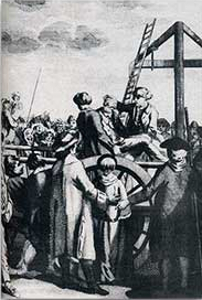
At Strabane jail on December 15, 1761, MacNaghten hurls himself from the gallows with such force that the rope breaks. He has the sympathy of the crowd who believe this is divine intervention for a man distraught with grief over the death of his love. Despite the belief that MacNaghten could not be hanged a second time, he fails to use the cover of a sympathetic crowd to make good his escape. Rather he defies the public mood of the people with the never-to-be-forgotten words, “I vow that no one will ever speak of me as Half-Hanged MacNaghten.” He returns himself to the jurisdiction of the hangman and, with a new rope, is dispatched into the arms of eternity.

John McNaghton is buried at Patrick Street graveyard, Strabane, County Tyrone.


Leave a comment

First Prisoners Arrive at Kilmainham Gaol

kilmainham-gaol

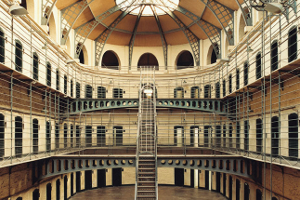
Kilmainham Gaol in Dublin receives its first prisoners on August 12, 1796. When it is first built in 1796, Kilmainham Gaol is called the “New Gaol” to distinguish it from the old prison it is intended to replace. It is officially called the County of Dublin Gaol, and is originally run by the Grand Jury for County Dublin.

Originally, public hangings take place at the front of the prison. However, from the 1820s onward very few hangings, public or private, take place at Kilmainham. A small hanging cell, located on the first floor between the west wing and the east wing, is built in the prison in 1891.

There is no segregation of prisoners as men, women, and children are incarcerated up to five in each cell, with light and heat provided by a single candle which has to last for two weeks. The cells are roughly 28 square metres in area.

At Kilmainham the poor conditions in which women prisoners are kept provide the spur for the next stage of development. Remarkably, for an age that prides itself on a protective attitude for the “weaker sex,” the conditions for women prisoners are persistently worse than for men. Male prisoners are supplied with iron bedsteads while females lay on straw on the floor. Half a century later, however, there is little improvement.

Many Irish revolutionaries, including the leaders of the 1916 Easter Rising, are imprisoned and executed in the prison by the British.

Kilmainham Gaol is decommissioned as a prison by the Irish Free State government in 1924. Seen principally as a site of oppression and suffering at the time, there is no declared interest in its preservation as a monument to the struggle for national independence. The jail’s potential function as a location of national memory is also undercut and complicated by the fact that the first four republican prisoners executed by the Free State government during the Irish Civil War are shot in the prison yard.

The Irish Prison Board contemplates reopening it as a prison during the 1920s but the plans are abandoned in 1929. In 1936 the government considers the demolition of the prison, but the price of this undertaking is seen as prohibitive.

In February 1960 detailed plans submitted by the Kilmainham Gaol Restoration Society for the restoration of Kilmainham, which notably also envisions the site’s development as a tourist attraction, receive the approval of the notoriously parsimonious Department of Finance. Restoration work begins in May of the same year. The final restoration of the site is completed in 1971 when Kilmainham Gaol chapel is re-opened to the public.

Kilmainham Gaol now houses a museum on the history of Irish nationalism and offers guided tours of the building. An art gallery on the top floor exhibits paintings, sculptures, and jewelry of prisoners incarcerated in prisons all over contemporary Ireland.  It is run by the Office of Public Works, an agency of the Government of Ireland.


1 Comment

Fenian James Carey Killed by Patrick O’Donnell

james-carey

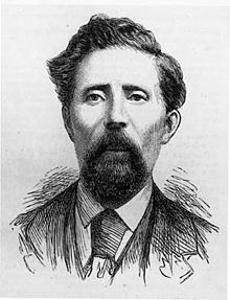
James Carey, a Fenian and informer most notable for his involvement in the Phoenix Park Murders, is shot and killed by Patrick O’Donnell aboard the Melrose on July 29, 1883.

Carey is born in James Street, Dublin, in 1845. He becomes a bricklayer and builder as well as the leading spokesman of his trade and obtains several large building contracts. During this period Carey is engaged in an Irish nationalist conspiracy, but to outward appearance he is one of the rising men of Dublin. He is involved in religious and other societies, and at one time is spoken of as a possible lord mayor. In 1882 he is elected a town councillor.

About 1861 Carey joins the Irish Republican Brotherhood, soon becoming treasurer. In 1881 he breaks with the IRB and forms a new group which assumes the title of the Irish National Invincibles and establishes their headquarters in Dublin. Carey takes an oath as one of the leaders. The object of the Invincibles is to remove all “tyrants” from the country.

The secret head of the Invincibles, known as No. 1, gives orders to kill Thomas Henry Burke, the under-secretary to the lord-lieutenant. On May 6, 1882, nine of the conspirators proceed to the Phoenix Park where Carey, while sitting on a jaunting-car, points out Burke to the others. At once they attack and kill him with knives and, at the same time, also kill Lord Frederick Cavendish, the newly appointed chief secretary, who happens to be walking with Burke.

For a long time no clue can be found to identify the perpetrators of the act. However, on January 13, 1883, Carey is arrested and, along with sixteen other people, charged with a conspiracy to murder public officials. On February 13, Carey turns queen’s evidence, betraying the complete details of the Invincibles and of the murders in the Phoenix Park. His evidence, along with that of getaway driver Michael Kavanagh, results in the execution of five of his associates by hanging.

His life being in great danger, he is secretly put onboard the Kinfauns Castle with his wife and family, which sails for the Cape on July 6. Carey travels under the name of Power. Aboard the same ship is Patrick O’Donnell, a bricklayer. Not knowing his true identity, O’Donnell becomes friendly with Carey. After stopping off in Cape Town, he is informed by chance of Carey’s real identity. He continues with Carey on board the Melrose for the voyage from Cape Town to Natal. On July 29, 1883, when the vessel is twelve miles off Cape Vaccas, O’Donnell uses a pistol he has in his luggage to shoot Carey dead.

O’Donnell is brought to England and is tried for murder. After being found guilty, he is executed on December 17 at Newgate.