
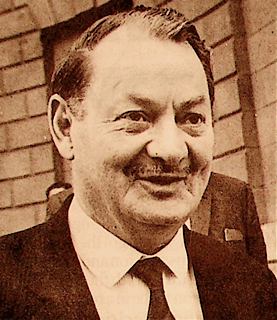
Mícheál Ó Móráin, an Irish Fianna Fáil politician, is born in Castlebar, County Mayo on December 24, 1911. He serves as Teachta Dála (TD) from 1938 to 1973, Minister for Lands from 1959 to 1968, Minister for the Gaeltacht from 1957 to 1959 and 1961 to 1968, and Minister for Justice from 1968 to 1970.
Ó Móráin hails from a strong Republican family, members of which had fought in the Irish War of Independence, and in the Irish Civil War on the Anti-Treaty side. A solicitor by profession, he is first elected to Dáil Éireann for the Mayo South constituency on his second attempt at the 1938 Irish general election. He remains on the backbenches for several years until he is appointed to the cabinet by Taoiseach Éamon de Valera in 1957 as Minister for the Gaeltacht. He is a native speaker of the Irish language. He is appointed Minister for Lands by Taoiseach Seán Lemass in 1959 and is re-appointed to the Gaeltacht portfolio in 1961. He remains in these two Departments until 1968.
Ireland formally applies for European Economic Committee (EEC) membership in July 1961. Ó Móráin, as Minister for Lands and the Gaeltacht, delivers a widely reported address to the Castlebar Chamber of Commerce in 1962. In the speech, he argues that Ireland is “ready to subscribe to the political aims of the EEC” and that Ireland does not want to be seen as “committed” to its policy of neutrality. In the ensuing controversy, he and Lemass deny that there is any suggestion Ireland might or should abandon neutrality. Outside the country, foreign governments see this episode as a deliberately provoked debate to evaluate the government’s domestic room for manoeuvre on neutrality.
Ó Móráin is appointed Minister for Justice by Taoiseach Jack Lynch in 1968. It is in this role that he is most remembered. While he is still Minister, the Arms Crisis in Ireland erupts in 1970. This political scandal sees Government ministers Charles Haughey and Neil Blaney dismissed by the Taoiseach for alleged involvement in a conspiracy to smuggle arms to the Irish Republican Army (IRA) in Northern Ireland. Ó Móráin continually suffers from ill health, which is accentuated by his alcoholism. When the Arms Crisis erupts, Lynch comes to see him in a hospital in Galway and asks for his resignation. Ó Móráin is a witness at the subsequent Arms Trial. He testifies that he had passed on Garda intelligence reports about the involvement of ministers with the IRA to the Taoiseach before the arms were seized at Dublin Airport. Hus evidence at the trial has been described as “erratic.”
Ó Móráin loses his Dáil seat at the 1973 Irish general election and retires from politics. He dies at his home in Sutton, Dublin, in on May 6, 1983. With a Fianna Fáil guard of honour, he is buried in Castlebar. With his wife, Madge, he has one daughter, Sorcha, and two sons, John, and Michael, who dies in a road accident in 1972.
 seamus dubhghaill