seamus dubhghaill

Promoting Irish Culture and History from Little Rock, Arkansas, USA


Leave a comment

Irish Brigade of France Participates in the Capture of Saint Kitts

On February 13, 1782, the Irish Brigade of France plays a significant role in the capture of Saint Kitts during the American Revolutionary War. The brigade, commanded by Arthur Dillon, is part of the French forces that besiege the British stronghold of Brimstone Hill. The siege lasts for 31 days, and after a fierce battle, the British forces surrender.

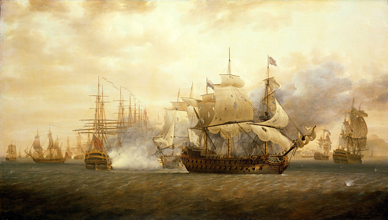
The Battle of Saint Kitts, also known as the Battle of Frigate Bay, is a naval battle fought on January 25 and 26, 1782, during the American Revolutionary War between a British fleet under Rear Admiral Sir Samuel Hood and a larger French fleet under François Joseph Paul de Grasse.

When Hood returns to the West Indies in late 1781 after the Battle of the Chesapeake, he is for a time in independent command owing to Admiral George Rodney‘s absence in England. The French admiral, François Joseph Paul de Grasse, attacks the British islands of Saint Kitts and Nevis with 7,000 troops and 50 warships, including the 110-gun Ville de Paris. He starts by besieging the British fortress on Brimstone Hill on January 11, 1782. Hoping to salvage the situation, Hood makes for Saint Kitts by departing Antigua on January 22 with twenty-two ships of the line, compared to de Grasse’s thirty-six.

The British fleet on January 24 consists of twenty-two sail of the line, and is close off the southeast end of Nevis. They run into and capture the French 16-gun cutter Espion, which carries a large amount of ammunition for the besieging French forces at Brimstone Hill.

At daybreak on January 25, the French fleet is discovered having stood to the southward of Basseterre, consisting of a 110-gun ship, 28 two-decked ships, and two frigates. Hood stands toward the French fleet with the apparent intention of bringing on action, and effectively draws the French fleet off the land. As soon as Hood effects this maneuver, he is aided by a favorable change in wind and is able to guide his fleet within the anchorage of Basseterre, which the French admiral has just quit. Hood orders his fleet in an L-formation and then orders his fleet to lay anchor. De Grasse makes three distinct attacks upon the British fleet on January 26 but is repulsed.

The Pluton, commanded by François Hector d’Albert de Rions, leads the French line, “receiving the crashing broadside of ship after ship until the splintered planking flew from her off side and her rigging hung in a tangled mass.” Chauvent goes on to describe the battle as “…a sulphurous hell, with cannon vomiting forth flame and death.” The entire battle lasts from 7:00 a.m. to 6:30 p.m., with the major action in the afternoon.

Damage on both sides is heavy, though the French suffer higher casualties. However, Hood is unable to stop the French and can only observe the land action. After the successful French siege of Brimstone Hill fortress, Saint Kitts and Nevis surrender on February 12. Hood leaves on February 14 and joins forces with the recently arrived Admiral George Rodney.

The capture of Saint Kitts marks a pivotal moment in the war, as it is the last major military action of the Irish Brigade of France. The regiment’s efforts are crucial in the French victory, and their legacy is remembered for their contributions to the fight for liberty.

In 1791, after the French Revolution, the Brigade’s close ties to the monarchy of France causes the leaders of the new Republic to disband the famous unit. Dillon, whose family and regiment sacrifice so much for France during its 100-years service, later dies on the Revolutionary government’s guillotine.

(Pictured: “The Battle of Frigate Bay, 26 January 1782,” oil on canvas painting by Nicholas Pocock, 1784, current location Royal Museums Greenwich)


Leave a comment

Sinking of the British Steamship Centurion

The U-20, a German U-boat under the command of  Kapitänleutnant Walther Schwieger, sinks the British steamship Centurion off the southeast coast of Ireland on May 6, 1915. This tragic event has far-reaching consequences and shapes the course of World War I.

The Centurion is traveling through the waters southeast of Ireland when a torpedo fired from the U-20 hits the vessel, causing it to rapidly sink. This act of aggression results in the loss of many innocent lives and sends shockwaves throughout the world.

At the time of the incident, World War I is in full swing. Germany, engaged in submarine warfare, seeks to disrupt British supply lines and cut off its access to vital resources. The sinking of merchant ships, regardless of their civilian nature, is part of Germany’s strategy to weaken the enemy. The attack on the Centurion is just one of many instances in which German submarines target and sink British vessels.

A difference in this particular incident as opposed to other similar incidents is the widespread outrage it triggers. The Centurion is an unarmed cargo ship carrying civilian goods, and its destruction is seen as a ruthless and unjustifiable act. The loss of civilian lives and the callousness with which the submarine attack is executed causes public opinion to turn against Germany.

The sinking highlights the growing concern over unrestricted submarine warfare and its impact on civilian populations. It pushes the United States, which at the time is neutral, closer to entering the war on the side of the Allies. The incident also plays a significant role in shaping public opinion in other neutral countries, putting pressure on Germany to reconsider its aggressive tactics.

In response to international outrage, Germany initially defends its actions, arguing that the Centurion was carrying contraband cargo. However, under mounting pressure, the German government eventually backs down and pledges to modify its submarine warfare policies to reduce the risk to civilian lives. This move is meant to appease neutral countries and prevent the United States from entering the war.

The sinking of the Centurion has a lasting impact on maritime warfare. The incident leads to the introduction of new rules of engagement, such as the requirement for submarines to surface and warn civilian vessels before attacking. These rules aim to minimize civilian casualties and reduce the risk of similar tragedies occurring in the future.

Moreover, the sinking serves as a catalyst for technological advancements in submarine warfare. Navies worldwide realize the need for more sophisticated anti-submarine measures and began developing detection systems and tactics to counter the stealth of submarines. This incident marks a turning point in the evolution of naval warfare, as nations seek to adapt and respond to the new challenges posed by underwater vessels.

The following day, May 7, 1915, the U-20 sinks the British ocean liner RMS Lusitania off the southern coast of Ireland. The liner sinks in eighteen minutes with 1,197 casualties. The wreck lies in 300 feet of water.

On November 4, 1916, U-20 becomes grounded on the Danish coast south of Vrist, after suffering damage to its engines. Her crew attempts to destroy her with explosives the following day, succeeding only in damaging the boat’s bow but making it effectively inoperative as a warship.

The U-20 remains on the beach until 1925 when the Danish government blows it up in a “spectacular explosion.” The Danish navy removes the deck gun and makes it unserviceable by cutting holes in vital parts. The gun is kept in the naval stores at Holmen, Copenhagen for almost 80 years. The conning tower is removed and placed on the front lawn of the local museum Strandingsmuseum St. George Thorsminde, where it remains today.

(Pictured: The U-20, second from left, at Kiel, Schleswig-Holstein, on February 17, 1914)