A car transporting police officers is leading the two-vehicle convoy. It is shot at as it travels out of the village, causing the Crossley Tender behind to stop close to the local hotel. RIC Constables Christopher O’Regan and William Power, Sergeant John Regan and Black and Tans Constable Hubert Oakes all die in the ambush. British forces are able to take refuge in the hotel, where they call for reinforcements.
Following the ambush, the Flying Column takes to the nearby Partry Mountains and are subsequently engaged by British troops from the Border Regiment. IRA Adjutant (South Mayo Brigade) Michael O’Brien sustains fatal injuries when he is shot while trying to assist the injured Brigade leader, Commandant Maguire. Another IRA Volunteer, Pádraig Feeney, is also killed that afternoon.
On May 3, 1921, in reprisal for the ambush, Crown forces burn several commercial establishments and homes in the area. Extensive searches and reprisals follow in the area over the next week.
Monuments commemorating Michael O’Brien and Pádraig Feeney have since been erected in County Mayo.
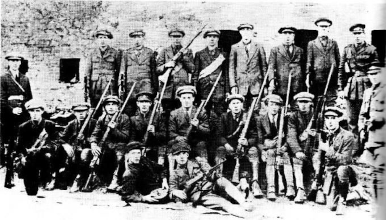
(Pictured: The South Mayo Flying Column of the Irish Republican Army, taken at Moore Hall in Muckloon, County Mayo, during the summer of 1921)
On September 18, 1920, the Mayo Brigade of the IRA is reorganized and spilt up into four separate brigades. Tom Maguire is appointed commander of the South Mayo brigade.
Maguire leads an ambush on a Royal Irish Constabulary (RIC) patrol in Toormakeady, County Mayo, on May 3, 1921, killing four. Maguire’s flying column then heads for the Partry Mountains. According to one account, the column is surrounded by many soldiers and policemen guided by aeroplanes. Maguire is wounded and his adjutant is killed, but the column manages to escape with no further casualties. Maguire is involved in numerous other engagements including the Kilfall ambush.
Maguire is a member of the anti-Treaty IRA executive which commands rebel troops during the Irish Civil War. Maguire is captured by the National Army while in bed and is told that he would be executed, but his life is spared. While in prison his brother, Sean Maguire, aged 17, is executed by the government.
Maguire remains a TD until 1927. He initially indicates a willingness to contest the June 1927 Irish general election as a Sinn Féin candidate but withdraws after the IRA threatens to court-martial any member under IRA General Army Order 28, which forbids its members from standing in elections.
Maguire subsequently drifts out of the IRA. In 1932, a Mayo IRA officer reports that Maguire, now firmly aligned with Sinn Féin, refuses to call on men to join the IRA when speaking at republican commemorations. When challenged on this, Maguire claims that, as the IRA “were no longer the same as they used to be,” he disagrees with the organisation.
In December 1938, Maguire is one of a group of seven people, who had been elected to the Second Dáil in 1921, who meet with the IRA Army Council under Seán Russell. At this meeting, the seven sign over what they contend is the authority of the Government of Dáil Éireann to the Army Council. Henceforth, the IRA Army Council perceives itself to be the legitimate government of the Irish Republic and, on this basis, the IRA and Sinn Féin justify their rejection of the states of the Republic of Ireland and Northern Ireland and political abstentionism from their parliamentary institutions.
When the majority of IRA and Sinn Féin decide to abandon abstentionism in the 1969–1970 split, Ruairí Ó Brádaigh and Dáithí Ó Conaill seek and secure Maguire’s recognition of the Provisional IRA as the legitimate successor to the 1938 Army Council. Of the seven 1938 signatories, Maguire is the only one still alive at the time.
Likewise, in the aftermath of the 1986 split in the Republican Movement, both the Provisional IRA and the Continuity IRA seek Maguire’s support. Maguire signs a statement which is issued posthumously in 1996. In it, he confers legitimacy on the Army Council of the Continuity IRA. In The Irish Troubles, J. Bowyer Bell describes Maguire’s opinion in 1986, “abstentionism was a basic tenet of republicanism, a moral issue of principle. Abstentionism gave the movement legitimacy, the right to wage war, to speak for a Republic all but established in the hearts of the people.”


 seamus dubhghaill