seamus dubhghaill

Promoting Irish Culture and History from Little Rock, Arkansas, USA


Leave a comment

The Battle of Chickamauga

On September 19, 1863, the 5th Confederate Infantry, consisting of a large number of Irish from Memphis, fight in one of the bloodiest battles of the American Civil War at Chickamauga, Georgia. One of the commanders is Cork-born Patrick Cleburne whom historians universally recognize as one of the most capable officers on either side during the awful conflict, although Chickamauga might not have been his finest hour. Cleburne is known as the “Stonewall of the West.” He is one of six Confederate generals to die in the Battle of Franklin.

The Battle of Chickamauga marks the end of a Union Army offensive, the Chickamauga campaign, in southeastern Tennessee and northwestern Georgia. It is the first major battle of the war fought in Georgia, the most significant Union Army defeat in the Western Theater, and involves a high number of casualties, second only to the casualties suffered at the Battle of Gettysburg.

The battle is fought between the Army of the Cumberland, one of the principal Union armies in the Western Theater, under Major General William Rosecrans and the Confederate Army of Tennessee under General Braxton Bragg and is named for Chickamauga Creek. The West Chickamauga Creek meanders near and forms the southeast boundary of the battle area and the park in northwest Georgia. The South Chickamauga ultimately flows into the Tennessee River about 3.5 miles northeast of downtown Chattanooga.

After his successful Tullahoma campaign, Rosecrans renews the offensive, aiming to force the Confederates out of Chattanooga. In early September, he consolidates his forces scattered in Tennessee and Georgia and forces Bragg’s army out of Chattanooga, heading south. The Union troops follow it and brush with it at Davis’s Cross Roads. Bragg is determined to reoccupy Chattanooga and decides to meet a part of Rosecrans’s army, defeat it, and then move back into the city. On September 17 he heads north, intending to attack the isolated XXI Corps. As Bragg marches north on September 18, his cavalry and infantry fight with Union cavalry and mounted infantry, which are armed with Spencer repeating rifles. The two armies fight at Alexander’s Bridge and Reed’s Bridge, as the Confederates try to cross the West Chickamauga Creek.

Fighting begins in earnest on the morning of September 19. Bragg’s men strongly assault but cannot break the Union Army line. The next day, Bragg resumes his assault. In late morning, Rosecrans is misinformed that he has a gap in his line. In moving units to shore up the supposed gap, Rosecrans accidentally creates an actual gap directly in the path of an eight-brigade assault on a narrow front by Confederate Lieutenant General James Longstreet, whose corps has been detached from the Army of Northern Virginia. In the resulting rout, Longstreet’s attack drives one-third of the Union Army, including Rosecrans himself, from the field.

Union Army units spontaneously rally to create a defensive line on Horseshoe Ridge (“Snodgrass Hill“), forming a new right wing for the line of Major General George H. Thomas, who assumes overall command of remaining forces. Although the Confederates launch costly and determined assaults, Thomas and his men hold until twilight. Union forces then retire to Chattanooga while the Confederates occupy the surrounding heights, besieging the city.

Thomas withdraws the remainder of his units to positions around Rossville Gap after darkness falls. The Army of Tennessee camps for the night, unaware that the Union Army has slipped from their grasp. Bragg is not able to mount the kind of pursuit that would be necessary to cause Rosecrans significant further damage. Many of his troops had arrived hurriedly at Chickamauga by rail, without wagons to transport them, and many of the artillery horses had been injured or killed during the battle. The Tennessee River is now an obstacle to the Confederates and Bragg has no pontoon bridges to affect a crossing. Bragg’s army pauses at Chickamauga to reorganize and gather equipment lost by the Union Army. Although Rosecrans had been able to save most of his trains, large quantities of ammunition and arms are left behind.

Army of Tennessee historian Thomas L. Connelly has criticized Bragg’s performance, claiming that for over four hours on the afternoon of September 20, he missed several good opportunities to prevent the Union escape, such as by a pursuit up the Dry Valley Road to McFarland’s Gap, or by moving a division to the north to seize the Rossville Gap or McFarland’s Gap via the Reed’s Bridge Road.

The battle is damaging to both sides in proportions roughly equal to the size of the armies: Union losses are 16,170 (1,657 killed, 9,756 wounded, and 4,757 captured or missing), Confederate losses are 18,454 (2,312 killed, 14,674 wounded, and 1,468 captured or missing). Among the dead are Confederate generals Benjamin Hardin Helm (husband of Abraham Lincoln‘s sister-in-law), James Deshler, and Preston Smith, and Union general William H. Lytle. Confederate general John Bell Hood, who had already lost the use of his left arm from a wound at Gettysburg, is severely wounded with a bullet in his leg, requiring it to be amputated. Although the Confederates are technically the victors, driving Rosecrans from the field, Bragg did not achieve his objectives of destroying Rosecrans or of restoring Confederate control of East Tennessee, and the Confederate Army suffers casualties that they can ill afford.

Leave a comment

The Second Battle of Fredericksburg

The 6th Louisiana Infantry, a largely Irish Confederate regiment, fights at the Second Battle of Fredericksburg, also known as the Second Battle of Marye’s Heights, on May 3, 1863, in Fredericksburg, Virginia, as part of the Chancellorsville Campaign of the American Civil War. With its ranks filled with Irishmen from New Orleans and roundabouts, the 6th fights in nearly every major battle of the Eastern Theater, from First Battle of Bull Run to the Battle of Appomattox Court House.

Confederate General Robert E. Lee leaves Major General Jubal Anderson Early to hold Fredericksburg on May 1, while he marches west with the rest of the Army of Northern Virginia to deal with Union Army Major General Joseph Hooker‘s main thrust at Chancellorsville with four corps of the Army of the Potomac. Early has his own division, along with William Barksdale‘s brigade from McLaws’ division and cannons from the artillery reserve. Early is assisted by Brigadier General William Pendleton of the artillery reserve. Cadmus Wilcox‘s brigade arrives on May 3, increasing Early’s strength to 12,000 men and 45 cannons. Most of the Confederate force is deployed south of Fredericksburg.

Early is ordered by Lee to watch the remaining Union force near Fredericksburg. If he is attacked and defeated, he is to retreat southward to protect the Confederate supply lines. If the Union force moves to reinforce Hooker, then Early is to leave a covering force and rejoin Lee with the remainder of his troops. On May 2, misunderstanding his orders, Early leaves one brigade at Fredericksburg and starts the rest of his force towards Chancellorsville. Lee corrects the misunderstanding and Early then returns to his positions that night before Major General John Sedgwick of the Union Army discovers the Confederate retreat.

Sedgwick is left near Fredericksburg with the VI Corps, the I Corps, and the II Corps division of Brigadier General John Gibbon. Hooker’s plan calls for Sedgwick to demonstrate near the city in order to deceive Lee about the Union plan. The VI and II Corps seize control of several crossings on April 29, laying down pontoon bridges in the early morning hours, and the divisions of William T. H. Brooks and James S. Wadsworth cross the river. The I Corps is ordered to reinforce the main army at Chancellorsville during the night of May 1. During the evening of May 2, Sedgwick receives orders to attack Early with his remaining forces.

Sedgwick moves his forces into Fredericksburg during dawn on May 3, uniting with Gibbon’s division which had crossed the river just before dawn. Sedgwick originally plans to attack the ends of Marye’s Heights, but a canal and a stream block the Union forces. He then decides to launch an attack on the Confederate center on the heights, which is manned by Barksdale’s brigade, with John Newton’s division. This attack is defeated. Colonel Thomas M. Griffin of the 18th Mississippi Infantry grants the Union forces a truce in order to gather in their wounded. During this truce, the Union commanders notice that the flank of Barksdale’s left regiment is unprotected.

Sedgwick launches another attack against this flank and Barksdale’s front using elements from all three VI Corps divisions, which pushes the Confederate forces off the ridge, capturing some artillery. The first men to mount the stone wall are from the 5th Wisconsin and the 6th Maine Infantry regiments. Barksdale retreats to Lee’s Hill, where he attempts to make another stand but is again forced to retreat southward.

Confederate casualties total 700 men and four cannons. Early withdraws with his division two miles to the south, while Wilcox withdraws westward, slowing Sedgwick’s advance. When he learns of the Confederate defeat, Lee starts moving two divisions east to stop Sedgwick. Following the campaign, Early becomes embroiled in an argument with Barksdale over what Barksdale considered a slight to his brigade in a newspaper letter that Early had written. The exchange continues until Lee orders the two generals to cease.

Sedgwick loses 1,100 men during the engagement. At first, he starts to pursue Early’s division but then follows the orders he received the previous day and starts west along the Plank Road towards Hooker’s army at Chancellorsville. Gibbon’s division is left in Fredericksburg to guard the city.

(Pictured: Three men in a tree on Stafford Heights watching distant fighting on Marye’s Heights during the Second Battle of Fredericksburg, 1863. Smoke from the battle is possibly visible in the distance which would make it one of the earliest combat photographs of a land battle. The destroyed railroad bridge over the Rappahannock River is in the middle ground of the photo. Source: National Park Service via the Western Reserve Historical Society)


Leave a comment

The Second Battle of Rappahannock Station

The Irish 6th Louisiana fights at the Second Battle of Rappahannock Station on November 7, 1863, near the village of Rappahannock Station (now Remington, Virginia), on the Orange and Alexandria Railroad. The battle is between Confederate forces under Maj. Gen. Jubal Early and Union forces under Maj. Gen. John Sedgwick as part of the Bristoe campaign of the American Civil War. The battle results in a victory for the Union.

Following the Battle of Gettysburg in July 1863, the Union and Confederate armies drift south and for three months spar with one another on the rolling plains of northern Virginia. In late October, General Robert E. Lee withdraws his Confederate army behind the Rappahannock River, a line he hopes to maintain throughout the winter. A single pontoon bridge at the town of Rappahannock Station is the only connection Lee retains with the northern bank of the river.

The Union Army of the Potomac‘s commander, Maj. Gen. George G. Meade, divides his forces just as Lee expects. He orders Maj. Gen. John Sedgwick to attack the Confederate position at Rappahannock Station while Maj. Gen. William H. French forces a crossing five miles downstream at Kelly’s Ford. Once both Sedgwick and French are safely across the river, the reunited army is to proceed to Brandy Station.

The operation goes according to plan. Shortly after noon on November 7, French drives back Confederate defenders at Kelly’s Ford and crosses the river. As he does so, Sedgwick advances toward Rappahannock Station. Lee learns of these developments sometime after noon and immediately puts his troops in motion to meet the enemy. His plan is to resist Sedgwick with a small force at Rappahannock Station while attacking French at Kelly’s Ford with the larger part of his army. The success of the plan depends on his ability to maintain the Rappahannock Station bridgehead until French is defeated.

Sedgwick first engages the Confederates at 3:00 PM when Maj. Gen. Albion P. Howe‘s division of the VI Corps drives in Confederate skirmishers and seizes a range of high ground three-quarters of a mile from the river. Howe places Union batteries on these hills that pound the enemy earthworks with a “rapid and vigorous” fire. Confederate guns across the river return the fire, but with little effect.

Maj. Gen. Jubal Early’s division occupies the bridgehead defenses that day. Early posts Brig. Gen. Harry T. Hays‘s Louisiana brigade and Captain Charles A. Green’s four-gun Louisiana Guard Artillery in the works and at 4:30 PM reinforces them with three North Carolina regiments led by Colonel Archibald C. Godwin. The addition of Godwin’s troops increases the number of Confederate defenders at the bridgehead to nearly 2,000.

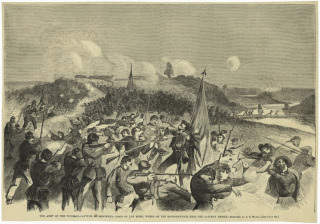
Sedgwick continues shelling the Confederates throughout the late afternoon, but otherwise he shows no disposition to attack. As the day draws to a close, Lee becomes convinced that the movement against the bridgehead is merely a feint to cover French’s crossing farther downstream. He is mistaken. At dusk the shelling stops, and Sedgwick’s infantry rushes suddenly upon the works. Col. Peter Ellmaker’s brigade advances adjacent to the railroad, precedes by skirmishers of the 6th Maine Volunteer Infantry. At the command “Forward, double-quick!” they surge over the Confederate works and engage Hays’s men in hand-to-hand combat. Without assistance, the 6th Maine breaches the Confederate line and plants its flags on the parapet of the easternmost redoubt. Moments later the 5th Wisconsin Infantry Regiment swarms over the walls of the western redoubt, likewise, wresting it from Confederate control.

On the right, Union forces achieve comparable success. Just minutes after Ellmaker’s brigade penetrates Hays’s line, Col. Emory Upton‘s brigade overruns Godwin’s position. Upton reforms his lines inside the Confederate works and sends a portion of the 121st New York Volunteer Infantry to seize the pontoon bridge, while the rest of his command wheels right to attack the confused Confederate horde now massed at the lower end of the bridgehead.

Confederate resistance dissolves as hundreds of soldiers throw down their arms and surrender. Others seek to gain the opposite shore by swimming the icy river or by running the gauntlet of Union rifle fire at the bridge. Confederate troops south of the Rappahannock look on hopelessly as Union soldiers herd their comrades to the rear as prisoners of war.

In all, 1,670 Confederates are killed, wounded, or captured in the brief struggle, more than eighty percent of those engaged. Union casualty figures, by contrast, are small: 419 in all. The battle is as humiliating for the South as it is glorious for the North. Two of the Confederacy’s finest brigades, sheltered behind entrenchments and well supported by artillery, are routed and captured by an enemy force of equal size.

The Civil War Trust and its partners have acquired and preserved 856 acres of the battlefield where the First and Second Battles of Rappahannock Station were fought. The battleground for both battles is located along the Rappahannock River at Remington, VA and features visible earthworks as well as bridge and mill ruins. The earthworks at Remington are no longer there and more than 75% of the battlefield has been developed over.