seamus dubhghaill

Promoting Irish Culture and History from Little Rock, Arkansas, USA


Leave a comment

The Woolwich Pub Bombing

The Woolwich pub bombing is an attack by the Provisional Irish Republican Army (IRA) on the Kings Arms, a public house in Woolwich in southeast London, on November 7, 1974. Two people are killed in the explosion.

Standing at 1 Frances Street to the south of Woolwich Dockyard and the Royal Marine Barracks, and northwest of the Royal Artillery Barracks, the Kings Arms was built in the 19th century. In the 1881 census it is listed as the Kings Arms Hotel.

The pub is attacked by the Provisional Irish Republican Army on November 7, 1974, and two people are killed: Gunner Richard Dunne (aged 42), of the Royal Artillery (whose barracks are just 100 yards away), and Alan Horsley (aged 20), a sales clerk. A further 35 people, including the landlady, Margaret Nash, are injured. Echoing similar attacks in Guildford the previous month, a bomb, made of 6 lbs. of gelignite plus shrapnel, is thrown through a window into the pub.

Initially a left-wing extremist group called Red Flag 74 says it had placed the bomb, but responsibility is subsequently claimed by the Provisional Irish Republican Army and specifically by part of the Active Service Unit apprehended in December 1975 at the Balcombe Street siege. Two of the Guildford Four are wrongfully charged in December 1974 with involvement in the Woolwich pub bombing, and their convictions in October 1975 are eventually quashed in 1989 after a long campaign for justice.

The bombing is most likely the work of the Balcombe Street ASU, which claims sole responsibility during the 1977 trial of four members apprehended at the siege and include Joe O’Connell, who states from the dock: 

“We have instructed our lawyers to draw the attention of the court to the fact that four totally innocent people – Carole Richardson, Gerry Conlon, Paul Hill and Paddy Armstrong – are serving massive sentences for three bombings, two in Guildford and one in Woolwich, which three of us and another man now imprisoned, have admitted that we did.”

The other three members apprehended at the siege are Hugh DohertyEddie Butler and Harry DugganLiam Quinn (a US-born member) and Brendan Dowd are also active within the unit. Sentenced to life imprisonment, the “Balcombe Street four” serve 23 years in English prisons until transferred to Portlaoise PrisonCounty Laois, in early 1998. They are then released in 1999 under the terms of the Good Friday Agreement.

Neither the Woolwich bombing nor the wrongful imprisonments result in further charges or convictions. Three British police officers—Thomas Style, John Donaldson and Vernon Attwell—are charged in 1993 with conspiracy to pervert the course of justice, but each is found not guilty.

In continuation of a “troubles” overseas offensive, the Royal Artillery Barracks in Woolwich are bombed by the IRA in December 1983.

On April 17, 2018, P2P Residential Limited obtains full planning permission to demolish the pub and redevelop it as 19 residential units, nine parking spaces and a replacement pub across the ground floor and basement.

Similar plans had been proposed in 2013. Permission was granted in 2015 for 12 residential units and a pub, but the then owner did not implement the consent. The pub is demolished for redevelopment in 2020. Following a 2022 planning application, a Tesco Express supermarket is opened on the ground floor of the building.

Leave a comment

Harrods Bombing

harrods-bombing

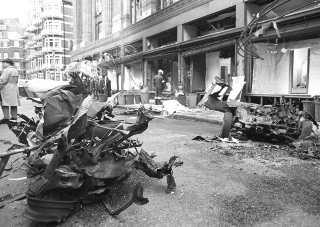
A Provisional Irish Republican Army (PIRA) car bomb kills six and injures ninety outside London‘s Harrods department store, a large, upmarket department store in the affluent Knightsbridge district near Buckingham Palace on December 17, 1983. The IRA Army Council claims that it has not authorised the attack and expresses regret for the civilian casualties. After the bombing, the IRA changes its tactic to focus on military targets on the mainland.

Harrods had been the target of an earlier IRA bomb on December 21, 1974, which was placed in the northeast corner of the first floor. There was a very short warning, and the store was in the process of being cleared when it exploded. It was also the target of a much smaller IRA bomb almost ten years later, in January 1993, which injured four people.

From 1973 the Provisional IRA has carried out waves of bombing attacks on commercial targets in London and elsewhere in England as part of its “economic war.” The goal is to damage the economy and cause disruption, which would put pressure on the British government to withdraw from Northern Ireland. On December 10, 1983, the IRA carries out its first attack in London in some time when a bomb explodes at the Royal Artillery Barracks, injuring three British soldiers.

One week later, on the afternoon of December 17, IRA members park a car bomb near the side entrance of Harrods, on Hans Crescent. The bomb contains 25 to 30 lbs. of explosives and is set to be detonated by a timer. It is left in a 1972 blue Austin 1300 GT four-door sedan. At 12:44 PM a man using an IRA codeword phones the central London branch of the Samaritans charity. The caller says there is a car bomb outside Harrods and another bomb inside Harrods and gives the car’s registration plate. According to police, he does not give any other description of the car.

The bomb explodes at about 1:21 PM, as four police officers in a car, an officer on foot and a police dog-handler near the suspect vehicle. Three officers and three bystanders are killed, and 90 others are injured, including 14 police officers. The blast damages 24 cars and all five floors on the side of Harrods, sending a shower of glass down onto the street. The police car absorbs much of the blast and this likely prevents further casualties.

Five people die at the scene of the bombing and a sixth later dies in the hospital. The bystanders who die are Philip Geddes (24), a journalist who had heard about the alert and went to the scene, Jasmine Cochrane-Patrick (25) and Kenneth Salvesen (28), a United States citizen. The Metropolitan Police Service officers killed are Sergeant Noel Lane (28) and Constable Jane Arbuthnot (22). A third officer, Inspector Stephen Dodd (34), dies in the hospital from his injuries on December 24. Constable Jon Gordon survives but loses both legs and part of a hand in the blast.

At the time of the explosion, a second warning call is made by the IRA. The caller says that a bomb has been left in the C&A department store at the east end of Oxford Street. Police clear the area and cordon it off, but this claim is found to be false. In the aftermath of the attack, hundreds of extra police and mobile bomb squads are drafted into London. Aleck Craddock, chairman of Harrods, reports that £1 million in turnover has been lost as a result of the bombing. Despite the damage, Harrods re-opens three days later, proclaiming it will not be “defeated by acts of terrorism.” Denis Thatcher, the husband of British Prime Minister Margaret Thatcher, visits the store and tells reporters “no damned Irishman is going to stop me going there.”