seamus dubhghaill

Promoting Irish Culture and History from Little Rock, Arkansas, USA


Leave a comment

Birth of Mary Irvine, First Female President of the High Court

Mary Irvine, Irish judge who is the President of the Irish High Court between 2020 and 2022, is born on December 10, 1956, in Clontarf, Dublin. She first practiced as a barrister. She is a judge of the High Court between 2007 and 2014, a judge of the Court of Appeal from 2014 to 2019 and serves as a judge of the Supreme Court of Ireland from May 2019 until becoming President of the High Court on June 18, 2020. In addition to being the first woman to hold that position, she is the first judge to have held four judicial offices. She is an ex officio member of the Supreme Court and the Court of Appeal.

Irvine is born to John and Cecily Irvine, her father once being deputy director of RTÉ. She is educated at Mount Anville Secondary School, University College Dublin (UCD) and the King’s Inns. She is an international golf player, winning the Irish Girls Close Championship in 1975.

Irvine is called to the Bar in 1978 and becomes a Senior Counsel in 1996. She is the secretary of the Bar Council of Ireland in 1992. She is elected a Bencher of the King’s Inns in 2004.

Irvine specialises in medical law, appearing in medical negligence cases on behalf of and against health boards in actions. She is a legal advisor to an inquiry into deposit interest retention tax (DIRT) conducted by the Public Accounts Committee, along with future judicial colleagues Frank Clarke and Paul Gilligan. She represents the Congregation of Christian Brothers at the Commission to Inquire into Child Abuse.

Irvine’s practice also extends to constitutional law. As a junior counsel, she represents the plaintiff in Cahill v. Sutton in 1980 in the Supreme Court with seniors Niall McCarthy and James O’Driscoll. The case establishes the modern Irish law of standing for applicants to challenge the constitutional validity of statutes. She appears with Peter Kelly to argue on behalf the right of the unborn in a reference made by President of Ireland Mary Robinson under Article 26 of the Constitution to the Supreme Court in 1995 regarding the Information (Termination of Pregnancies) Bill 1995.

Irvine is appointed as a Judge of the High Court in June 2007. She is in charge of the High Court Personal Injuries list from 2009 to 2014 and subsequently becomes the second Chair of the Working Group on Medical Negligence and Periodic Payments, established by the President of the High Court.

Irvine is appointed to Court of Appeal on its establishment in October 2014. Some of her judgments on the Court of Appeal reduce awards given by lower courts for personal injuries compensation. She writes “most of the key” Court of Appeal judgments between 2015 and 2017 which have the effect of reducing awards arising from subsequent actions in the High Court.

Irvine is appointed to chair a statutory tribunal to conduct hearings and deal with cases related to the CervicalCheck cancer scandal in 2019. However, following her appointment as President of the High Court in 2020, she is unable to continue with the position.

On April 4, 2019, Irvine is nominated by the Government of Ireland as a Judge of the Supreme Court. She is appointed by the President of Ireland, Michael D. Higgins, on May 13, 2019. She writes decisions for the court in appeals involving planning law, the law of tort, intellectual property law, judicial review, and chancery law.

Irvine is appointed by Chief Justice Frank Clarke in 2019 to chair the Personal Injuries Guidelines Committee of the Judicial Council. The purpose of the committee is to review the levels of compensation issues in court cases arising out of personal injuries. Minister of State at the Department of Finance Michael W. D’Arcy writes a letter to congratulate her on her appointment and outlines his views that personal injuries awards in Ireland should be “recalibrated.” She responds to the letter by saying it is the not the committee’s duty to tailor its findings “in a manner favourable to any particular interest group.”

Following a cabinet meeting on June 12, 2020, it is announced that Irvine will be nominated to succeed Peter Kelly as President of the High Court. A three-person panel consisting of the Chief Justice Frank Clarke (later substituted by George Birmingham), the Attorney General Séamus Woulfe and a management consultant, Jane Williams, reviews applications for the position, before making recommendations to cabinet. The President of the Law Society of Ireland welcomes her appointment, describing her as an “outstandingly able judge.” She is the first woman to hold the role. As she is previously an ordinary judge of three courts, her appointment as President of the High Court makes her the first person to have held four judicial offices. She is appointed on June 18, 2020, and makes her judicial declaration on June 19.

Irvine takes over as president in the midst of the COVID-19 pandemic in the Republic of Ireland. She issues guidelines for lawyers to negotiate personal injuries cases outside of court due to the backlog formed by delays in hearings. She issues a practice direction in July 2020 that face coverings are to be worn at High Court hearings. She criticises barristers and solicitors in October 2020 for not wearing masks in the Four Courts.

In Irvine’s first week as president, she presides over a three-judge division of the High Court in a case taken by a number of members of Seanad Éireann. The plaintiffs seek a declaration that the Seanad should sit even though the nominated members of Seanad Éireann have not been appointed. The court refuses the relief and finds for the State. In 2021, she also presides over a three-judge division on a Seanad Éireann voting rights case, where the plaintiff argues for the extension of voting rights to graduates of all third-level educational institutions and the wider population. The court finds against the plaintiff.

Irvine continues to sit in the Supreme Court following her appointment.

In April 2022, Irvine announces her intention to retire in July 2022. She retires on July 13, 2022, and is succeeded by David Barniville.

Irvine is formerly married to retired judge Michael Moriarty, with whom she has three children. Her only known son, Mark Moriarty, dies suddenly on August 19,2022.

(Pictured: Justice Mary Irvine with the President of Ireland, Michael D. Higgins, on her appointment on the Supreme Court in 2019)

Leave a comment

Birth of Susan Denham, First Female Chief Justice of Ireland

Susan Jane Denham, SC (née Gageby), Irish judge who is the first woman to hold the position of Chief Justice of Ireland (2011-17), is born in Dublin on August 22, 1945. She serves as a Judge of the Supreme Court of Ireland (1992-2017) and is the longest-serving member of the court on her retirement. She also serves as a Judge of the High Court (1991-92).

Gageby is the daughter of the former editor of The Irish Times, Douglas Gageby, the sister of another barrister, Patrick Gageby, and maternal granddaughter of Seán Lester. She is from a Church of Ireland background. She is educated at Alexandra College, Dublin, and attends Trinity College Dublin, the King’s Inns, and the Law School of Columbia University, New York City (LL.M. 1972). She is involved with the Free Legal Advice Centres while studying in Dublin and is a founder and president of the Archaeology and Folklife Society at Trinity College.

Gageby is called to the bar in July 1971 and becomes a Senior Counsel in October 1987. She is the fourth woman to enter the Inner Bar. She becomes a senior counsel on the same day as future Supreme Court colleague Mary Laffoy. She works on the Midland circuit until 1979, following which she is based in Dublin. She is involved in a number of leading cases while a junior barrister and a Senior Counsel particularly in the area of judicial review. She becomes a High Court judge in 1991.

Gageby marries paediatrician Dr. Brian Denham in 1992. Also in 1992, at the age of 47, Denham is the first woman appointed to the Supreme Court. She is considered for appointment to the role of President of the High Court in 1994 but declines to have her name put forward. She makes two dissents early on in her period on the Court. Throughout her tenure as a judge, she is seen by commentators to be a “liberal” judge.

In Kelly v Hennessy in 1996, Denham outlines criteria for a court to consider the evidence of the existence of nervous shock in Ireland. In 2001, she is the sole member of the Supreme Court to dissent in TD v Minister for Education. The court overturns a decision of Peter Kelly in the High Court to direct the government to build secure care units for certain children.

From 1995 to 1998, Denham chairs the Working Group on a Courts Commission, which is responsible for a significant reform of the organisation of the courts since the foundation of the state. It leads to the establishment of the Courts Service. She is on the Interim Board of the Court Service and serves on the Board of the Court Service from its inception and chairs the board from 2001 to 2004. She chairs the Committee on Court Practice and Procedure which recommends in 2002 the establishment of a commercial court within the High Court.

From 2006, Denham chairs the Working Group on a Court of Appeal. The report of the group is published by the government in August 2009 and recommends the establishment of a general Court of Appeal. This is ultimately established in 2014, after a referendum in 2013.

Denham is part of the Irish delegation which, with the Netherlands and Belgium, establishes the European Network of Councils for the Judiciary (ENCJ) and she continues an involvement in this Network. From January 1, 2015, to December 31, 2016, she is President of the Network of the Presidents of the Supreme Judicial Courts of the European Union which is an association of Supreme Court Presidents and Chief Justices of EU Member States.

Denham writes the judgment in McD v. L (2009), upholding the parental rights of a sperm donor.

On July 4, 2011, Denham is nominated by Taoiseach Enda Kenny to become Chief Justice of Ireland and is appointed as Chief Justice by President Mary McAleese on July 25, 2011. She is the first woman appointed to the office and as a member of the Church of Ireland, she is the first non-Catholic to hold the position. She is also the first graduate of Trinity College Dublin to have been appointed as Chief Justices have largely been graduates of University College Dublin. She succeeds John L. Murray.

During Denham’s tenure as Chief Justice, the Supreme Court issues suspended declarations of unconstitutionality for the first time. The possibility to delay the effect of a court declaration that a piece of legislation is contrary to the Constitution is first explored by Denham in A v Governor of Arbour Hill Prison. The court first adopts this approach in N.V.H. v Minister for Justice & Equality in May 2017.

As Chief Justice, Denham oversees changes in the operations of the Supreme Court and the courts generally. She oversees the removal of the requirement for judges to wear wigs while hearing cases. In 2015, the Supreme Court sits outside Dublin for the first time since 1931, sitting in Cork. She corresponds with the Office of Public Works over the lack of heating in the Four Courts, threatening to cancel sittings if the issue is not resolved. She advocates for the inclusion of a new courtroom for the Supreme Court in plans to develop a new family court complex on Hammond Lane.

In her capacity as Chief Justice, Denham oversees the administration of the Presidential Declaration of Office at the inauguration of President Michael D. Higgins in Dublin Castle in November 2011.

Denham retires from the position in July 2017 and is succeeded by Judge Frank Clarke. She is the third-longest serving Supreme Court judge ever at the time of her retirement. In her remarks on her retirement, she draws attention to the government’s failure to institute a judicial council, having first attempted to persuade the government to establish one in 1997.

In 2019, Denham is made an honorary fellow of Trinity College Dublin, where she was a Pro-Chancellor from 1996-2010.

The Courts Service announces on August 24, 2020, that the Supreme Court has appointed Denham to review the attendance of Supreme Court judge Séamus Woulfe at a dinner organised by the Oireachtas Golf Society. She is appointed on a non-statutory basis as the relevant section in the Judicial Council Act 2019 on judicial conduct has not yet been commenced.


Leave a comment

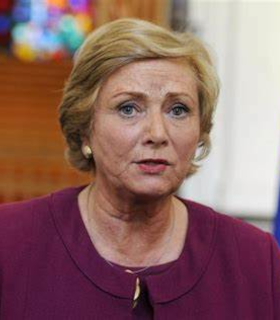
Resignation of Tánaiste Frances Fitzgerald

Tánaiste Frances Fitzgerald resigns from Government in the “national interest” on November 28, 2017, hours ahead of a no-confidence motion in the Dáil threatens to bring down the Government.

Fitzgerald tells a Cabinet meeting she will be “vindicated” by the Disclosures Tribunal led by Justice Peter Charleton, which is examining allegations of the smear campaign against Garda whistleblower Sgt. Maurice McCabe.

The Tánaiste tells her colleagues she believes she has done nothing wrong but is resigning to avoid “an unwelcome and potentially destabilising general election.” In a statement, she says, “It has been the greatest honour of my life to serve in Government, but I believe it is necessary to take this decision to avoid an unwelcome and potentially destabilising general election at this historically critical time.”

The Tánaiste says she has always sought to act with integrity and responsibility and is now seeking to place “the national interest ahead of my own personal reputation.” She adds, “I decided that my continuation in office risks destabilising that good work, and so I have decided to step down so that this work may continue, and the country can be spared an unnecessary election. It will also allow me to vindicate my good name at the Charleton tribunal, without causing any further distraction to the work of the government. I have always believed in due process, and I believe that in the current situation that is becoming increasingly difficult for me. I acted correctly in difficult circumstances and, in fact, did everything that I could to support the search for truth and protect whistleblowers.”

Earlier in the day, Attorney General Séamus Woulfe gives a presentation to the Cabinet insisting it would be “inappropriate and improper” for Fitzgerald to have intervened when she received the emails in 2015.

Taoiseach Leo Varadkar accepts Fitzgerald’s resignation at the end of the Cabinet meeting and telephones Fianna Fáil leader Micheál Martin to advise him of the development. In a statement in the Dáil, Varadkar says she is leaving office without getting a full and fair hearing, but the work of Government must not be interrupted. It is my strong view that a good woman is leaving office without getting a full and fair hearing. Frances has been an exemplary member of Government and a loyal colleague.”

Varadkar announces that he is launching an external inquiry into how the “dysfunctional” Department of Justice responded to the emails about Sgt. McCabe. He also has to appoint a new Tánaiste and a new Minister for Business, Enterprise and Innovation.

Varadkar also announces that Minister for Justice Charles Flanagan is to make a Dáil statement on the controversies surrounding his department. He tells the Dáil that Flanagan will apologise for his department’s failure to answer questions fully in recent weeks and will offer further assurance that questions not answered yet would be answered.

In the evening, Secretary General of the Department of Justice Noel Waters confirms his departure from his position. He is due to resign in February 2018 but confirms he will leave the role immediately. This is a decision he has made on his own, he adds.

Meanwhile, Fine Gael sources say the resignation of Fitzgerald has handed the Fianna Fáil leader a “significant win” and has damaged the Taoiseach. Speaking at his frontbench meeting after the resignation is confirmed, Martin thanks his party for their patience over a difficult few days. He says the focus now needs to be on Brexit and supporting the Government’s stance during the talks scheduled for mid-December.

Fitzgerald had been under intense political pressure in recent days over the handling of the case of Garda whistleblower Sgt McCabe. However, even if the immediate threat of an election has been removed, the crisis has significantly weakened the Government and damaged trust between Fine Gael and Fianna Fáil, which supports the minority Government with a confidence-and-supply arrangement.

Fitzgerald has insisted she was unaware of a legal strategy by former Garda commissioner Nóirín O’Sullivan in 2015 to question the integrity and credibility of Sgt. McCabe at the O’Higgins commission, which was examining allegations of Garda malpractice.

Fianna Fáil and Sinn Féin have been seeking the Tánaiste’s resignation, and both table motions of no confidence in her, the first of which is due to have been heard at 8:00 PM that evening.

During the crisis Varadkar stands by Fitzgerald and offers her his full support. However, Fine Gael Teachtaí Dála (TD) and Ministers question Varadkar’s confidence in Fitzgerald in recent days as more details emerge. Fine Gael Ministers react with fury on November 27 when it emerges that Fitzgerald had received three emails on two separate dates notifying her of the legal strategy pursued by O’Sullivan against Sgt. McCabe.

The Department of Justice emails show Fitzgerald was repeatedly told in 2015 about an “aggressive” approach to undermine Sgt. McCabe at the O’Higgins commission. In two separate emails on July 4, 2015, she is advised of media queries about the “aggressive” approach being adopted by former Garda commissioner O’Sullivan and advises how to respond if the media asks her about the matter. It is a senior Department of Justice official who describes the approach as “aggressive.”

The emails reveal that a senior official suggested to Fitzgerald that she should say that it would be “very unfair to Sgt. McCabe” if she was to respond to queries about the commission. This release of emails about the controversy undermines efforts to defuse the row between Fine Gael and Fianna Fáil over Fitzgerald’s position.

Earlier in the day, Independent Alliance members of Cabinet say they will seek “political accountability” from Fitzgerald. There had been no appetite from within Fine Gael for a general election on the matter, as they fear they will face an intense backlash from voters.

(From: “Frances Fitzgerald resigns in ‘national interest’ to avoid an election” by Sarah Bardon, The Irish Times, http://www.irishtimes.com, November 28, 2017)