
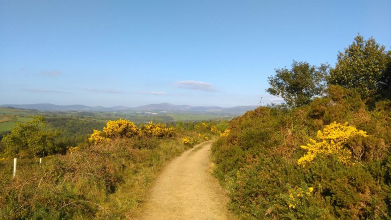
The Battle of Deputy’s Pass is fought in County Wicklow on May 29, 1599, during the Nine Years’ War in Ireland. A Gaelic Irish force under Felim McFiach O’Byrne ambushes an English army of about 500, under Sir Henry Harington, which is marching from Rathdrum to Wicklow. The English army is routed and loses about 250 men.
The O’Byrnes had been allied to Hugh O’Neill, Earl of Tyrone, since the outbreak of the Nine Years’ War in 1593. Fiach McHugh O’Byrne had worked together with O’Neill, so much that he is described as the earl’s “right arm in Leinster.” However, when Fiach is killed in 1597, the power of the O’Byrnes seems to wane. When Robert Devereux, 2nd Earl of Essex, is appointed Lord Lieutenant of Ireland in 1599, he orders Harrington into County Wicklow to deal with the O’Byrnes and their allies, the O’Tooles.
Harrington’s force consists of five foot companies, but four of them are inexperienced levies recently raised in England. The only experienced foot company is that of Captain Loftus, whose men are mostly Irish. The companies are organised into a regiment under the command of Sir Alexander Radcliffe. To this is added fifty horsemen commanded by Captain Charles Montague. Harrington wants to take his troops out to scout the Irish fortifications on the ford of the Avonmore River at Rathdrum, and possibly to give his raw troops some experience in fieldcraft. His first attempt to view the Irish position on May 28 fails. Harrington returns to his camp about a mile from the ford. A second effort to view the Irish fortifications is made on May 28, but this is turned back due to poor weather. Harrington orders the men to march back to Wicklow town.
The English army stretches out in a column. In the lead is the van, then the baggage, followed by the battle and then the rear. Captain Atherton, the Sergeant Major of the army, has little doubt that the weight of any Irish attack will fall on the rear of the column. Thus, the horse (cavalry) is placed at the rear. The army has marched little over a mile before the Irish shot (musketeers and caliver-men) begin skirmishing with the rear of Harrington’s force. The Irish try to take a ford to block the advance, but the English secure the crossing, with the shot of the English rear skirmishing with the Irish, allowing the rest of the army to pass unhindered.
The march continues two miles to another ford, with the rear continuing to hold O’Byrne’s Irish shot at bay. Again, the English shot secures the crossing, as Irish fire slackens, possibly due to a shortage of gunpowder. Harrington places 40–50 shot behind an earthen bank on the left flank of the column on the far side of the ford. The Irish bring up a stand of pikemen, but their attack is limited to the English left, as the right of the column is shielded by thick gorse bushes. Atherton gathers 60–80 men to counter-attack the Irish pike. The English shot behind the bank is to hold their fire until Atherton attacks, but instead prematurely fires a single volley at the Irish pike then abandons their position. Without the support from their shot, Atherton’s men refuse to charge the Irish, then withdraw to the main body of the English column.
Atherton finds that the English shot have fled the column, abandoning the main stand of English pike. Now exposed to Irish gunfire, the English pike become disordered as they press to make the river crossing. Exploiting the English confusion, the Irish pike charges into the English rear, killing many without resistance. Montague’s English cavalry charges to support the panicking infantry, but the Irish pike square opens, allowing the horse to pass through. The Irish pike spear the English horse as they pass, including Montague who is wounded by a pike thrust into his side. Despite their officer’s best efforts, the English soldiers’ resistance collapses. The rout continues with the Irish slaughtering Harrington’s men to within one and a half miles of Wicklow town. All the English companies lose their colours, except for Captain Loftus, but they are later recovered by the English horse. After the battle, Radcliffe estimates the English army has lost 250 men killed, missing or deserted.
The first English reports suggest that they lost the battle due to the inexperience of most of their troops. Harrington at first blames the English pikemen for refusing to fight, but at the court-martial in July, Harrington, supported by two of his officers (Captains Linley and Mallory) blames Captain Loftus and his Lieutenant Walsh. This is convenient, as Loftus had died from his wounds and could not refute their accusations. Their version is supported by a map drawn of the battle, possibly by Montague (Harrington’s nephew). Loftus and Walsh are found guilty by the court-martial. Loftus is already dead, but Walsh is executed by firing squad. Mallory and Linley are not found guilty, but they are cashiered, losing command of their foot companies. The men in Loftus’ company are sentenced to death but this is commuted to decimation by drawing lots. Even by Elizabethan standards this is deemed overly harsh. Though Harrington is not charged with misconduct, he is never given command of a force this size again.

 seamus dubhghaill