
The Sheemore ambush is an ambush carried out by the Irish Republican Army (IRA) on March 4, 1921, during the Irish War of Independence. It takes place at Sheemore near Carrick-on-Shannon, County Leitrim.
The ambush is carried out by the IRA’s South Leitrim Brigade on a British Army and Auxiliary Division convoy. The British force suffers casualties and admits one fatality, a captain in the Bedfordshire and Hertfordshire Regiment, although some local sources claim several more are killed.
On Friday morning, March 4, 1921, as the congregation makes their way out of the ‘First Friday Mass’ in the Roman Catholic parish church in Gowel, they are met by three lorries carrying 30–40 Auxiliaries, Royal Irish Constabulary (RIC), and British Army members. The men are lined up for searching on one side while a ‘female searcher’ attends to the women. There is no panic and as nothing is found and there are no arrests. The church had been identified as a likely place for volunteers of the IRA’s South Leitrim Brigade to attend. Father Edward O’Reilly, the church’s curate, is openly friendly towards the volunteers. After they search the church interior, the police and soldiers remount their lorries and continue back to Carrick-on-Shannon.
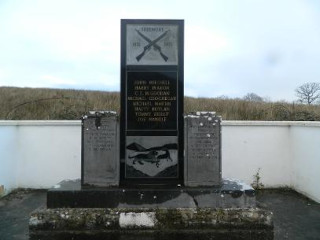
About 2 kilometres down the road, on the slopes of Sheemore, volunteers of the South Leitrim Brigade await them. The day before, the Brigade had received word from Joe Nangle from Drumshanbo of the British operation. They take up position behind a low wall which runs on the brink of an eighty-foot-high rock face on the side of Sheemore. It is four hundred yards from the road. There are seven volunteers – Brigadier Seán Mitchel (who was in command), Charles E. McGoohan (from Ballinamore), Michael Geoghegan (from Aughacashel), Mattie Boylan (from Carrick-on-Shannon), Michael Martin (from Ballinamore), Joe Nangle and Harry McKeon.
At the command from Mitchell, the IRA opens fire on the convoy. The members of the convoy jump from their lorries, and take cover behind a wall which runs along the road. The police run despite the shouts from the soldiers to stand their ground. The officer in command tries to use field glasses to spot the positions of the IRA. After a forty-five-minute gunfight the IRA withdraws, and the British make no attempt to follow them. Instead they gather up their casualties and return to Carrick-on-Shannon, where Black and Tans later undertake reprisals, burning and looting, and burn both the premises of the Leitrim Observer newspaper and the local rowing club to the ground. They also burn the Temperance Hall in Gowel.
Nurse Alice Grey (or Gray), the ‘female searcher,’ who is a member of the ambushed convoy, is recognised by the British authorities for her role in the incident.
Contemporary newspaper reports indicate that one officer and four men of the Bedfordshire Regiment were wounded, as were two members of the RIC. The British officer died the following day, and some people reportedly left the area for fear of reprisals.
(Pictured: Monument in memory of the Volunteers who took part in the Sheemore Ambush)
 seamus dubhghaill