seamus dubhghaill

Promoting Irish Culture and History from Little Rock, Arkansas, USA


Leave a comment

The Siege of Cork

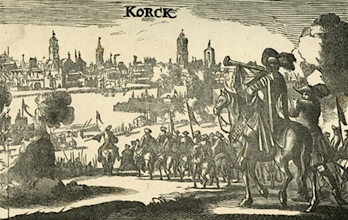
The siege of Cork begins on September 21, 1690, during the Williamite War in Ireland. It happens shortly after the Battle of the Boyne during James II’s attempt to retake the English throne from King William III. In a combined land and sea operation, the Williamite commander, John Churchill, takes the city and captures 5,000 Jacobites.

After the Battle of the Boyne, William occupies Dublin and the Jacobites retreat to the west of Ireland. William assaults and besieges Limerick in August 1690 but is repulsed. To secure the Jacobite-held ports of Cork and Kinsale on the southern coast, he dispatches a force under John Churchill, then 1st Earl of Marlborough.

Marlborough reaches Cork by sea on September 21, 1690. His English forces are 5,000 strong and he also has at his disposal a fleet which blockades the port of Cork. He captures several of the harbour’s defences, including Fort Camden, and lands troops at Passage West on September 24, before setting up his base at Red Abbey, to the south of the walled city. Approaching from the northern, landward side are 4,000 Danish troops under the Ferdinand Willem, Duke of Württemberg-Neuenstadt.

The Williamites take the forts, such as Elizabeth Fort, which command the hills around Cork and commences a bombardment of the city from the heights. When a breach is opened in the city walls, the city’s garrison opens surrender negotiations, asking to be allowed to leave Cork and join the main Jacobite army at Limerick. Marlborough refuses the request, although Württemberg is in favour of granting the terms.

A few days later, the Williamites mount a joint English-Danish assault of the breach from the south. Henry FitzRoy, 1st Duke of Grafton, is reputedly mortally wounded while leading this assault. After the Williamites reach the walls, the Governor of CorkRoger McElligott, opens new surrender talks and agrees that the garrison will become prisoners and will surrender their arms and stores. Marlborough accepts and the city surrenders.

In spite of this, the Williamite troops sack the city, do a great deal of damage, looting much property and abusing the Catholic inhabitants. Many civilians are killed before Württemberg and Marlborough restore order.

It remains for the Williamites to take nearby Kinsale, which is strongly defended by two forts, the Old Fort, also known as James’s Fort, and the New Fort or Charles Fort. Marlborough assaults these fortifications but is unable to take them by storm. The Old Fort, defended by the Governor Colonel Cornelius O’Driscoll, falls after an assault is made possible by an accidental explosion in its gunpowder magazine, which kills forty. After some 200 are slain in the following assault, including Colonel O’Driscoll, the rest surrender, receiving quarter. Charles Fort, however, holds out for ten days and surrenders only after receiving guarantees that its 1,200-strong garrison can march away to Limerick. It is defended by the elderly and experienced Governor Sir Edward Scott, and his Deputy Governor Colonel Donal IV O’Donovan.

Leave a comment

The Capture of Bandon

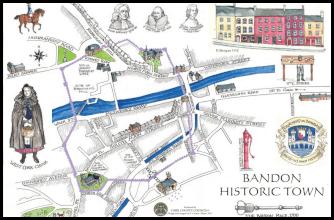
The Capture of Bandon begins on February 23, 1689, when the town of Bandon, County Cork, is forcibly seized from its rebellious Protestant inhabitants by force of Irish Army troops under Justin McCarthy. The skirmishing at the town takes place during the early stages of the Williamite War in Ireland. The Jacobite success at Bandon helps suppress any chance of a general Munster uprising against the rule of James II similar to that which occurs in Ulster the same year. The slogan “No Surrender!” is believed to have been first used at Bandon and subsequently taken up, more famously, by the defenders at the Siege of Derry later in the year.

In 1685, the Catholic James II comes to the throne. This leads to a sharp reversal of government policy in Ireland, which had previously favoured the Protestant inhabitants. This is quickly changed by James’ representative Richard Talbot, 1st Earl of Tyrconnell. Under Talbot’s administration, the army and civil government are mostly purged of Protestants, who are replaced by Catholics. In Bandon, the previous town burgesses are replaced by Catholic nominees.

Talbot’s actions lead to a growing hostility amongst the Protestant inhabitants across the island toward the King and his Irish government. Bandon is a historic centre of Protestants, dating back to the Plantation of Munster in the Elizabethan era and is a natural focus of dissent against James’s rule. In 1688, a similar opposition in England leads to the Glorious Revolution, in which William III successfully invades with a Dutch Army. Many Protestants now believe William to be their rightful King while Catholics, and some Protestants, remain loyal to James. During the growing turmoil, many rural County Cork Protestants come to shelter in Bandon.

Fearing a potential outbreak of rebellion in Bandon will occur, the government sends a detachment of the Irish Army under Captain Daniel O’Neill to take the town. They reportedly enter on a Sunday morning while the inhabitants are attending church services. The following day, February 24, sometimes referred to as “Black Monday,” the townspeople rise and attack the soldiers. Various sources say between three and eight of the redcoats are killed and the remainder are driven out of the town. Using their captured weapons, the Protestants then make an effort to prepare Bandon to withstand an assault.

Having received word about the growing rebellion in the county, Talbot in Dublin has already dispatched six companies of infantry under Justin McCarthy, an experienced Irish Catholic soldier. Instead of immediately assaulting Bandon, McCarthy first seizes nearby Cork, another major centre of Protestants in the south of the country and clamps down on other potential dissidents. He then proceeds to Bandon with his troops, plus some cavalry and artillery. Although they had previously hung out a banner proclaiming “No Surrender,” the defenders negotiate a surrender in exchange for generous conditions. Despite the usual punishment for rebellion being death, the town corporation is fined £1,000 and the walls are ordered to be demolished.

The comparatively light terms imposed on the town are part of a wider attempt by King James to convince Protestants of his goodwill toward them. It angers more hardline Catholics, including McCarthy’s nephew, Donough MacCarthy, 4th Earl of Clancarty, who wants a harsher punishment for the rebels.

The fighting at Bandon is part of a succession of defeats of locally raised Protestant troops both across Munster (at Castlemartyr) and Ireland as a whole, with the Ulster-raised Army of the North suffering heavy defeats at the Break of Dromore and the Battle of Cladyford. The advance of the mainly Catholic Jacobite Army is halted by the successful Protestant defence of Enniskillen and Derry. The arrival of large-scale reinforcements under Frederick Schomberg and King William reverse the tide, and Dublin is captured following the Battle of the Boyne in 1690. The same year, Bandon is re-taken by Protestant forces following John Churchill, 1st Duke of Marlborough‘s successful Siege of Cork. The walls are not rebuilt, as they are becoming increasingly militarily obsolete.