
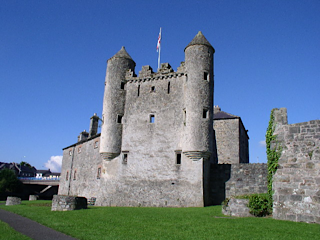
The first siege of Enniskillen takes place at Enniskillen in Fermanagh, present day Northern Ireland, beginning on January 25, 1594, during the Nine Years’ War. In February 1594, the English have captured Enniskillen Castle from the Irish after a waterborne assault and massacre the defenders after they surrender. From May 1594, an Irish army under Hugh Maguire and Cormac MacBaron O’Neill besiege the English garrison in the castle, and in August they defeat an English relief force. A second relief force is allowed to resupply the garrison, but the castle remains cut off. Eventually, in May 1595, the English garrison surrenders to the Irish and are then massacred.
In 1593, Hugh Maguire, Chief of the Name and Lord of Fermanagh, objects to the behaviour of the newly-appointed English Crown sheriff Humphrey Willis. As he had done before being expelled by Hugh Roe O’Donnell from Tyrconnell in 1592, Willis is cattle raiding and plundering throughout Clan Maguire territory. Maguire is not strong enough to resist the sheriff, but after receiving reinforcements from Hugh O’Neill, Earl of Tyrone, Maguire expelled Willis. In May and June 1593, Maguire and Brian Oge O’Rourke of West Breifne raids lands held by the English Lord President of Connaught, Richard Bingham. They destroy the town around Ballymote Castle. This is part of a proxy war waged to distract the Crown while Hugh O’Neill strengthens his position in Ulster. As hoped for, the Crown responds by sending an army under Sir Henry Bagenal and Gaelic leader Hugh O’Neill, Earl of Tyrone (outwardly still loyal to the Crown), who defeats Maguire’s force at the Battle of Belleek in October 1593. However, Maguire’s main force remains unscathed.
Enniskillen Castle sits on the River Erne and commands the strategic bottleneck between Upper and Lower Lough Erne. On January 25, 1594, English Captain John Dowdall arrives at Enniskillen by boat with three infantry companies. They dig trenches in which they place light cannons and musketeers, but the cannons are too small to make much of an impact on the castle walls. On January 30, Captain George Bingham arrives with 300 men.
They launch a waterborne assault on the castle. While musketeers in boats and artillery on land fire at the castle, a large boat holding 67 men anchors at a vulnerable part of the walls. They make a breach in the wall with pickaxes, forcing the Irish to take shelter in the keep. Dowdall threatens to destroy the castle with gunpowder if the garrison does not surrender. An Irish witness claims there are 36 fighting men and 40 women and children in the castle, while Dowdall claims there are 200. After they surrender, Dowdall has them put to the sword and claims to have killed 150. Captain Thomas Lee, who is present, describes this as a great dishonor to the Queen as the defenders had surrendered “uppon composicion, And your majesties worde being past to the poore beggars that kept it, they were all notwithstandinge dishonourably putt to the sworde in a most miserable state.”
Dowdall writes on February 2 to the Lord Deputy of Ireland that he has captured the castle from the “rebel” Hugh Maguire. An English garrison is left in place. A detailed coloured illustration of the siege was made shortly after.
A second siege begins on May 17, 1594. Now acting with the covert support of Hugh O’Neill, Hugh Maguire and Cormac MacBaron O’Neill lay siege to Enniskillen which is now isolated in hostile country. This siege ends on August 30 when Lord Deputy William Russell’s beleaguered garrison withdraws. Following this, there is a truce, but “subterfuge and deception were the hallmarks of this stage of the war.”
A third siege begins when Maguire raises the clan and attacks the castle again in January 1595. In May 1595 the garrison agrees to surrender Enniskillen to the Irish in exchange for their lives. However, the entire garrison is then massacred.
 seamus dubhghaill