
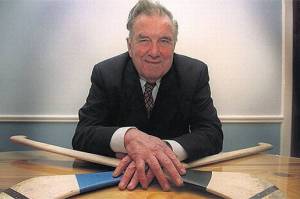
John Doyle, Irish sportsperson and politician, hailed as one of the best defenders in hurling and his county’s most iconic player upon his death, is born in Holycross, County Tipperary, on February 12, 1930.
Doyle first excels at hurling while at school in Thurles CBS. Regarded as too good for CBS Primary School team, he is drafted into the secondary school’s under-15 Croke Cup team in 1942. Doyle plays at wing-forward as Thurles CBS wins the championship that year.
Doyle arrives on the inter-county scene at the age of sixteen when he first links up with the Tipperary minor team. He makes his senior debut in the 1947-48 National League. A 5-6 to 4-2 defeat of Cork in the provincial decider gives him his first Munster medal. Tipperary retains their provincial crown in 1947, with Doyle collecting a second Munster medal following a 2-4 to 1-2 defeat of Waterford. Doyle goes on to play a key role for Tipperary during a hugely successful era for the team, winning eight All-Ireland medals, ten Munster medals, and ten National Hurling League medals.
On June 26, 1949, Doyle makes his senior championship debut in a Munster quarter-final replay against Cork. As a member of the Munster inter-provincial team for fifteen years, Doyle wins six Railway Cup medals. At club level he wins three championship medals with Holycross-Ballycahill.
After surrendering their provincial crown in 1966, Tipperary bounces back the following year, with Doyle winning a record tenth Munster medal following a 4-12 to 2-6 defeat of Clare. On September 3, 1967, Tipperary faces Kilkenny in the All-Ireland decider, a game which presents Doyle win the opportunity of making history by winning a record-breaking ninth All-Ireland medal. Despite leading at halftime 2-6 to 1-3, Kilkenny goalkeeper Ollie Walsh makes a series of spectacular saves in the second half and Kilkenny is victorious 3-8 to 2-7 and lays to rest a bogey that Tipperary has had over the team since 1922. The defeat brings the curtain down on Doyle’s inter-county career.
For almost fifty years Doyle, together with Christy Ring, hold a unique record as the only players to win eight All-Ireland medals on the field of play. This record is subsequently surpassed by Henry Shefflin on September 30, 2012. His record of National League medals has yet to be equalled. Throughout his career, Doyle makes 54 championship appearances, a Tipperary record which stands until August 9, 2009 when it is surpassed by Brendan Cummins.
In retirement from inter-county hurling, Doyle continues to work on his farm in Holycross. In later years he enters politics. He stands unsuccessfully as a Fianna Fáil candidate at the 1969 general election for the Tipperary North constituency, but is subsequently elected to Seanad Éireann on the Agricultural Panel. He serves until 1973 when he loses his seat.
Doyle is widely regarded as one of the greatest hurlers in the history of the game. During his playing days he wins two Cú Chulainn awards, and is named Texaco Hurler of the Year in 1964. He is repeatedly voted onto teams made up of the sport’s greats, including as left corner-back on the Hurling Team of the Century in 1984 and the Hurling Team of the Millennium in 2000.
John Doyle dies on December 29, 2010. Taoiseach Brian Cowen is among those who pay tribute saying “He was an immense hurler and an incredibly decent man, his love of the GAA was matched by his concern for his country and his own community, he was a Tipperary legend and a proud Irishman.” Doyle is buried at Holy Cross Abbey outside Thurles on December 31, 2010.

 seamus dubhghaill