
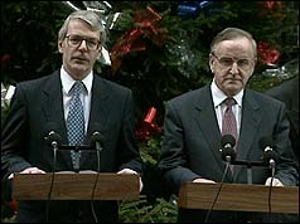
 Taoiseach of the Republic of Ireland, Albert Reynolds, and Prime Minister of the United Kingdom, John Major, sign the Downing Street Declaration (DSD) on December 15, 1993, at the British Prime Minister’s office in 10 Downing Street. The joint declaration stipulates that, if the Irish Republican Army (IRA) stops its campaign for three months, Sinn Féin will be allowed to join all-party talks.
The declaration affirms both the right of the people of Ireland to self-determination, and that Northern Ireland will be transferred to the Republic of Ireland from the United Kingdom only if a majority of its population is in favour of such a move. It also includes, as part of the prospective of the so-called “Irish dimension,” the principle of consent that the people of the island of Ireland, have the exclusive right to solve the issues between North and South by mutual consent.
The latter statement, which later becomes one of the points of the Good Friday Agreement, is key to produce a positive change of attitude by the republicans towards a negotiated settlement. The joint declaration also pledges the governments to seek a peaceful constitutional settlement, and promises that parties linked with paramilitaries, such as Sinn Féin, can take part in the talks, so long as they abandon violence.
The declaration, after a meeting between Sinn Féin President Gerry Adams and American congressman Bruce Morrison, which is followed by a joint statement issued by Adams and John Hume, is considered sufficient by the Provisional Irish Republican Army to announce a ceasefire on August 31, 1994 which is then followed on October 13 by an announcement of a ceasefire from the Combined Loyalist Military Command.
(Pictured: (L to R) John Major, Prime Minister of the United Kingdom, and Albert Reynolds, Taoiseach of the Republic of Ireland)

 seamus dubhghaill