
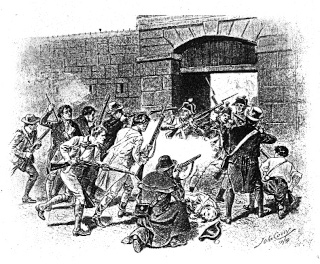
The Hearts of Steel, also known as the Steelboys, an exclusively Protestant movement originating in County Antrim due to grievances about the sharp rise of rent and evictions, is involved in conflict in Ulster on December 23, 1770. Five hundred members of the Hearts of Steel force the release a prisoner in Belfast.
The Hearts of Steel arise in 1769 in opposition to unjust and exorbitant rents, chiefly exacted by middlemen, speculators or “forestallers,” who take lands from absentee landlords at greatly increased rents and make their own profit by doubling the rents on the poor tenants.
In 1770 in Templepatrick, County Antrim, a local landlord evicts tenants and replaces them with speculators who can outbid the locals for the land. At some point a local is arrested and charged with maiming cattle belonging to a merchant from Belfast, which spurs the farmers of Templepatrick to take up arms and march on Belfast to demand his release. The protestors surround the barracks and threaten to burn the house of Waddell Cunningham, who is one of the new speculators in Templepatrick. The soldiers in the barracks fire upon the protestors killing several and wounding others. The protestors eventually set fire to Cunningham’s house and as the fire threatens to spread and destroy the town of Belfast itself, the mayor decides to free the prisoner.
Further consternation is caused by the sharp increase of rents throughout Ulster. At the same time the leases expire for Lord Donegall‘s south County Antrim estate. While he keeps his rent at the old prices, he greatly increases their renewal fee. These coincide with several years of severe harvest failures which result in high bread prices. The result of this is that people are unable to support themselves or their families, being left in the utmost state of deprivation and destitution, with many evicted from their land for failure to pay.
The Hearts of Steel protests and uprisings quickly spread throughout the county and into counties Armagh, Down, and Londonderry, which are also subject to the Hearts of Oak protest movement with which it merges. One tactic of the protestors is the “houghing” of cattle, which involves laming cattle by cutting the leg tendons. They also force farmers to sell food at prices they set, and demand anyone letting out land to do so at the cost of 12 shillings per acre. Landlords are threatened that if they try to collect the cess from anyone that their houses will be destroyed.
The disturbances are so widespread in the affected counties that the Irish government passes legislation to severely punish the “wicked and disorderly persons.” By the later half of 1772 they send the army into Ulster to crush them. Men are hanged while many others are said to have drowned trying to flee across the sea to Scotland. The Lord Lieutenant of Ireland, Lord Townshend, privately blames the landlords and their actions for the disturbances and so issues a general pardon in November 1772.
(Pictured: The Hearts of Steel storming the barracks at Belfast, December 1770 | Linen Hall Library)

 seamus dubhghaill
July 28, 2021 at 6:12 PM
Mr. Doyle – Thank you for your post of Dec 23, 2020 about the Hearts of Steel storming the Belfast Barracks. My gggg grandfather, John Richey of Parkgate was one of the Steelboys that stormed the barracks. Do you have any information on what the site of the barracks looks like in the present day? Is there anything left? Is there a plaque or monument? I’m planning to visit Ireland next year, and would like to visit this site.
Thank you for your consideration in this matter.
Preston Richey
LikeLike
July 29, 2021 at 2:45 PM
Good afternoon! It is always fascinating to hear from people who have ties directly to a particular post. Unfortunately, I do not have any information on the present day condition of the site. If you are able to visit the site next year, I’d love to hear about your findings. Best wishes!
LikeLike
August 28, 2023 at 11:26 AM
Mr. Doyle- I happened to run across the following information in our family records.
“James Steel and his brother Thomas Robert were born in Castle Blaney, near Carrick MaCross, County Monaghen, Providence of Ulster, Ireland. They were of English-Scotch-Irish ancestors. They were banished from Ireland about 1771 as leaders in the Steel Boy Insurrection. They were forced aboard a ship bound for Philadelphia. James Steel settled in Westmoreland County, on 450 acres of land in a forbidden area known as Sewickley Manor, which was a reservation of the “Penn Heirs”. He joined the Mt. Pleasant Associates and was in the Revolutionary Army for three years, serving about Philadelphia and the Jersey’s.
Robert Steel in June 1775 was in the company of Capt. Hendricks, who was part of Gen. Benedict Arnold’s Army in the Quebec campaign. Capt. Hendricks was killed and Robert Steel was captured. No further word or record of Robert has been found”
I cannot find any documentation of any leaders of the insurrection named James Steel or Thomas Robert Steel. What are the chances they changed their last name to Steel when arriving in America?
LikeLike
August 30, 2023 at 6:16 AM
Hello, Mike! Thank you for visiting my site! I would think it to be quite possible that James and Thomas altered the spelling of their last name. I know that the spelling of my surname has evolved through several iterations (Doile and Doyal to name a couple). Best wishes!
LikeLike
March 4, 2025 at 1:24 PM
Thank you for this information! This is very helpful and interesting.
Have you by chance stumbled across any information for a William Ray (Rea, Wray, maybe McCrea)? He is my 6x great grandfather and I am having a hard time finding his family. He was born 1740 in Ireland (possibly Belfast) and died just shy of his 100th birthday in 1840 Vigo County, Indiana. He married Ann Brown born 1756 in Maryland and died 1825 in Vigo County, Indiana. Her family is also unknown.
According to family tradition, he was a member of the Hearts of Steel. He was arrested (around 1770-1772), imprisoned, and sentenced to death. It was said that his sister helped him escape prison by hiding him in a hogshead cask and smuggling him onto a ship bound for America in 1772. A sister (not sure if it’s the same one) came with him to the colonies. She married surname Marquel and settled in Kentucky.
William settled in Chester County, Pennsylvania and worked in Isaac Wayne’s tannery. Isaac was a veteran of the Battle of the Boyne and father of “Mad” Anthony Wayne who William Ray served under during the American Revolution.
I would love any resources or direction on how to use these details to find William Ray in Ireland or family records.
Thanks for your time and consideration!
-Victoria McCarty
Illinois
LikeLike
March 5, 2025 at 6:16 AM
Hello, Victoria! Thank you for visiting my site! The only information I have on a William with any of the surnames you mention, is William McCrea. But is not the person you are looking for. This William McCrea was a mathematician and astronomer born in Dublin in 1904. Have you queried the Find-a-Grave website (www.findagrave.com)? I occasionally find missing information there. I’ll keep my eyes open for a William Ray, Rea, Wray or McCrea. Best wishes!
LikeLike