
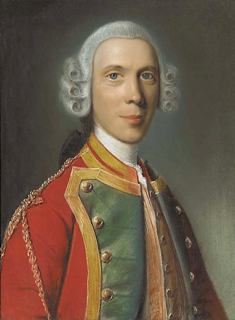
Thomas Eyre, an Irish military engineer, dies in Dublin on February 22, 1772, while attending a session of the Irish House of Commons from an apoplectic fit.
Eyre is born around 1720, the second son of Colonel Samuel Eyre of Eyreville, County Galway, a descendant of Colonel John Eyre, who accompanies General Ludlow to Ireland in 1651 and acquires large estates in County Galway, including the Manor of Eyrecourt.
Eyre is that rare man whose military and engineering training occurs entirely in the Americas before he assumes the significant office of Surveyor General of Ireland in 1752. In 1738, he joins the regiment of James Oglethorpe, the founder of the Province of Georgia, and sails to the colony. As a cadet in Oglethorpe’s Regiment, he is sent to the colony’s interior as an agent to the Cherokee Indians. He rises from the rank of cadet to be sub-engineer for Georgia and the Province of South Carolina and in 1740 he is commissioned an ensign. He learns engineering from Major William Cook, the Regiment’s Engineer, and he marries Cook’s daughter Anne, who has accompanied her father to Georgia. The date of the wedding is not documented, but occurs by 1743, by which date both Eyre and Cook have returned to London. In the last two years of his tour of duty, Eyre serves also as the Sub-engineer for South Carolina and Georgia.
In 1744, Eyre is commissioned a lieutenant and joins Trelawney’s Regiment of Foot, headed by Edward Trelawney, Governor of Jamaica. He serves in Jamaica and at Roatán (Rattan) and is in charge of Roatán’s defences until 1748, when the Treaty of Aix-la-Chapelle ends the War of the Austrian Succession and returns the island to Spain. He is promoted to captain in 1748. For the four years after his departure from Roatán and before his resignation from Trelawney’s Regiment, little is known about his activities until he retires from active duty in 1752.
On August 31, 1752, Eyre is appointed Surveyor General of Ireland, having purchased the office from Arthur Jones-Nevill. Joseph Jarratt works as his deputy in this role. He undertakes works at the Royal Barracks in Dublin, but the condition of the barracks is criticised by the Commissioners of the Ordnance for Ireland. As Surveyor General, he is also involved in harbour works at Dún Laoghaire, and is responsible for the rebuilding of the State Apartments at Dublin Castle. In 1763, the office of Surveyor General is abolished, and he is transferred to the new post of Chief Engineer of the Ordnance.
Eyre resigns his commission in 1766 and becomes member of the Irish House of Commons for Thomastown (1761-68) and Fore (1768-1772). He dies on February 22, 1772, from an apoplectic fit brought on by the sudden death of a much loved daughter, at Parliament House, Dublin, while attending a session of the House.


April 3, 2026 at 12:34 PM
Hello,
The information about Thomas Eyre is very interesting to me. I have researched some of his career in the course of my search for information about William Eyre, who was also an Irish engineer in the British army. William Eyre named Thomas Eyre the executor of his will. I have been trying to determine what their connection to each other was but I do not know if they were related. Have you by chance encountered anything about William Eyre? He attained the rank of lieutenant colonel before tragically dying in a shipwreck when returning from service in North America in 1764. I will appreciate any information you might be able to provide. Thank you, J. C.
LikeLike
April 4, 2026 at 6:26 AM
Hello, James! Thank you for visiting my site! I have found nothing that defines the connection between Thomas and William Eyre. There is a Wikipedia page for each of them but neither mentions the other Eyre. If I stumble across any information connecting the two, I will let you know. Best wishes!
Jim
LikeLike
April 4, 2026 at 8:49 AM
Hello Jim,
Thank you for looking into this for me. If I establish a connection between the Eyres I’ll let you know. Ironically, I was watching the recent PBS series on Ireland (“From That Small Island”, episode 2) and it mentioned there was a William Eyres with Columbus on his 1492 voyage to America! Supposedly, Columbus visited Galway and engaged Eyres, who was a seaman. Unfortunately, Eyres died on the island of Hispanola. Who knows–maybe he was an ancestor of the William Eyre I am researching. Again, thank you so much.
James
LikeLike