
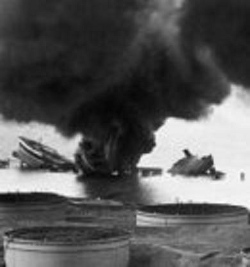
The Whiddy Island disaster, also known as the Betelgeuse incident, occurs on January 8, 1979, at around 1:00 AM, when the oil tanker Betelgeuse explodes in Bantry Bay in County Cork, at the offshore jetty for the oil terminal at Whiddy Island, while discharging its cargo of oil.
The explosion and resulting fire claim the lives of 50 people including 42 French nationals, 7 Irish nationals, and 1 United Kingdom national. Only 27 bodies are recovered. A further fatality occurs during the salvage operation with the loss of a Dutch diver.
On November 24, 1978, the Betelgeuse leaves Ras Tanura in the Persian Gulf bound for Leixões, Portugal, with a full cargo of crude oil. Originally the Betelgeuse is to call at Sines, Portugal, to lighten the load of the ship but poor weather conditions prevent the vessel from entering the harbour. Plans are further frustrated at Leixões as a ship has run aground across the harbour entrance preventing the Betelgeuse from berthing there to discharge her cargo. The Betelgeuse is then instructed to sail for Whiddy Island, Ireland.
The Betelgeuse first puts in at Vigo, Spain, to change some of her crew and then sails for Whiddy Island on December 30, 1978. During the passage the vessel encounters heavy weather in the Bay of Biscay and, after reporting a leakage of oil, is instructed to head towards Brest, France, at reduced speed. However, the origin of the leak is discovered and stopped. The vessel proceeds on its original planned course, arriving in Bantry Bay on January 4, 1979.
On the evening of January 6, 1979, the Betelgeuse has completed berthing at the offshore jetty in around 98 feet of water. At 11:30 PM the vessel commences discharging its 114,000 tonnes of mixed Arabian crude oil. This process is expected to take about 36 hours.

At about 1:00 AM on Monday, January 8, a rumbling noise is heard from the vessel followed shortly by a huge explosion within its hull. The force of the explosion blows men from the jetty into the sea. Local residents report seeing the Betelgeuse engulfed in a ball of fire a few moments later. A series of further explosions follow, breaking the vessel in half. Much of the oil cargo still on board ignites. The concrete unloading jetty crumbles and firefighters, arriving on the scene from several neighbouring towns, are unable to get near the vessel. The firefighters concentrate their efforts on preventing the fire from spreading to the tanks of the storage farm and on containing the oil spillage.
About 12 hours after the explosion the Betelgeuse sinks at her moorings in 130 feet of water, which largely extinguishes the main body of the fire. In spite of this, rescue workers are not able to approach the wreck for two weeks due to clouds of toxic and inflammable gas surrounding it. After two weeks, it is possible to start recovering bodies from the wreck and pumping off the remainder of the oil cargo that is still on board.
A number of memorial services have been held to commemorate anniversaries of the incident. A memorial sculpture, incorporating the ship’s bell which was recovered from the wreck, has been erected in the hillside graveyard overlooking the harbor. The bodies of two unidentified casualties from the incident are interred nearby.

 seamus dubhghaill