seamus dubhghaill

Promoting Irish Culture and History from Little Rock, Arkansas, USA


Leave a comment

John Joseph “Jack” Doyle Becomes First Major League Pinch Hitter

jack-doyle

John Joseph “Jack” Doyle, Irish-American first baseman of the Cleveland Spiders in Major League Baseball, becomes the first to pinch hitter in a baseball game on June 7, 1892. He comes through with a game-winning single against the Brooklyn Dodgers.

Doyle is born in Killorglin, County Kerry, on October 25, 1869, and emigrates with his family to the United States when he is a child, settling in Holyoke, Massachusetts. After attending Fordham University, Doyle embarks on a baseball career that lasts 70 years. He makes his first appearance at the major league level by signing and playing two years for the Columbus Solons of the American Association. Doyle plays for ten clubs between 1889 and 1905, batting .299 in 1,564 games with 516 stolen bases. He begins as a catcher–outfielder and becomes a first baseman in 1894. His best years are in 1894, when he bats .367 for the New York Giants, and in 1897, when he hits .354 with 62 stolen bases for the Baltimore Orioles.

Because of his aggressive playing style, Doyle is known as “Dirty Jack”, often feuding with umpires, fans, opposing players, and even at times, his own teammates. He carries on a lengthy feud with John McGraw that starts when they are teammates in Baltimore. McGraw, of course, has to have the last word. In 1902, McGraw is appointed manager of the Giants and his first act is to release Doyle, even though he is batting .301 and fielding .991 at the time. Even with these seemingly out-of-control traits, Doyle is deemed a natural leader and is selected as team captain in New York, Brooklyn and Chicago, and serves as an interim manager for the Giants in 1895 and Washington Senators in 1898.

In 1905, after playing one game with the New York Highlanders, Doyle becomes manager of Toledo of the Western Association. One year later, he is named the manager of the Des Moines Champions, so named because they won the league championship the previous year, and they win it again under Doyle’s helm. Following his championship season at Des Moines, he manages Milwaukee in 1907.

In 1908–1909, the only years of his adult life spent outside of baseball, Doyle serves as police commissioner of his hometown of Holyoke. He returns to baseball as an umpire and works in the National League for 42 games in 1911. He later joins the Chicago Cubs as a scout in 1920. He remains in that capacity until his death at age 89 on New Year’s Eve 1958. Doyle is buried at St. Jerome Cemetery in Holyoke.


Leave a comment

Ireland’s First Ever Win in International Soccer

ifa-original-badgeIreland wins its first ever match in international soccer on February 19, 1887, beating Wales 4-1 in Belfast. Prior to 1921 and the partition of the country, all of Ireland is represented by a single side, the Ireland national football team, organised by the Irish Football Association (IFA).
On February 18, 1882, fifteen months after the founding of the Irish FA, Ireland makes its international debut against England, losing 13–0 in a friendly played at Bloomfield in Belfast. This remains the largest ever defeat for the team, and is also England’s largest winning margin.

Ireland competes in the inaugural British Home Championship in 1884 and loses all three games. Ireland finally wins its first game on February 19, 1887, with a 4–1 win over Wales in Belfast. Between their 1882 debut and this game, the Ireland team has a run of 14 defeats and 1 draw, the longest run without a win in the 1800s. Despite the end of the losing streak, heavy defeats continue. In March 1888 they lose 11–0 to Wales and 10–2 to Scotland. Further heavy defeats come in March 1890 when they lose 9–1 to England, in 1899 when they lose 13–2 to England, and in February 1901 when they lose 11–0 to Scotland.

Ireland is partitioned into Northern Ireland and Southern Ireland in 1920. Southern Ireland gains independence in 1922 as the Irish Free State, later to become a republic under the name of Ireland. Amid these political upheavals, a rival football association, the Football Association of Ireland, emerges in Dublin in 1921 and organises a separate league and international team. In 1923, at a time when the home nations have withdrawn from the Fédération Internationale de Football Association (FIFA), the FAI is recognised by FIFA as the governing body of the Irish Free State on the condition that it changes its name to the Football Association of the Irish Free State. The IFA continues to organise its national team on an all-Ireland basis.

Between 1928 and 1946 the IFA is not affiliated to FIFA and the two Ireland teams co-exist, never competing in the same competition. However, on March 8, 1950, in a 0–0 draw with Wales at the Racecourse Ground in Wrexham, North Wales in a World Cup qualifier, the IFA fields a team that includes four players who were born in the Irish Free State. All four players have previously played for the FAI in their qualifiers and as a result have played for two different associations in the same FIFA World Cup tournament.

After complaints from the FAI, FIFA intervenes and restricts players’ eligibility based on the political border. In 1953, FIFA rules that neither team can be referred to as Ireland, decreeing that the FAI team officially be designated as the Republic of Ireland, while the IFA team is to become Northern Ireland.


Leave a comment

Birth of Tipperary Hurling Legend John Doyle

john-doyle

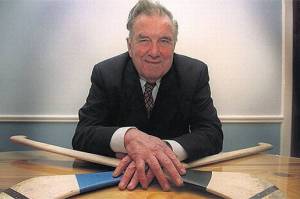
John Doyle, Irish sportsperson and politician, hailed as one of the best defenders in hurling and his county’s most iconic player upon his death, is born in Holycross, County Tipperary, on February 12, 1930.

Doyle first excels at hurling while at school in Thurles CBS. Regarded as too good for CBS Primary School team, he is drafted into the secondary school’s under-15 Croke Cup team in 1942. Doyle plays at wing-forward as Thurles CBS wins the championship that year.

Doyle arrives on the inter-county scene at the age of sixteen when he first links up with the Tipperary minor team. He makes his senior debut in the 1947-48 National League. A 5-6 to 4-2 defeat of Cork in the provincial decider gives him his first Munster medal. Tipperary retains their provincial crown in 1947, with Doyle collecting a second Munster medal following a 2-4 to 1-2 defeat of Waterford. Doyle goes on to play a key role for Tipperary during a hugely successful era for the team, winning eight All-Ireland medals, ten Munster medals, and ten National Hurling League medals.

On June 26, 1949, Doyle makes his senior championship debut in a Munster quarter-final replay against Cork. As a member of the Munster inter-provincial team for fifteen years, Doyle wins six Railway Cup medals. At club level he wins three championship medals with Holycross-Ballycahill.

After surrendering their provincial crown in 1966, Tipperary bounces back the following year, with Doyle winning a record tenth Munster medal following a 4-12 to 2-6 defeat of Clare. On September 3, 1967, Tipperary faces Kilkenny in the All-Ireland decider, a game which presents Doyle win the opportunity of making history by winning a record-breaking ninth All-Ireland medal. Despite leading at halftime 2-6 to 1-3, Kilkenny goalkeeper Ollie Walsh makes a series of spectacular saves in the second half and Kilkenny is victorious 3-8 to 2-7 and lays to rest a bogey that Tipperary has had over the team since 1922. The defeat brings the curtain down on Doyle’s inter-county career.

For almost fifty years Doyle, together with Christy Ring, hold a unique record as the only players to win eight All-Ireland medals on the field of play. This record is subsequently surpassed by Henry Shefflin on September 30, 2012. His record of National League medals has yet to be equalled. Throughout his career, Doyle makes 54 championship appearances, a Tipperary record which stands until August 9, 2009 when it is surpassed by Brendan Cummins.

In retirement from inter-county hurling, Doyle continues to work on his farm in Holycross. In later years he enters politics. He stands unsuccessfully as a Fianna Fáil candidate at the 1969 general election for the Tipperary North constituency, but is subsequently elected to Seanad Éireann on the Agricultural Panel. He serves until 1973 when he loses his seat.

Doyle is widely regarded as one of the greatest hurlers in the history of the game. During his playing days he wins two Cú Chulainn awards, and is named Texaco Hurler of the Year in 1964. He is repeatedly voted onto teams made up of the sport’s greats, including as left corner-back on the Hurling Team of the Century in 1984 and the Hurling Team of the Millennium in 2000.

John Doyle dies on December 29, 2010. Taoiseach Brian Cowen is among those who pay tribute saying “He was an immense hurler and an incredibly decent man, his love of the GAA was matched by his concern for his country and his own community, he was a Tipperary legend and a proud Irishman.” Doyle is buried at Holy Cross Abbey outside Thurles on December 31, 2010.


Leave a comment

Birth of N.I. Footballer Robert Dennis “Danny” Blanchflower

danny-blanchflower

Robert Dennis “Danny” Blanchflower, former Northern Ireland international footballer and football manager, is born on February 10, 1926 in the Bloomfield district of Belfast, the first of five children born to John and Selina Blanchflower.

Blanchflower is educated at Ravenscroft public elementary school and is awarded a scholarship to Belfast College of Technology. He leaves school early to become an apprentice electrician at Gallaher’s cigarette factory in Belfast. He also joins the Air Raid Precautions and, in 1943, joins the Royal Air Force after lying about his age. By 1946, after a trainee navigator course at St. Andrews University and further training in Canada, he is back at Gallaher’s in Belfast and building a reputation as an outstanding footballer.

Blanchflower signs with Glentoran F.C. in 1946 before crossing the Irish Sea and signing with Barnsley F.C. for £6000 in 1949 at the age of 23. He transfers from Barnsley to Aston Villa F.C. for a fee of £15,000 and makes his First Division debut in March 1951. He makes 155 senior appearances for Villa before being bought by Tottenham Hotspur F.C. in 1954 for a fee of £30,000. During his ten years playing at White Hart Lane he makes 337 League appearances and 382 total appearances.

The highlight of his time with the Spurs comes in the 1960–61 season, while serving as captain, the Spurs win their first 11 games and eventually win the league by 8 points. They beat Leicester City F.C. in the final of the FA Cup, becoming the first team in the 20th century to win the League and Cup double and a feat not achieved since Aston Villa in 1897.

In 1962, Blanchflower again captains the Spurs team to victory in the FA Cup in 1962, narrowly missing out on a second double when they finish a close third in the league behind Ipswich Town F.C. and Burnley F.C. In 1963, he captains the team to victory over Atlético Madrid in the final of the European Cup Winners’ Cup, making Spurs the first English team to win a European trophy.

Between 1949 and 1963, he earns 56 caps for Northern Ireland, often playing alongside his brother Jackie until the younger Blanchflower’s playing career is cut short as a result of injuries sustained in the Munich air disaster of February 1958. In 1958, captains his country when they reached the quarter-finals of the World Cup.

On December 4, 1957, he captains the Northern Ireland team against Italy in Belfast in a bad tempered game that comes to be known as the “Battle of Belfast.” Blanchflower attempts to keep the peace as the game turns nasty.

Blanchflower announces his retirement as a player on April 5, 1964, having played nearly 400 games in all competitions for the Spurs and captains them to four major trophies.

Following his retirement as a player, Blanchflower coachs for the Spurs for a number of years. Manager Bill Nicholson intends for Blanchflower to be his successor but, when Nicholson resigns in 1974, Blanchflower is passed over in favour of Terry Neill. He leaves the Spurs and becomes manager of Northern Ireland for a brief spell in 1978 before being appointed boss of Chelsea F.C. The team wins only three of fifteen games under his charge and he leaves the team in September 1979.

On May 1, 1990, Tottenham holds a testimonial match for Blanchflower at White Hart Lane, but at this point he is in the early stages of what is later diagnosed as Alzheimer’s disease and Parkinson’s disease. He is eventually placed in a Staines nursing home where he dies as a result of pneumonia on December 9, 1993, at the age of 67.

Blanchflower’s hometown of Belfast has honoured him with an Ulster History Circle plaque, located at his childhood home at 49 Grace Avenue, recognising the late sportsman as one of the greatest players in the history of Tottenham Hotspur FC.