seamus dubhghaill

Promoting Irish Culture and History from Little Rock, Arkansas, USA


Leave a comment

Birth of Mícheál Ó Muircheartaigh, Gaelic Games Commentator

Mícheál Ó Muircheartaigh, an Irish Gaelic games commentator for the Irish national radio and television, RTÉ, is born in Doonshean just outside Dingle, County Kerry, on August 20, 1930. In a career that spans six decades he comes to be regarded as the “voice of Gaelic games.” He has been described as a national treasure. His prolific career earns him a place in Guinness World Records.

Ó Muircheartaigh grows up on the family farm and is educated locally in Dingle. In September 1945, he begins studying at Coláiste Íosagáin in Ballyvourney in the County Cork Gaeltacht where he trains to be a teacher. It is at this all-Irish language school that his name changes from Michael Moriarty to the Irish version Mícheál Ó Muircheartaigh. He says that Irish is his stronger language. In September 1948, he begins the final year of his teacher training at St. Patrick’s College of Education in Drumcondra, Dublin.

In early March 1949, Ó Muircheartaigh, along with ten other students from the college, and several from other colleges, do a test commentary on a hurling match at Croke Park. Each student has to commentate for five minutes in Irish and the most successful is to be selected for further commentary work. Up to this point, he has never seen a game of hurling before in his life. He is the one selected and his first assignment is to provide an all-Irish commentary on the 1949 Railway Cup final on Saint Patrick’s Day.

Ó Muircheartaigh graduates from St. Patrick’s College a little later and also completes a Bachelor of Arts degree from University College Dublin (UCD) in 1952. He also completes a Higher Diploma in Education in 1953. He teaches economics, accountancy and Irish in both primary and secondary schools throughout Dublin, the majority of which are run by the Christian Brothers. He continues teaching up until the 1980s, when he becomes a full-time broadcaster with RTÉ.

For the early part of his broadcasting career, Ó Muircheartaigh commentates on Minor GAA matches, in the Irish language. He also replaces the legendary Michael O’Hehir when he is not available to commentate. Eventually when O’Hehir is forced to retire in the mid-1980s Ó Muircheartaigh takes over as the station’s premier radio commentator. He develops his own inimitable style of commentary, and his accent is unmistakably that of a native Irish speaker. He is a true lover of Gaelic Athletic Association, and it is reflected in the enthusiasm he brings to matches. His unusual turn of phrase makes him a much-loved broadcaster and often imitated character. He becomes particularly famous in Ireland for his unusual turns of phrase in the heat of the moment while commentating. Towards the end of his life, he commentates on RTÉ Radio 1. In 2004, he publishes his autobiography, From Dún Sion to Croke Park.

On March 5, 1988, Ó Muircheartaigh presents the Saturday Live show on RTÉ 1. In 1990, he holds an impromptu interview with Britain’s Prince Edward, after his greyhound had won at the English Greyhound Derby qualifier when he was commentating.

Ó Muircheartaigh’s commentaries for RTÉ Radio 1’s Sunday Sport show win him a Jacob’s Award in 1992. He is also the Parade Grand Marshal for the 2007 St. Patrick’s Festival, having been given the honour by the chairman of the festival in recognition and appreciation of his unique contribution to Irish culture. He is the Parade Grand Marshal for the 2011 St. Patrick’s Parade in Toronto, Ontario, Canada, also in recognition and appreciation of his unique contribution to Irish culture.

On September 16, 2010, Ó Muircheartaigh announces his retirement from broadcasting. The last All-Ireland he commentates on is the 2010 All-Ireland Senior Football Championship Final on September 19, 2010.

On October 29, 2010, it is announced that the 2nd International Rules test at Croke Park would be Ó Muircheartaigh’s final broadcast as commentator on RTÉ Radio 1. The following day he commentates his final commentary alongside RTÉ’s pundit and former Meath footballer Bernard Flynn.

Ó Muircheartaigh is contracted to officiate at the 2011–2012 Volvo Ocean Race finish in Galway where he commentates on the finish to the round-the-world race, giving it a uniquely Irish conclusion. Sailing is his longtime hobby.

Ó Muircheartaigh writes a weekly sports column for Foinse, the Irish-language newspaper free with the Irish Independent each Wednesday. He is invited to read out a piece in Irish and in English at an event called “Laochra” in Croke Park on April 24, 2016, to commemorate the 100th anniversary of the Easter Rising.

In 2007, Ó Muircheartaigh is awarded the UCD Foundation Day Medal. His nephew by marriage, John McGuire, has presented several programmes on RTÉ.

Ó Muircheartaigh dies in hospital in Dublin at the age of 93 on June 25, 2024.

Ó Muircheartaigh is awarded an honorary doctorate by NUI Galway in 1999 for his lifetime service to broadcasting. Shortly after his 90th birthday, he is awarded the only GAA GPA All Stars Award of 2020. No further All Stars can be awarded as competition is suspended due to the COVID-19 pandemic and only completed that December.


Leave a comment

Birth of Irish Hurler Dillon Quirke

Dillon Quirke, Irish hurler who plays for Tipperary Senior Hurling Championship club Clonoulty–Rossmore and at inter-county level with the Tipperary senior hurling team, is born in Rossmore, County Tipperary, on February 28, 1998.

Quirke, whose father, Dan Quirke, won an All-Ireland medal at under-21 level in the All-Ireland Under-21 Hurling Championship, first plays as a schoolboy in various juvenile competitions at Rossmore National School before later lining out as a student at CBS Thurles. He lines out in all grades and is a member of the CBS Thurles senior team that beats St. Francis’ College to win the Dr. Harty Cup in 2015, before losing the subsequent All-Ireland Post-Primary Schools Croke Cup final to St. Kieran’s College.

Quirke begins his club career at juvenile and underage levels with Clonoulty–Rossmore. He wins consecutive divisional championship titles with the club’s minor team in 2014 and 2015, before winning a Tipperary U21AHC title after a defeat of Thurles Sarsfields in the final. He scores two points from play when Clonoulty–Rossmore beats Nenagh Éire Óg in the 2018 Tipperary Senior Hurling Championship final.

Quirke begins a two-year association with the Tipperary minor hurling team in advance of the 2015 Munster Minor Hurling Championship. He is an unused substitute for the Munster final defeat of Limerick, and again for the All-Ireland final defeat by Galway. Again eligible for the minor grade in 2016, he wins a second successive Munster Minor Hurling Championship medal from the substitutes’ bench after a 17-point defeat of Limerick in the Munster final. He later wins an All-Ireland Minor Hurling Championship medal on the field after coming on as a substitute in the 1–21 to 0–17 defeat of Limerick.

After a year away from the inter-county scene, Quirke is called up to the Tipperary under-21 hurling team for the 2018 Munster Under-21 Hurling Championship. After lining out at left wing-back in Tipperary’s 2–23 to 1–13 defeat by Cork in the Munster final, he is in the same position when the result is reversed and Tipperary beats Cork in the subsequent 2018 All-Ireland Under-21 Hurling Championship final.

Quirke is one of twelve under-21 players called up to the senior team‘s pre-season training panel in November 2018, however, he is later released from the panel. He is later recalled to the senior panel and makes his first appearance in a 2–14 to 0–18 defeat by Limerick in the first round of the 2020 National Hurling League. Later that season, he makes his championship debut when he comes on as a 73rd-minute substitute for Jason Forde in an All-Ireland qualifier defeat of Cork. By 2022, he is a regular member of the starting fifteen and starts all four games in Tipperary’s unsuccessful Munster Championship campaign.

On August 5, 2022, Quirke collapses and dies while playing a Tipperary Senior Hurling Championship match for his club against Kilruane MacDonagh’s at Semple Stadium. The match is abandoned after he is taken to Tipperary University Hospital. Tipperary GAA postpones the weekend’s matches as a mark of respect. President of Ireland Michael D. Higgins and Taoiseach Micheál Martin pay tribute. A vigil is held at his home club on August 6. Tributes are also paid on television ahead of the camogie finals on August 7.

Quirke’s funeral is held on August 9 in Clonoulty. His inter-county and club teammates, as well as the opposition Kilruane MacDonagh’s team from the fateful match, provide a guard of honour as the cortege makes its way from the GAA Clubhouse through the village to St. John the Baptist Church for the Requiem Mass. The coffin is draped in the colours of his club side as well as his county and is brought into the church by his Clonoulty-Rossmore teammates.


Leave a comment

Birth of Irish Hurler Brendan Maher

Brendan Maher, an Irish hurler who plays for club side Borris–Ileigh and previously at inter-county level with the Tipperary senior hurling team, is born on January 5, 1989, at Borrisoleigh, County Tipperary. Regarded as one of the great talents of his generation, Maher enjoys a 13-season career with the Tipperary senior hurling team, wins three All-Stars and is a Hurler of the Year nominee in 2010. He wins eight major trophies in his inter-county career, comprising three All-Ireland Championships, captaining the team in 2016, and five Munster Championships. A versatile player who switches between attacking and defensive positions, he makes a combined 124 league and championship appearances.

Maher first comes to prominence as a hurler with St. Joseph’s College in Borrisoleigh. He plays in every grade before eventually joining the senior hurling team and lines out in several Harty Cup campaigns.

Maher studies at Mary Immaculate College in Limerick between 2006 and 2009 and joins the senior hurling team in his second year. On March 7, 2009, he is named man of the match when Mary Immaculate College defeats the University of Ulster by 1–12 to 1–05 to win the Ryan Cup.

Maher joins the Borris–Ileigh club at a young age and plays at all grades in juvenile and underage levels. He joins the club’s senior team as a 16-year-old during the 2005 North Tipperary Senior Hurling Championship. During his time with Borris-Ileigh, the team wins the North Tipperary Senior Hurling Championship in 2005, 2007 and 2017, the All-Ireland Mini 7s Championship in 2015, and the Tipperary Senior Hurling Championship and Munster Senior Club Hurling Championship in 2019.

Maher first plays for Tipperary as a member of the minor team during the 2005 Munster Minor Hurling Championship. He and the team go on to win the Munster Minor Hurling Championship in 2007, the All-Ireland Minor Hurling Championship in 2006 and 2007, the Munster Under-21 Hurling Championship in 2008 and 2010, and the All-Ireland Under-21 Hurling Championship in 2010.

Maher joins the Tipperary senior team in advance of the 2009 National Hurling League. During his ten years with the senior team, they win the Munster Senior Hurling Championship in 2009, 2011, 2012, 2015 and 2016, and the All-Ireland Senior Hurling Championship in 2010, 2016 and 2019. On August 21, 2021, he announces his retirement from inter-county hurling after 13 years with the team.

Maher is added to the Munster team in advance of the 2012 Inter-Provincial Hurling Championship. He makes his first appearance for the team on February 19, 2012, when he lines out at left wing-forward in a 3–14 to 1–16 defeat by Leinster. On March 3, 2013, he lines out at midfield when Munster qualifies to play Connacht in the 2013 Inter-Provincial Hurling Championship final. He ends the game with a Railway Cup medal following the 1–22 to 0–15 victory. On December 15, 2016, he wins a second Railway Cup medal after captaining the team from midfield in a 2–20 to 2–16 defeat of Leinster in the final.

On October 19, 2011, Maher is named on the Ireland squad for the Shinty-Hurling International Series. On October 29, 2011, he lines out at centre-forward when Ireland defeats Scotland on an aggregate scoreline of 3–25 to 3–19 following a two-game series. He is selected for the Ireland team for the second time in his career on October 22, 2013. He claims a second winners’ medal from right wing-forward following Ireland’s 5–27 to 2–26 aggregate defeat of Scotland on November 2, 2013.

In October 2022, Maher is announced as Offaly senior hurling team performance coach under the management of Johnny Kelly.


Leave a comment

Birth of Cork GAA Hurler Christy Ring

Nicholas Christopher Michael Ring, better known as Christy Ring, an Irish hurler whose league and championship career with the Cork GAA senior team spans twenty-four years from 1939 to 1963, is born in Kilboy, Cloyne, County Cork, on October 12, 1920. His 24-year career record earns him a reputation as the greatest hurler of all time.

Ring establishes many championship records, including career appearances (65), scoring tally (33-208), and number of All-Ireland medals won (8), however, these records are subsequently bested by Brendan Cummins, Eddie Keher, and Henry Shefflin respectively. Ring is widely regarded as one of the greatest hurlers in the history of the game, with many former players, commentators, and fans rating him as the number one player of all time.

Ring first excels at hurling following encouragement from his local national school teachers Michael O’Brien and Jerry Moynihan. He first appears on the Cloyne GAA minor team at the age of twelve before later winning a county minor championship medal with the nearby St. Enda’s team. A Cork Junior Hurling Championship medal with Cloyne follows, however, a dispute with club officials sees Ring join Glen Rovers GAA in Blackpool in 1941. Over the next twenty-six years with the club, Ring wins one Munster Senior Club Hurling Championship medal and fourteen county senior championship medals. As a Gaelic footballer with the Glen’s sister club, St. Nicholas’ GAA, he also wins a county senior championship medal. He retires from club hurling at the age of forty-six following a victory over University College Cork GAA in the 1967 championship quarter-final. Over the course of his senior championship career Ring estimates that he played in 1,200 games.

Ring makes his debut on the inter-county scene at the age of sixteen when he is picked on the Cork minor panel for the All-Ireland final. In spite of victory, he is denied an All-Ireland Minor Hurling Championship medal as he is Cork’s last non-playing substitute. Still eligible for the grade in 1938, Ring collects a set of All-Ireland and Munster Minor Hurling Championship medals as a member of the starting fifteen. An unsuccessful year with the Cork junior hurlers follows before he makes his senior debut during the 1939-40 league. Over the course of the next quarter century, Ring wins eight All-Ireland medals, including a record four consecutive championships from 1941 to 1944, a lone triumph in 1946 and three additional consecutive championships from 1952 to 1954. The only player to lift the Liam MacCarthy Cup three times as captain, he is denied a record-breaking ninth All-Ireland medal in 1956 in what is his last All-Ireland final appearance. Ring also wins nine Munster medals, four National Hurling League medals, and is named Hurler of the Year at the age of thirty-eight. He plays his last game for Cork in June 1963. After indicating his willingness to line out for the team once again in 1964, Ring fails to be selected for the Cork team, a move which effectively brings his inter-county career to an end.

After being chosen as a substitute on the Munster GAA inter-provincial team in 1941, Ring is an automatic choice on the starting fifteen for the following twenty-two years. He scores 42-105 as he wins a record eighteen Railway Cup medals during that period, in an era when his skill and prowess draw crowds of up to 50,000 to Croke Park for the annual final on Saint Patrick’s Day. Ring’s retirement from the game is often cited as a contributory factor in the decline of the once prestigious championship.

In retirement from playing Ring becomes involved in team management and coaching. As a mentor to the St. Finbarr’s College senior team, he guides them to their first two All-Ireland and Harty Cup triumphs in 1963 and 1969. At club level Ring is instrumental as a selector with Glen Rovers when they claim their inaugural All-Ireland title in 1973, having earlier annexed the Munster and county senior championship titles. It is with the Cork senior team that he enjoys his greatest successes as a selector. After an unsuccessful campaign in his first season on the selection panel in 1973, Ring is dropped the following year before being reinstated in 1975. Over the next three years Cork claims three successive All-Ireland titles.

Ring is most famous for his scoring prowess, physical strength, and career longevity. He remains the only player to have competed at inter-county level in four different decades. Often the target of public attention for his hurling exploits, in private Ring is a shy and reserved individual. A teetotaller and non-smoker throughout his life, he is also a devout Roman Catholic.

On Friday, March 2, 1979, Ring has a scheduled appointment with his doctor and former teammate Dr. Jim Young in Cork city centre. As he is walking past the Cork College of Commerce on Morrisson’s Island at 3:30 PM he suffers a massive heart attack and collapses. He is taken by ambulance to the South Infirmary Hospital but is pronounced dead on arrival.

Ring’s sudden death and the scenes which follow at his funeral are unprecedented in Cork since the death of the martyred Lord Mayor of Cork Tomás Mac Curtain in 1920. He is posthumously honoured by being named on the Hurling Team of the Century in 1984 and the Hurling Team of the Millennium in 2000, while he is also named as the Century’s Best Hurler in The Irish Times.


Leave a comment

Death of Irish Hurler Christy Ring

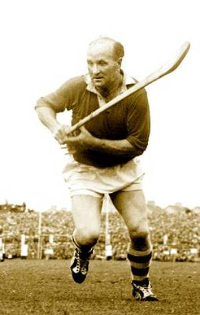
christy-ring

Nicholas Christopher Michael Ring, better known as Christy Ring, an Irish hurler whose league and championship career with the Cork GAA senior team spans twenty-four years from 1939 to 1963, dies at Morrison’s Island, Cork, on March 2, 1979.

Ring establishes many championship records, including career appearances (65), scoring tally (33-208), and number of All-Ireland medals won (8), however, these records are subsequently bested by Brendan Cummins, Eddie Keher, and Henry Shefflin respectively. Ring is widely regarded as one of the greatest hurlers in the history of the game, with many former players, commentators, and fans rating him as the number one player of all time.

Born near Cloyne, County Cork, Ring first excels at hurling following encouragement from his local national schoolteachers Michael O’Brien and Jerry Moynihan. He first appears on the Cloyne GAA minor team at the age of twelve before later winning a county minor championship medal with the nearby St. Enda’s team. A Cork Junior Hurling Championship medal with Cloyne follows, however, a dispute with club officials sees Ring join Glen Rovers GAA in Blackpool in 1941. Over the next twenty-six years with the club, Ring wins one Munster Senior Club Hurling Championship medal and fourteen county senior championship medals. As a Gaelic footballer with the Glen’s sister club, St. Nicholas’ GAA, he also wins a county senior championship medal. He retires from club hurling at the age of forty-six following a victory over University College Cork GAA in the 1967 championship quarter final. Over the course of his senior championship career Ring estimates that he played in 1,200 games.

Ring makes his debut on the inter-county scene at the age of sixteen when he is picked on the Cork minor panel for the All-Ireland final. In spite of victory, he is denied an All-Ireland Minor Hurling Championship medal as he is Cork’s last non-playing substitute. Still eligible for the grade in 1938, Ring collects a set of All-Ireland and Munster Minor Hurling Championship medals as a member of the starting fifteen. An unsuccessful year with the Cork junior hurlers follows before he makes his senior debut during the 1939-40 league. Over the course of the next quarter century, Ring wins eight All-Ireland medals, including a record four consecutive championships from 1941 to 1944, a lone triumph in 1946 and three additional consecutive championships from 1952 to 1954. The only player to lift the Liam MacCarthy Cup three times as captain, he is denied a record-breaking ninth All-Ireland medal in 1956, his last All-Ireland final appearance. Ring also wins nine Munster medals, four National Hurling League medals, and is named Hurler of the Year at the age of thirty-eight. He plays his last game for Cork in June 1963. After indicating his willingness to line out for the team once again in 1964, Ring fails to be selected for the Cork team, a move which effectively brings his inter-county career to an end.

After being chosen as a substitute on the Munster GAA inter-provincial team in 1941, Ring is an automatic choice on the starting fifteen for the following twenty-two years. He scores 42-105 as he wins a record eighteen Railway Cup medals during that period, in an era when his skill and prowess draw crowds of up to 50,000 to Croke Park for the annual final on Saint Patrick’s Day. Ring’s retirement from the game is often cited as a contributory factor in the decline of the once prestigious championship.

In retirement from playing Ring becomes involved in team management and coaching. As a mentor to the St. Finbarr’s College senior team, he guides them to their first two All-Ireland and Harty Cup triumphs in 1963 and 1969. At club level Ring is instrumental as a selector with Glen Rovers when they claim their inaugural All-Ireland title in 1973, having earlier annexed the Munster and county senior championship titles. It is with the Cork senior team that he enjoys his greatest successes as a selector. After an unsuccessful campaign in his first season on the selection panel in 1973, Ring is dropped the following year before being reinstated in 1975. Over the next three years Cork claims three successive All-Ireland titles.

Ring is most famous for his scoring prowess, physical strength, and career longevity. He remains the only player to have competed at inter-county level in four different decades. Often the target of public attention for his hurling exploits, in private Ring is a shy and reserved individual. A teetotaller and non-smoker throughout his life, he is also a devout Roman Catholic.

On Friday, March 2, 1979, Ring has a scheduled appointment with his doctor and former teammate Dr. Jim Young in Cork city centre. As he is walking past the Cork College of Commerce on Morrisson’s Island at 3:30 PM he suffers a massive heart attack and collapses. He is taken by ambulance to the South Infirmary Hospital but is pronounced dead on arrival.

Ring’s sudden death and the scenes which follow at his funeral are unprecedented in Cork since the death of the martyred Lord Mayor of Cork Tomás Mac Curtain in 1920. He is posthumously honoured by being named on the Hurling Team of the Century in 1984 and the Hurling Team of the Millennium in 2000, while he is also named as the Century’s Best Hurler in The Irish Times.