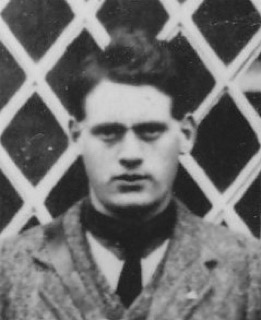
Burke is born into an influential Drogheda family, the Burkes of Duleek Street. His father, also named Christopher Patrick Burke, is a gas works secretary, and his mother is Mary McQuillan. The family lives initially on Coola Street before moving to Duleek Street after his father’s death in 1906.
Raised in a well-off household, Burke’s early years are shaped by the nationalist and cultural revival movements of the time, including the Gaelic League, which fosters physical resilience and republican ideals. His family connections, including to fellow revolutionary Thomas Burke, provide him with early exposure to Sinn Féin and Irish Volunteers activities.
Burke operates under the nom de guerre “Seán Jones” (also “Seaghan Mac Seaghan”) and is captured on at least one occasion by British forces, later released in a prisoner exchange.
During the Irish Civil War, Burke undertakes a 23-day hunger strike, reflecting his continued commitment to republican resistance against the Irish Free State.
In 1932, Burke is brought to court by his older brother, Michael, after assaulting him in the family home on Duleek Street, Drogheda. The house had been left to Michael in the will of their aunt Jane McQuillan, who died in 1919, leaving the premises to him, but requiring his mother and two sisters, Mary “Maise” and Christina Mary “Tena”, to be supported there. However, Burke insists on living there, along with his brother Joseph, leading to a family dispute. The Justice rules that the will gives Michael Burke the ownership of the house and the tenants subject to the charges set out in it. He fines Burke five shillings.
After this, Burke goes into the dairy business with his brother Joseph, and builds a house on the family farm in Bryanstown, County Meath. He dies from coronary occlusion at the age of 65 in his home on June 23, 1964. His sister, Christina Mary “Tena” Burke is present at his death. His requiem mass is celebrated at St. Mary’s Church in Drogheda. His republican comrades attend the funeral, and the Mayor of Drogheda and members of the Drogheda Corporation walk in the cortége wearing their robes of office.
Burke’s contributions to the IRA’s armament production and his steadfast republican stance cements his place in Irish revolutionary history. His life bridges the technical skills of a craftsman with the political resolve of a nationalist leader, making him a notable figure in the struggle for Irish independence.
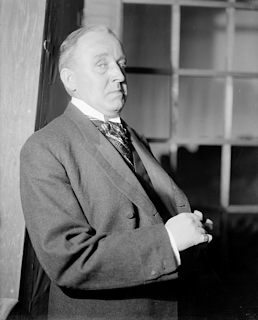
John Dudley Digges, Irish stage actor, director, and producer as well as a film actor, is born in Ranelagh, Dublin, on June 9, 1879. Although he gains his initial theatre training and acting experience in Ireland, the vast majority of his career is spent in the United States, where over the span of 43 years he works in hundreds of stage productions and performs in over 50 films.
Digges is the child of James Digges and Catherine Forsythe. He becomes acquainted with theatre directors William and Frank Fay and takes an interest in acting. He joins W. G. Fay’s Irish National Dramatic Company, along with others including Máire Nic Shiubhlaigh, James H. Cousins, Frederick Ryan and Maire Quinn (who becomes his wife). Their first production, Cathleen Ni Houlihan, with Maud Gonne in the lead role, and Déirdre, is on April 2, 1902. The company, which has no funds to speak of, acquires a couple of bare rooms at 34 Lower Camden Street, which with the help of friends from Irish-revival societies they turn into a small theatre. However, this proves too small for the plays they are planning to stage. They rehearse at the Coffee Palace in Westmoreland Street and also use the Molesworth Hall for productions.
In 1903, the playwrights and most of the actors and staff from these productions go on to form the Irish National Theatre Society, which has its registered offices in Camden Street. The society founds the Abbey Theatre.
Digges goes to the United States with a group of fellow-actors in 1904, and becomes successful as both actor and producer. He is stage manager for a time to both Charles Frohman and George Arliss, and by the 1920s he has become a notable performer on Broadway. One of his best-known roles there is as Ficsur in the original 1921 production of Ferenc Molnár‘s Liliom (later adapted into the musical Carousel by Rodgers and Hammerstein). In 1924, in Woodstock, New York, he founds the Maverick Theater with the assistance of Hervey White, who had established the Maverick Arts Colony. He is also artistic director of a company that includes Helen Hayes and Edward G. Robinson.
Digges expands his career into films by 1929, and over nearly two decades he performs in more than 50 films, including the original pre-Hays Code adaptation of The Maltese Falcon (1931). He Is cast in that feature as Casper Gutman, the character later portrayed by Sydney Greenstreet in the 1941 version. In The Invisible Man (1933) he plays the Chief Detective who plots to capture the title character, opposite the unseen Claude Rains. He plays the role of the Heavenly Examiner in both the original Broadway production and the 1930 screen version of Sutton Vane‘s Outward Bound. He also works as a director on Broadway.
Digges marries only once, to Irish actress Maire Quinn. The couple wed on August 27, 1907, in New York City and remain together until Maire’s death in August 1947. On October 24, 1947, just two months after his wife’s death, he dies of a stroke in his Manhattan apartment at 1 West 64th Street. He is survived by three siblings, all living in Ireland: a sister, Mrs. Mai Gannen, and two brothers, James and Ernst. Following a requiem mass at Blessed Sacrament Roman Catholic Church on October 28, he is buried next to his wife at Gate of Heaven Cemetery in Hawthorne, New York.
(Pictured: Digges as Boss Mangan in the 1920 Broadway production Heartbreak House, which he also directs)
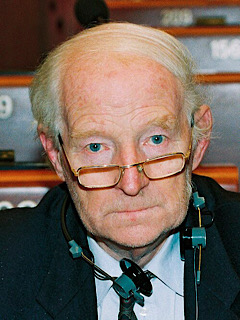
Maher is born on April 29, 1922, at Castlemoyle, Boherlahan, Cashel, County Tipperary, the seventh child of Thomas Maher, farmer, and his wife Julianne Maher. Raised on the family’s forty-five-acre holding and educated locally at Ardmaylenational school and at the Christian Brothers school and VEC school in Cashel, he takes over the farm in 1948 when ill health forces his father into retirement. He subsequently enlarges it to 120 acres. Mechanically adept, a talented sportsman, and a member of Cashel Dramatic Society, he joins Macra na Feirme and is a founder member of the National Farmers’ Association (NFA) in January 1955.
Maher is a member and chairman of the dairy committee of the NFA before coming to national attention through his participation in the historic farmers’ rights march to Dublin led by Rickard Deasy (October 7-19, 1966), part of the militant campaign for fairer agricultural prices and for reform of taxation and rates on farmland. His part in the subsequent three-week sit-down protest and meeting with incoming minister Neil Blaney, at the Department of Agriculture, confirms his reputation as a tenacious campaigner for agricultural causes. In August 1967, shortly after 100 farmers have served prison sentences for withholding rates, he succeeds Deasy as NFA president. Charismatic, articulate, and decisive, he also has a strong sense of personal responsibility, which governs his expectations of colleagues and associates. With exhausting rounds of travel and meetings, he is impossible to ignore and grist to the media mill, with his apparently impromptu but, in reality, carefully rehearsed speeches criticising politicians, parties, bureaucracy, and tardy national policy. He warns of national economic failure unless government and public services take radical modernising initiatives. He is at once nationalist, internationalist, and a revolutionary campaigner for change, an idealistic firebrand who is essentially conservative in social matters.
Maher’s campaign for agriculture is tempered by a wider interest in the social and economic future of Ireland ahead of crucial negotiations for membership of the European Economic Community (EEC). He becomes a household name, gadfly of bureaucrats and hero of farmers. In November 1967 he attends the European Congress of the International Federation of Agricultural Producers in Rome as an advance action prior to taking part in the subsequent negotiations leading to Ireland’s “entry to Europe” in January 1973. He is re-elected president of the NFA in 1970.
Amalgamating the NFA with several of the agricultural producers’ organisations, Maher oversees its reemergence as the Irish Farmers’ Association (IFA) in January 1971 and remains president until 1976. Strengthened by his pro-European leadership, the IFA withstands the counter-propaganda which, in the referendum of May 1972, urges rejection of the EEC on economic, social, and religious grounds. Despite his own moderately conservative social views and unequivocal opposition to abortion in Ireland, his commitment to European integration is not in question.
Maher is a director of prestigious state-sponsored bodies including Bord Bainne, the Irish Sugar Company, and the B & I shipping line. He also serves six terms between 1976 and 1983 as president of the Irish Co-operative Organisation Society (ICOS). Such relative sinecures are balanced by adherence to humanitarian causes that occupy most of his subsequent life. Passionate about practical support for developing countries, he becomes a founder and chairman of Bóthar, the Irish self-help relief agency for supply of livestock overseas. He urges prison reform and supports Amnesty International in its prisoners’ rights campaigns. Running as an independent candidate, he is elected Member of the European Parliament (MEP) for Munster in 1979, beating the strong Fine Gael candidate Alan Dukes. Describing himself as a public representative rather than a politician, he sits in the Liberal and Democratic parliamentary group and continues to fly agricultural and other kites as a non-party deputy. Typically, he criticises the scale of Irish embassies abroad, suggesting alternative teams of trade and tourism personnel. He advocates fairer agricultural policies towards developing countries in spite of prevailing European attitudes of self-interest, and urges the transfer of Northern Ireland from British jurisdiction to European protectorate status. At home he seeks all-party consensus on economic recovery from the depressed condition of the mid 1980s, well intentioned and lonely causes that fail to draw significant political support.
Maher’s habit of traveling with tools to unlock sealed hotel windows is an example of his sometimes eccentric practicality. His unsuccessful attempt to win a Dáil seat for Tipperary South in the 1981 Irish general election postpones his return to Ireland, although he is twice reelected an MEP before retiring in 1994. During his time in Strasbourg he is a quaestor of the European Parliament and a member of its committees on rural development, regions and petitions. He advocates decentralisation of power in Ireland while also criticising local authorities for laxity in their commitment to environmental protection.
For all his outspokenness, Maher is widely respected for the courageous positions he adopts. When time permits, he is an avid reader of history. He maintains his rural pastimes, especially attendance at Gaelic sports, where he can test the political pulse of his constituents. Following a short illness, he dies on April 19, 2002, aged 79, at St. Vincent’s Hospital, Dublin. He is buried at Boherlahan cemetery following a Requiem Mass, celebrated by his surviving brother, the Rev. Michael Maher CSSp (a former veterinary surgeon), and his cousin Denis.
Maher marries Elizabeth (Betty) Kennedy from Bansha, near Cashel, on January 8, 1958. They live at Castlemoyle and have one daughter, Julianne, and two sons, Thomas and Denis. His brother James (Jamesie), who predeceases him in October 1975, had been a medical consultant at St. Vincent’s and consultant surgeon to the Irish Rugby Football Union (IRFU).
(From: “Maher, Thomas Joseph” by Patrick Long, Dictionary of Irish Biography, http://www.dib.ie, October 2009)
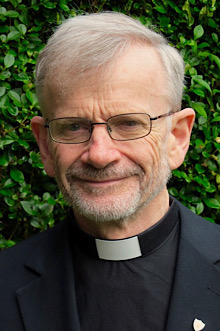
McGuckian is the youngest of six children to Brian McGuckian and his wife Pauline (née McKenna). He is named after his uncle, also Alexander Aloysius McGuckian, who dies five month before he is born. Yet another uncle, Daniel McGuckian, is a priest of the Diocese of Down and Connor and serves as parish priest of Cushendun and then Randalstown until his death in 1980. His father is a successful pig farmer who, alongside his brothers, develops the world’s biggest pig farm.
Two of McGuckian’s brothers are also Jesuit priests, while another brother is a businessman. Both of his sisters predecease him.
McGuckian is ordained to the priesthood on June 22, 1984, and makes his final profession on February 15, 1997.
Following ordination, McGuckian spends four years as a teacher in Clongowes Wood College and vocations director for the Jesuits, before undertaking a six month period of spiritual renewal in southern India and serving in a shanty town in Quezon City, Philippines.
McGuckian returns to Ireland in 1992, where he is appointed director of the Jesuit Communication Centre, during which he develops Sacred Space, a website which allows people to pray at their computer, in 1999, and Catholic news service CatholicIreland.net in 2004.
McGuckian also serves as editor of both An Timire and Foilseacháin Ábhair Spioradálta, later translating the autobiography of Ignatius of Loyola into Irish under the title Scéal an Oilithrigh. He also co-authors the drama 1912 – A Hundred Years On with Presbyterian historian Philip Orr in 2011, which looks at the experiences of the Ulster Covenant and the wider Home Rule movement from both nationalist and unionist perspectives.
McGuckian also serves as chaplain to many of the Gaelscoileanna in the Diocese of Down and Connor, and subsequently as chaplain to Ulster University campuses in Belfast and Jordanstown. Following the publication of the Living Church Report, which outlines the findings of a synodal process within the diocese, he is appointed by Noël Treanor in 2012 to set up and lead the Living Church Office, whose aim is to realise the hopes and aspirations expressed in the report and subsequently in the upcoming diocesan pastoral plan.
McGuckian is also appointed diocesan director of formation for the permanent diaconate in 2014, and also works during his directorship of the Living Church Office to establish pastoral communities across the diocese, through fostering a culture of co-responsibility for the mission of the Church between clergy and lay people.
McGuckian is appointed Bishop-elect of Raphoe by Pope Francis on June 9, 2017. His appointment makes him the first member of the Jesuits to be appointed a bishop in Ireland.
In an interview with The Irish Catholic in September 2019, McGuckian says that having a home is as fundamental as the right to life and education, and that the Government must be “pushed” to enshrine a right to housing in the Constitution of Ireland. He also joins a number of church leaders in the West of Ireland on September 16, 2021, in calling on the Irish government to offer reparations to homeowners whose properties are affected by defective concrete blocks.
In an interview with The Irish Catholic in February 2021, McGuckian takes issue with the view held by political leaders that public worship is deemed to be “non-essential” during the COVID-19 pandemic in the Republic of Ireland. Quoting Pope Francis, who states that “the right to worship must be respected, protected and defended by civil authorities like the right to bodily and physical health,” he expresses a need to let political leaders know that public worship is not only central, but also “utterly essential.”
Following a fatal explosion in Creeslough, County Donegal, on October 7, 2022, McGuckian refers to the explosion as “the darkest day in Donegal,” adding that the local community is “living through a nightmare of shock and horror.” He also concelebrates at the Funeral Masses of each of the victims, describing the fact that the parish church would be holding two funerals in the space of three hours as “surreal.”
McGuckian is appointed Bishop of Down and Connor by Pope Francis on February 2, 2024. In his first address following his appointment, he expresses his hope that the restoring of the Northern Ireland Executive will help the most vulnerable in society.
Ó Muirthile is educated at cork, taking a BA in Irish and French at UCC. His Irish is acquired at school and from sojourns in the Gaeltacht of West Kerry. He is a member of a group of poets at UCC in the late 1960s who choose Irish as a creative medium and are closely associated with the modernist poetry journal Innti, founded by fellow poet Michael Davitt. They are influenced by the work of Cork poet Seán Ó Ríordáin, by the musician and composer Seán Ó Riada, and by popular American culture.
Greg Delanty, writing for Poetry International, claims that a fundamental achievement of Ó Muirthile and other members of the Innti group was to adapt the language to a contemporary urban landscape in a way that reflected the counterculture of the sixties.
Ó Muirthile has been described as a poet of immense formal and musical mastery who reads deeply into the classical and neo-classical poetry of the Irish language. He studies French literature as a student and this influences his work. He translates poetry by Guillaume Apollinaire, François Villon, Jacques Prévert and Anne Hébert.
Ó Muirthile’s first collection of poetry is Tine Chnámh (1984). This receives the Irish American Cultural Institute’s literary award and an Oireachtas prize for poetry. He subsequently publishes a number of other collections. In 1996, he receives the Butler Award for his novel Ar Bhruach na Laoi. Several plays by him have been staged. From 1989 to 2003 he writes a weekly column, “An Peann Coitianta,” for The Irish Times. Poems by him have been translated into English, German, French, Italian, Hungarian and Romanian.
Two of Ó Muirthile‘s poems, Meachán Rudaí and Áthas, have been put to music by the Irish/American group The Gloaming and featured on their third studio album The Gloaming 3.
Daly studies Classics at Queen’s University Belfast (QUB). He earns his BA with Honours and also the Henry Medal in Latin Studies in 1937 and completes his MA the following year. He enters St. Patrick’s College, Maynooth and is ordained to the priesthood on June 22, 1941. He continues studies in theology in Maynooth, from where he obtains a doctorate in divinity (DD) in 1944. His first appointment is as Classics Master in St. Malachy’s College (1944–45).
In 1945, Daly is appointed Lecturer in Scholastic Philosophy at Queen’s University, Belfast, retaining the post for 21 years. In the academic year 1952–53 QUB grants him sabbatical leave, which he spends studying at the Catholic University of Paris where he receives a licentiate in philosophy. He returns to France at many points, particularly for holidays. He persists with his studies well into his retirement. He is a popular figure with the university and fondly remembered by his students. He is named a Canon of the Cathedral Chapter of Diocese of Down and Connor in 1966.
Daly is a peritus, or theological expert, at the Second Vatican Council (1962–65) to Bishop William Philbin during the first session of the Council and to Cardinal William Conway for the rest of the council. He dedicates himself to scholarship for 30 years, and publishes several books seeking to bring about understanding between the warring factions in Northern Ireland.
Daly is appointed Reader in Scholastic Philosophy at QUB in 1963, a post he holds until 1967, when he is appointed Bishop of Ardagh and Clonmacnoise on May 26.
Daly spends 15 years as bishop in Longford and is diligent about parish visitation and confirmations gradually assume a greater national profile. From 1974 onward, he devotes himself especially to ecumenical activities for the Pontifical Council for Promoting Christian Unity. His pastoral letter to Protestants, written in 1979, pleads for Christian unity.
Daly succeeded William Philbin as the 30th Bishop of Down and Connor when he is installed as bishop of his native diocese at a ceremony in St. Peter’s Cathedral, Belfast, on October 17, 1982.
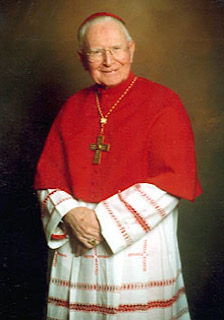
On November 6, 1990, Daly is appointed Archbishop of Armagh and, as such, Primate of All Ireland. His age makes him an unexpected occupant of the post. Despite this it is requested that he stay in the role for three years before usual age of episcopal retirement at 75. Cardinal Daly takes a notably harder line against the Irish Republican Army (IRA) than his predecessor, Cardinal Tomás Ó Fiaich.
Daly is respectful of Protestant rights and opposes integrated education of Catholics and Protestants. This policy is criticised by those who see segregated education as one of the causes of sectarianism in Northern Ireland, but is seen by the Catholic clergy as important for passing on their faith to future generations. He is utterly orthodox in opposing divorce, contraception, abortion, the ordination of women and any idea of dropping clerical celibacy.
Daly is heckled by the audience on live television during a broadcast of The Late Late Show on RTÉ One on the topic of pedophilia in the 1990s. After his retirement in 1996, he makes no public statement on the issue.
Daly retires as Archbishop of Armagh on his 79th birthday, October 1, 1996, and subsequently suffers ill health. Although it is announced that he will attend the funeral of Pope John Paul II, he stays home on the advice of his doctors. His age makes him ineligible to participate in the 2005 conclave that elects Pope Benedict XVI.
Daly is admitted to the coronary unit of Belfast City Hospital on December 28, 2009. His health has already been declining, leading to prayers being ordered for him. He dies in hospital in Belfast on December 31, 2009, aged 92. His family are at his bedside at the time. His death brings to an end a two-year period during which Ireland has, for the first time in its history, three living Cardinals.
Daly lay in state in Belfast and then his remains are taken to Armagh. Pope Benedict XVI pays tribute at this stage. Large numbers of people travel from as far as County Westmeath to attend Mass at Armagh on January 4, at which Monsignor Liam McEntaggart, the former parish priest of Coalisland, says, “When the history of peace making in Ireland comes to be written, the contribution of Cardinal Daly will be accorded a high place.” Monsignor McEntaggart himself dies on August 22, 2010, aged 81, less than eight months after Cardinal Daly’s passing.
Dinneen is a leading figure in the Irish Texts Society, publishing editions of Geoffrey Keating‘s Foras Feasa ar Éirinn, poems by Aogán Ó Rathaille, Piaras Feiritéar, Tadhg Gaelach Ó Súilleabháin, and other poets. He also writes a novel and a play in Irish, and translates such works as Charles Dickens‘s A Christmas Carol into Irish. His best known work, however, is his Irish–English dictionary, Foclóir Gaedhilge agus Béarla, which is first published in 1904. The stock and plates of the dictionary are destroyed during the Easter Rising of 1916, so Dinneen takes the opportunity to expand the dictionary. A much larger second edition, compiled with the assistance of Liam S. Gógan, is published in 1927. His request to the Irish Texts Society to include Gogan’s name on the title page is refused. Gogan continues to work on the collection of words up to his death in 1979. This complementary dictionary is published online in 2011.
Farquhar is assistant priest at Dunsford and Ardglass Parish. He is a hospital chaplain in 1966. He is later assigned to teach Latin at St. MacNissi’s College, Garron Tower, where he stays as a teacher from 1966 to 1970. From 1970 to 1975 he is assistant chaplain, along with Ambrose Macaulay, to Queen’s University Belfast, and finally as Chaplain/Lecturer at the University of Ulster from 1975 to 1983.
On April 6, 1983, aged 42, Farquhar is appointed Titular Bishop of Hermiana and, with Patrick Walsh, as Auxiliary Bishop of Down and Connor. The principal consecrator is the Bishop of Down and Connor, Cahal Daly, (later Cardinal Archbishop of the Archdiocese of Armagh) and principal co-consecrators are Archbishop Gaetano Alibrandi, the Apostolic Nuncio to Ireland and William J. Philbin (Bishop Emeritus of Down and Connor). During the ordination ceremony, the assistant Priests to Bishop Farquhar are his priest uncles, Canon Walter Larkin and Fr. Thomas Aquinas Larkin O.C.D.
Farquhar’s episcopal motto is “Sapientia Proficere” (“to increase in wisdom”) from Luke 2:52. He takes an active and ongoing interest in interchurch relations and serves as Chairman of the Irish Catholic Bishops’ Conference on Ecumenism.
In December 2007, he officiates at the dedication of the new altar in the Church of the Good Shepherd in his native parish of the Most Holy Rosary, Belfast, following the renovation programme.
A book titled Inter-Church Relations: Developments and Perspectives, published by Veritas Communications to mark the 25th anniversary of Farquhar’s ordination as a bishop, contains contributions by a number of people praising Farquhar’s work. Seán Brady notes he was “engaged actively in promoting bonds of friendship and understanding at times when it has been far from easy to do so.”
On December 3, 2015, Pope Francis accepts Farquhar’s resignation on the grounds of age. He is at the time the longest serving bishop in Ireland.
Farquhar dies in Belfast on November 18, 2023, at the age of 83. His funeral requiem mass is celebrated in the Church of the Good Shepherd, Ormeau Road, Belfast, on November 23 followed by interment in the adjoining cemetery.
O’Higgins is described at his removal as a great Christian gentleman whose secular activities were outstanding both to his country and to Europe.
The chief mourners in St. Patrick’s Church are joined by the President of Ireland, Mary McAleese, and many representatives of the judiciary and politics. The mourners are led by his widow Terry, his children Tom, Geraldine, Michael, Barry, Kevin, Derval and Shane, his thirty grandchildren, his brother Michael and sister Rosaleen.
The parish priest, Father Maurice O’Moore, tells many hundreds in the congregation that O’Higgins and his wife had been regular worshippers at the church.
“Tom was a man of deep faith and his demeanour at prayer was an inspiration to me personally and to parishioners. I think of him this evening as a man of faith, as a man of prayer and a great Christian gentleman. His secular activities through his legal expertise were outstanding both to his country and to Europe,” he says.
Father O’Moore adds that many tributes had been paid to O’Higgins in the media, and everybody can be proud of the contribution he made as an Irishman through his religious faith, his sincerity and love of his country.
Father Bruce Bradley SJ, a friend of the family, gives a reading from the Gospel.
Also attending is Harry Hill SC, retired master of the High Court, Feargus Flood, chairman of the Flood Tribunal, as well many Supreme Court and High Court judges and barristers. The director-general of the Law Society, Ken Murphy, is also present, as are many solicitors.
The world of politics is well represented, particularly by members of the Fine Gael party, for which O’Higgins was a Teachta Dála (TD) and minister in the 1940s and 1950s.
Two former taoisigh, Garret FitzGerald and Liam Cosgrave, attend. Also present is the leader of the Fine Gael party, Enda Kenny, and Tom Hayes, chairman of the Parliamentary Party, as well as many party TDs and former deputies.
(From: “A great Christian gentleman’ whose secular activities served State, Europe,” by Christine Newman, The Irish Times, http://www.irishtimes.com, February 27, 2003)
Hardebeck is born on December 10, 1869, in Clerkenwell, London, to a German father and Welsh mother. He loses his sight when he is a baby. He attends the Royal Normal School for the Blind in London (1880–92) where, under his teacher Frederick Corder, a professor from the Royal Academy of Music, he shows a marked aptitude for music.
In 1893, at the age of twenty-four, Hardebeck moves to Belfast, where he opens a music store, but the venture fails, and he becomes the organist of a small parish in the city, the Holy Family Church, Wellington Place. He enters an anthem, O God of My Salvation, for contralto and chorus, for the 1897 Dublin Feis Ceoil and wins. On this occasion he hears folk song arrangements of Charles Villiers Stanford and others for the first time. At the 1901 Feis Ceoil, he again wins a prize, this time for a large cantata, The Red Hand of Ulster. In 1914, his wife, Mary Reavy, dies.
In 1919, Hardebeck becomes the director of the music school in Cork and becomes the first professor of Irish music at University College Cork (UCC) in 1922. Ill-suited for administrative tasks, he relinquishes the post after one year and returns to Belfast, which after the Irish Civil War has become the capital of Northern Ireland. In 1932, he finally settles in Dublin, where he works for An Gúm, the Irish government publisher, as arranger of Irish traditional songs for piano and choirs, many of which become teaching material at schools in the nascent Republic of Ireland. He also teaches Irish and traditional music in the Dublin Municipal School of Music for two years. On many occasions he acts as adjudicator in singing and musical competitions across Ireland.
Despite Hardebeck’s mixed German/Welsh/English background, the events of the 1913 Dublin lock-out, the outbreak of World War I, and the 1916 Easter Rising radicalise him, turning him into an Irish nationalist. He is quoted as saying, “I believe in God, Beethoven and Patrick Pearse.” He studies the Irish language and collects folk songs from around the country, making some unique arrangements that bridge the gap between traditional and art song.
At home in Dublin, Hardebeck plays his excellent arrangements of Irish melodies on a Schiedmayerharmonium. The instrument has a “percussion” stop, which he uses to great effect. He also owns a Knauss piano but plays the harmonium by choice. He is quite an authority on plainchant. The noted Irish harpsichord maker Cathal Gannon is a close friend of his for many years. Hardebeck teaches him how to appreciate the structure of the classical symphony and concerto and passes on his enthusiasm and love of Irish melodies.
Following Hardebeck’s death at his home, 14 St. Vincent Street, Berkeley Road, Dublin, on February 10, 1945, a Radio Éireann-sponsored symphony concert, held in the Capitol Theatre in Dublin, begins with a sympathetic performance of his orchestral variations upon Seoithín Seó. A state funeral is held in Saint Joseph’s Church, Berkeley Road, Dublin. The church is packed; various government ministers, the Lord Mayor and representatives of PresidentDouglas Hyde and of Éamon de Valera are there. Hardebeck’s own Kyrie and Agnus Dei are performed at the Requiem Mass. He is interred in Glasnevin Cemetery, where a Benedictus is chanted by the clergy present. A vote of sympathy is issued by the Irish National League of the Blind to Hardebeck’s widow and relatives, in which the hope is expressed “that the nation as a whole would not be unmindful of the important contribution which the late Dr. Hardebeck had made to Irish culture, music and art.”
Unfortunately, very little attention has been given to Hardebeck, who is one of the instigators in the revival of Irish music. Indeed, he is largely forgotten after his death. This is possibly due to his mixed origins and place of birth. His arrangement for orchestra of The Lark in the Clear Air is a fine piece of music, but he is content to sell it to the music publishers Boosey & Hawkes for just six guineas.
In June 2013, a plaque to Hardebeck’s memory is installed at Holy Family Church, Belfast.
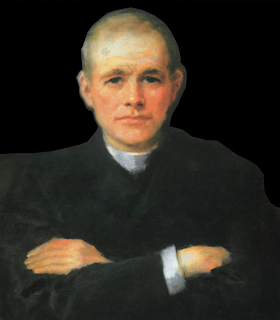
(Pictured: “Carl Hardebeck (1869-1945),” oil on canvas, National Museums NI)