seamus dubhghaill

Promoting Irish Culture and History from Little Rock, Arkansas, USA


Leave a comment

Birth of Frank Stapleton, Association Footballer & Manager

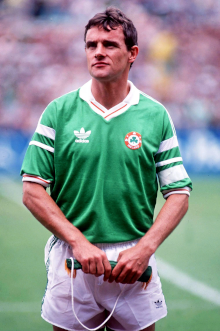
Francis Anthony Stapleton, Irish former professional association football player and manager, is born in Dublin on July 10, 1956. He is best remembered for his time at Arsenal, Manchester United and as a pivotal player for the Republic of Ireland national football team. He has also been manager at Bradford City and Major League Soccer (MLS) club New England Revolution.

Stapleton is a distinguished centre-forward, once touted as being among the best in the world in his position, and an exceptionally strong header of the ball. He starts his career with Arsenal, joining them in 1972 as an apprentice, after being turned down by Manchester United. He makes his first-team debut in March 1975, at home to Stoke City, and goes on to form a potent striking partnership with Malcolm Macdonald. The two score 46 goals between them in 1976–77. He is Arsenal’s top scorer for the three following seasons and helps the Gunners reach a trio of FA Cup finals. He scores one of the goals in Arsenal’s 1979 FA Cup Final 3–2 win over Manchester United, and scores 108 goals in 300 appearances in total for the Gunners.

Stapleton moves on to Manchester United in the summer of 1981 for £900,000 as new manager Ron Atkinson begins building a team capable of challenging for silverware after a disappointing 1980–81 season under Dave Sexton. He helps United win the 1983 and 1985 FA Cups. It is in the first of those finals, when he scores against Brighton & Hove Albion, in which he makes history by becoming the first man to score for two different clubs in FA Cup Finals. United finishes in the top four of the league in each of Stapleton’s first five seasons at Old Trafford, and comes close to winning a league title medal in the 1985–86 season after United wins their first ten league games of the season before their form slumps and they finished fourth. Atkinson is sacked and replaced by Alex Ferguson in November 1986, and Stapleton remains a regular member of the first team under the new manager, but he leaves at the end of the season to sign for Ajax. There, he makes just six appearances and scores one goal before quickly being moved to Belgian side Anderlecht at the end of 1987, followed by a three-month loan back to England with Derby County. He then plays for French club Le Havre for a season, before returning to England with Blackburn Rovers in 1989, followed by moves to Aldershot, Huddersfield Town (as player-coach) and Bradford City.

After three seasons as player-manager at Bradford, Stapleton is sacked following their narrow failure to qualify for the Division Two playoffs at the end of the 1993-94 season. He then has a brief spell at Brighton & Hove Albion in the 1994–95 season, playing two games before finally announcing his retirement as a player.

Stapleton also wins 71 caps for the Republic of Ireland national team, scoring a then record 20 goals. He makes his international debut under then player-manager Johnny Giles in a friendly against Turkey in Ankara in 1976 at 20 years of age. He scores after only three minutes of his debut when he heads home a Giles free-kick at the near post. That friendly international finishes 3–3 and marks the start of a magnificent international career for the quiet and reserved Stapleton.

Stapleton is committed to international football insisting that an “international release clause” be inserted to all of his contracts so that he can be released to play in international games for Ireland.

Stapleton plays a significant role in Ireland’s attempt to qualify for the 1982 FIFA World Cup in Spain in 1982. Goals against Cyprus, the Netherlands and France by him in the qualifying matches are not enough as Ireland is denied a place at the World Cup by a superior French goal difference. He is made captain of the national team for the qualifying campaign for the 1986 FIFA World Cup though Ireland fails to emulate their fine performance in the 1982 qualifiers.

Jack Charlton takes over as the Irish manager in 1986 and he keeps Stapleton as captain despite a sometimes uneasy relationship between the two men. Stapleton scores a magnificent diving header in the opening UEFA Euro 1988 qualifier against Belgium in the 2–2 draw at the Heysel Stadium, Brussels, that September. He also scores in the 2–1 defeat by Bulgaria in Sofia on April 1, 1987, with another goal against Luxembourg in the 2–1 victory at Lansdowne Road the following September.

Stapleton captains the Irish team to the 1988 Euro finals and plays in all of their matches during the competition including Ireland’s famous victory against England.

After the 1988 European Championships Stapleton remains on the fringe of the national team during qualification for 1990 FIFA World Cup in Italy making just two appearances late in the campaign. By then, his 20 goals for the Republic had made him the national side’s all-time leading goalscorer, a record which is broken ten years later by Niall Quinn, who is in the early stages of his own international career when Stapleton bows out of the international scene. He does, however, score an 87th-minute goal against Malta in a 3–0 friendly in Valletta just prior to those finals in Italy.

Stapleton moves to the United States to manage Major League Soccer side New England Revolution in 1996. In the 2003–04 season he briefly returns to English football as a specialist coach of Bolton Wanderers. The Bolton manager, Sam Allardyce, wants Stapleton to enhance the skills of the strikers at the club and sees the Irishman as an ideal candidate, given his successful playing career.

Stapleton is appointed assistant manager to former teammate Ray Wilkins with Jordan on September 3, 2014.


Leave a comment

Birth of Kevin Moran, Gaelic & Association Footballer

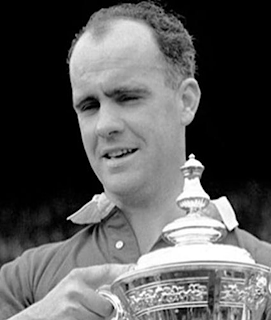
Kevin Bernard Moran, Irish footballer who excels at the top levels of Gaelic and association football, is born in Dublin on April 29, 1956. In Gaelic football, he is known for his time at senior level with the Dublin county football team, winning two All-Ireland Senior Football Championships with them, and in association football for his career with Manchester United F.C. and the Republic of Ireland national football team. In 1985 he becomes the first man to be sent off in an FA Cup Final.

Moran grows up in Rialto, Dublin until his early teens, before he moves to the Long Mile Road in Walkinstown. While there, he attends James’s Street CBS and Drimnagh Castle Secondary School where Gaelic football is the dominant sport although association football proves to be the sport he plays on the streets while growing up. During the period in which he plays Gaelic football for Good Counsel GAA and association football for Rangers A.F.C., Bohemian F.C. and Pegasus A.F.C., he has divided loyalties between the two sports, as both sports are then played on Saturday.

In his native Ireland, Moran plays at senior level for the Dublin county football team. A former Dublin under-21 player, he is called up to the senior panel for the first time in 1976. He wins two All-Ireland Championship medals with Dublin in 1976 and 1977. In the 1976 final, he helps Dublin to defeat (by 3–8 to 0–10) Kerry, the winner over Dublin in the 1975 final, and again in the 1977 semi-final, aided by new tactics which manager Kevin Heffernan introduces, and which hinders Kerry’s tactic of pulling defenders forward and taking full advantage of the space behind the half-back line. The 1977 final results in a 5–12 to 3–6 victory over Armagh at Croke Park. He is awarded a GAA GPA All-Stars Award for his performance in the 1976 championship.

Moran is also part of the 1976–77 side that wins the National Football League for Dublin with a win over Derry in the final. He plays his club football for Dublin-based GAA club Good Counsel.

With Bohemian F.C. winning everything bar the FAI Cup in the 1974-75 League of Ireland season, 18-year-old Moran does not have an opportunity for much game time and only makes one League of Ireland appearance in the last game of the season on April 17, 1975. After Bohs he moves to University College Dublin A.F.C. where in December 1975 he wins the Collingwood Cup. In February 1976 he wins the Universities Championship when he scores the winner for the Irish Universities against their Scottish counterparts. He plays for Pegasus A.F.C. from 1976-78.

Moran is spotted by Billy Behan, a Manchester United F.C. scout, who reports to United manager Dave Sexton, and Moran signs for Manchester United in February 1978. He makes his senior debut on April 20, 1979, against Southampton F.C., and is a regular player in the first team by the time Ron Atkinson succeeds Sexton as manager in June 1981. Despite not being the tallest of defenders, he is known for his strong aerial ability and is a threat in the box from corners and set pieces. Playing as a centre-back, he wins FA Cup medals with the club in 1983 and 1985.

Moran is notable for being sent off in the 1985 FA Cup Final against Everton F.C., the first player ever to be sent off in an FA Cup final. TV cameras reveal that he had gone for the ball, and not for Peter Reid in the offending tackle. He is later presented with the winner’s medal that had at first been withheld.

After 10 years with United, Moran leaves Old Trafford as a 32-year-old in the summer of 1988, having played his final 18 months at the club under the management of Alex Ferguson. His first team opportunities are limited since the arrival of Steve Bruce in December 1987.

Moran transfers to Sporting Gijón, where he remains for two seasons, making 33 appearances without scoring. During his time at Sporting Gijón, he rooms with promising youngster and future Real Madrid CF and FC Barcelona star Luis Enrique.

In 1990, Moran returns to England to join Second Division Blackburn Rovers F.C. He is an automatic choice in the first team but endures a disappointing first season at Ewood Park as Rovers finishes 19th in the Second Division. The following season is a huge success, however, as playoff victory ends the club’s 26-year exile from the top division and secures their place in the new Premier League. He continues in his role as club captain as Rovers finishes fourth in 1992–93 and runners-up in 1993–94. He retires at the end of the 1993–94 season, one year before Rovers wins their first league title in 81 years. In both seasons preceding his retirement, Rovers are beaten to the title by his old club, Manchester United.

Moran makes his debut for the Republic of Ireland against Switzerland in 1980 and plays a key role in Ireland’s unsuccessful attempt to qualify for the 1982 FIFA World Cup finals in Spain. He plays 71 times for Ireland between 1980 and 1994, including UEFA Euro 1988 in Germany and the 1990 FIFA World Cup in Italy, and scores 6 goals. He is also a member of the Irish squad at the 1994 FIFA World Cup in the United States, despite being 38 years old and about to retire from playing completely but does not play due to an injury he picks up before the tournament starts.

After retiring from football, Moran makes a career in business. In 1994, he forms a football agency, Proactive Sports Management, with Paul Stretford and Jesper Olsen. His own clients include John O’Shea and Steve Finnan. He also works as a pundit on Irish television channel TV3.

Moran’s brother Ray is a knee specialist known as “Dr. Cruciate” and as a “surgeon to the stars,” with clients including rock star Jon Bon Jovi and numerous athletes (such as Bernard Brogan, Colm Cooper, Brendan Maher, Alan Quinlan and Josh van der Flier). Moran sits on the board of his brother’s Sports Surgery Clinic (SSC) in Santry, Dublin, which opens in 2007.


Leave a comment

Birth of Steve Morrow, Professional Footballer & Manager

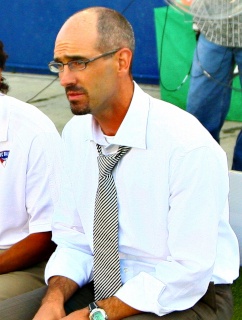
Stephen Joseph Morrow, Northern Irish former professional footballer and manager, is born on July 2, 1970, in Belfast, Northern Ireland.

Morrow makes his full international debut for Northern Ireland in May 1990 against Uruguay. He goes on to win 39 caps for his country from then until 1999.

Morrow becomes a semi-regular with Arsenal in 1992–93. He plays most of his matches in midfield, replacing the injured Paul Davis as Arsenal reaches the League Cup and FA Cup finals. He starts the League Cup final against Sheffield Wednesday. After falling behind to a John Harkes goal, Arsenal equalises through Paul Merson, and then Merson sets up Morrow to score the winner, which is also his first for the club. In the celebrations after the match, Arsenal skipper Tony Adams attempts to pick up Morrow and parade him on his shoulders, but Adams slips, and Morrow awkwardly hits the ground. He breaks his arm and has to be rushed to hospital.

As a result, Morrow misses the rest of that season, including the 1993 FA Cup Final, where Arsenal completes the Cup Double. Before the final kicks off, he receives his League Cup winners’ medal.

Morrow is fit enough by the start of the next season but plays only 13 matches, compared to 25 the previous season. One of those is the scene of an Arsenal triumph, the club’s 1994 European Cup Winners’ Cup Final win over Parma. In an Arsenal midfield depleted of John Jensen and David Hillier, he makes his first appearance in the competition that season partnering 20-year-old Ian Selley in central midfield as Arsenal beats Parma 1–0 with an Alan Smith goal.

Morrow nearly leaves the club in March 1994, following an approach from the Premier League‘s bottom club Swindon Town, but the transfer falls through and he signs a new contract with Arsenal, where he spends three more years.

Morrow goes on to play over 20 matches the following season, including a second Cup Winners’ Cup final, which Arsenal loses to Real Zaragoza. He scores his second Arsenal goal in the League Cup once again against Sheffield Wednesday, and scores his first Arsenal league goal in a 3–1 defeat at Blackburn Rovers, who win the Premier League that season. However, he never finds favour under new Arsenal boss Bruce Rioch, who only gives the Irishman five matches in 1995–96.

After the arrival of Arsène Wenger in 1996, Morrow is told he is surplus to requirements at Highbury, and he is loaned to Queens Park Rangers (QPR) in March 1997, the deal being made permanent that summer. He plays 85 games for Arsenal in total, scoring three goals.

At QPR, Morrow is initially a regular, but the club struggles, going from contenders for promotion to the Premiership to facing relegation to the Football League Second Division. Injuries to his shoulder ligaments ruled him out for most of the 1999–2000 season, and he loses his place in the side. He later has a loan spell at Peterborough United, but it does not become permanent, and he is released on a free transfer in the summer of 2001.

Struggling to find a club in the United Kingdom, Morrow moves to the United States to play for Major League Soccer (MLS) side Dallas Burn. He spends two seasons at Dallas, who rename themselves FC Dallas in 2004, before retiring because of a persistent neck injury.

On February 3, 2004, Morrow is named as an assistant coach to FC Dallas but resigns in late May due to personal reasons. However, he returns to the club on January 27, 2005, under coach Colin Clarke. When Clarke is fired on November 7, 2006, Morrow is named interim head coach. On December 11, 2006, FC Dallas removes the ‘interim’ from his title. He is fired as coach on May 20, 2008.

On September 12, 2008, Morrow returns to Arsenal as International Partnerships – Performance Supervisor, managing Arsenal’s international partnerships, which includes the Colorado Rapids of Major League Soccer in the United States, BEC Tero of Thailand and Hoàng Anh Gia Lai of Vietnam, and assisting Arsenal’s academies in countries such as Egypt and Ghana. From 2014, he works as Arsenal’s head of youth development. He leaves Arsenal in 2019 following a coaching staff shake up.

On May 7, 2021, Morrow is appointed The FA’s head of player selection and talent strategy working across England men’s teams.


Leave a comment

Death of Elisha Scott, Northern Irish Goalkeeper

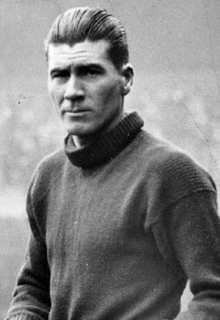
Elisha Scott, Northern Irish football goalkeeper, dies in Belfast on May 16, 1959. He plays for Liverpool from 1912 to 1934 and still holds the record as their longest-serving player.

Scott is born in Belfast on August 24, 1893. He plays for Linfield and Broadway United before Liverpool manager Tom Watson signs him on September 1, 1912, following a recommendation from Scott’s older brother Billy Scott. Liverpool only gets the opportunity to sign Scott when Everton decides that the 19-year-old is too young.

Scott is reported as signed by Crewe Alexandra in August 1913, presumably under some sort of loan arrangement. He succeeds Thomas Charles Allison as deputy for the first-choice keeper, Arthur Box, and plays for them in the early part of the 1913-14 season.

Scott finally makes his Liverpool debut on January 1, 1913, at St. James’ Park. The team plays Newcastle United to a 0–0 draw.

During the early days of his career, Scott is understudy to Kenny Campbell and only appears occasionally. World War I interrupts his career for four years. He finally gets a chance of a run in the Liverpool goal at the end of the season. His goalkeeping position is set in stone when Campbell is allowed to leave in April 1920. He establishes himself as Liverpool’s number one. He is a major part of the back-to-back Championship winning teams of 1922 and 1923, missing just three games of the first title and none in the second.

Numerous stories about Scott exist in Liverpool folklore. One such story relates to a 1924 game, after Scott has just made a phenomenal save at Ewood Park against Blackburn Rovers. A man appearing from the crowd goes over to Scott and kisses him. He is part of one of the legendary rivalries of the day along with Everton’s Dixie Dean. The two of them are the main topic of discussion when the day of the Merseyside derby is approaching. Everton declares that Dean will score while Liverpool disagrees, saying Scott will not let a single shot past. A famous story, possibly apocryphal, associated with the two men is that of how they once encountered each other in Belfast city centre the day before an Ireland versus England game. Dean, famed for his remarkable heading ability, touches his hat and nods to Scott as they are about to pass. Scott responds by diving as if to try to save an imaginary header, much to the initial shock and then delight of the locals who witness it while a mildly shocked Dean smiles and quietly continues on his walk.

Towards the end of the decade, Scott loses his starting position to another Liverpool goalkeeper, Arthur Riley, but he never gives up the battle for the position of goalkeeper. However, at the beginning of the 1930s it becomes more and more difficult for Scott to get into the line-up. Eventually he asks if he can return to his homeland when his old team Belfast Celtic offers him a player-manager role in 1934. Liverpool consents. He plays the last of his 467 appearances at Chelsea on February 21, 1934, where Chelsea defeats Liverpool 2–0.

Upon Liverpool’s final home match of the season Scott heads to the director’s box to give his adoring fans a farewell speech. He plays his final game for the Belfast club in 1936 at the age of 42. In his time as manager of the Celtics, he wins ten Irish League titles, six Irish Cups, three City Cups, eight Gold Cups and five County Antrim Shields.

Scott dies in Belfast on May 16, 1959, and is buried in Belfast City Cemetery.