The Ulster Volunteer Force (UVF) explodes a bomb at McGurk’s Bar, an Irish Catholic-owned pub in Belfast, on December 4, 1971, killing fifteen Catholic civilians including two children and wounding seventeen others. This is the highest death toll from a single incident in Belfast during the Troubles. The bombing sparks a series of tit-for-tat bombings and shootings by loyalists and republicans, which help make 1972 the bloodiest year of the conflict.
On the evening of Saturday, December 4, 1971, a four-man UVF team meets in the Shankill area of Belfast and are ordered to bomb a pub on North Queen Street. According to the only convicted bomber, Robert Campbell, they are told not to return until the job is done. Campbell says that their target had not been McGurk’s, but another pub nearby. It is believed this is a pub called The Gem, which is allegedly linked to the Official Irish Republican Army (IRA). The 50-pound bomb is disguised as a brown parcel, which they place in a car and drive to their target. Campbell says they stop near The Gem at about 7:30 p.m. but are unable to gain access to it because there are security guards outside. After waiting for almost an hour, they drive a short distance to McGurk’s. At about 8:45 PM, one of them places the bomb in the porch entrance on Great George’s Street and rushes back to the car. It explodes just moments after they drive off. Campbell implies that McGurk’s had been chosen only because it was “the nearest Catholic pub.”
The blast causes the building to collapse. Bystanders immediately rush to free the dead and wounded from the rubble. Firefighters, paramedics, police, and soldiers are quickly on the scene. Fifteen Catholic civilians are killed, including two children, and an additional seventeen are wounded. The rescue effort lasts many hours.
Within two hours of the blast, a sectarian clash erupts nearby at the New Lodge–Tiger’s Bayinterface. The British Army and Royal Ulster Constabulary (RUC) move in, and a gun battle develops. A British Army officer, Major Jeremy Snow, is shot by the IRA on New Lodge Road and dies of his wounds on December 8. Two RUC officers and five civilians are also wounded by gunfire. Eventually, five companies of troops are sent into the district, and they search almost 50 houses.
Meanwhile, the UVF team has driven to a nearby pickup point where they dump their car. They walk to the area of St. Anne’s Cathedral and are picked up by another car. They are driven back to the Shankill area and meet the man who had ordered the attack in an Orange Hall, telling him that “the job has been done.”
Among those killed are Philomena and Maria McGurk, wife and 12-year-old daughter of pub owner Patrick McGurk. Patrick and his three sons are seriously injured. Shortly after the attack, McGurk appears on television calling for no retaliation, “It doesn’t matter who planted the bomb. What’s done can’t be undone. I’ve been trying to keep bitterness out of it.”
In March 1976, the RUC receives intelligence that links UVF member Robert Campbell and four others to the McGurk’s bombing. Campbell is arrested on July 27, 1977, and held at Castlereagh RUC base. He admits his part in the bombing but refuses to name the others.
On July 29, 1977, Campbell is charged with 15 counts of murder and 17 counts of attempted murder. On September 6, 1978, he pleads guilty to all charges and receives life imprisonment with “a recommendation to serve no less than 20 years,” in part for a separate conviction for the murder of a Protestant delivery driver in 1976. He is the only person to have been charged for the bombing. He eventually serves fifteen years in prison and is released on September 9, 1993.
Patrick Henry Pearse, teacher, barrister, poet, writer, nationalist, and political activist who is one of the leaders of the 1916 Easter Rising, is born in Dublin on November 10, 1879. Pearse’s father, James, is a stone worker who works on church buildings in Dublin and his mother, Margaret, comes from a family that has endured the Great Famine in 1846 and has left County Meath for Dublin. Here she brings up four children, Patrick being the second. Pearse has a comfortable childhood as his father is in constant work.
It is at school that Pearse first develops a love of Irish history. He is also taught the Irish language for the first time and while still a teenager, Patrick joins the Gaelic League, an organisation that wants to promote the Irish language and Irish literature. Pearse graduates with a law degree from the King’s Inns and, in 1901, he starts a BA course in modern languages but is called to the Bar in Dublin.
Regardless of his law training, Pearse is more interested in what he is learning about Ireland as a nation. All his knowledge about law has been based around the English language and he wants to know more about what he considers to be the rightful language of Ireland. This is not the Gaelic used in Dublin. Pearse has convinced himself that the real Irish language is based in Connaught, and he teaches himself the dialect of the area. Connaught is also a region that has been severely affected by the Great Famine. Therefore, the number of people who speak what Pearse considers to be proper Gaelic have been greatly reduced. From 1903 to 1909, Pearse develops his involvement in the Gaelic League’s An Claidheamh Soluis (The Sword of Light) which seeks to expand the use of Gaelic in Irish life, and, in particular, literature.
By 1909, Pearse has developed some political leanings. He cannot accept the impact England, and all things English have on Ireland and the Irish people, but his concern is more for Irish culture rather than Irish politics. Pearse wants Irish history and culture taught as compulsory subjects in both Irish schools and colleges. He breaks with the Roman Catholic Church when its national college, St. Patrick’s College, Maynooth, demotes courses in Irish history/culture to topics for trainee priests. He is keen for Maynooth to have compulsory Irish courses simply because priests then have a major influence in the areas where they work. However, all of Pearse’s protests fall on deaf ears. As a result, he founds his own school in Dublin, an “Irish-Ireland” school called St. Enda’s School.
Between 1909 and 1912, Pearse becomes more interested and involved in politics. Despite a limited income and the problems of keeping St. Edna’s on an even financial keel, Pearse launches his own newspaper called An Barr Buadh (The Trumpet of Victory). At this time the Home Rule issue has reared its head again. Sinn Féin and other republican movements have far more impact than Pearse, who seems to many to be no more than a political maverick. Many feel that Pearse is out of his depths in politics and that his input into Irish politics is no more than romanticism with an Irish slant.
By 1913, Pearse has become more depressed about the way Ireland is going under the rule of London. Those who know him, describe him as becoming more and more melancholy as the year progresses. Others believe that he is becoming more fanatical. He helps to organise the Irish Volunteers, the public face of the outlawed Irish Republican Brotherhood, before the outbreak of World War I. In 1914, he is sent on a fund-raising tour of America by Clan na Gael, an organisation that aids the Irish Republican Brotherhood. While the tour is a reasonable success financially, not many Americans are swayed by Pearse’s speeches.
By the time World War I starts, Pearse has taken an extreme political stance. He wants full Irish independence – not what the suspended Home Rule Bill of 1912 offers. He does not support the part Ireland plays in the war effort. He also splits the Irish Volunteers. He takes a small number of these men with him when John Redmond gives his agreement to suspend the Home Rule Bill until the war is over. By now, Pearse has become extreme. He publishes a pamphlet called The Murder Machine which is a severe condemnation of the Irish educational system. He also realises that with London totally focused on the war in Europe, the time is ripe to overthrow British rule in Ireland.
However, in this respect, Pearse is totally wrong. The young men who have volunteered to fight in the war have done so because they want to. Pearse has no mass support in Ireland whereas John Redmond has far more public support in the south. He also assumes incorrectly that all those in southern Ireland are completely against British rule. What Pearse fails to recognise, is that many people in Dublin itself rely on the British for work. They may not like this, but work brings in money regardless of where or who it comes from.
Those who participate in the Easter Uprising of 1916 are in the minority. Pearse decides to take command of the rebellion, and he reads aloud the declaration of independence at the General Post Office. Pearse also is one of the signatories of “Poblacht na hÉireann” (To the People of Ireland).
If Pearse expects the actions of the rebels in Dublin to spark off other uprisings in other Irish cities and towns, he is mistaken. In Dublin, the people of the city fail to offer the rebels any support. In fact, some Dubliners take the opportunity of the rebellion to loot the shops in Sackville Street. The Uprising is doomed from the start.
During the rebellion, Pearse says, “When we are all wiped out, people will blame us for everything, condemn us…. (but) in a few years they will see the meaning of what we tried to do.” Ironically, he is correct in this assessment.
On Friday, April 28, 1916, Pearse surrenders to the British army. By the following day all the rebels have surrendered. As they are paraded through the streets of Dublin before going to Kilmainham Gaol, they are jeered and verbally abused by Dubliners who have seen parts of their city destroyed. They blame Pearse and his followers rather than the British.
At Kilmainham Gaol, Pearse is charged with treason by a military court and sentenced to death. On May 16, Pearse is shot by firing squad. Eventually fourteen other rebel leaders are also executed by firing squad. Pearse’s body, and those of the other leaders, are thrown into a pit without a coffin or a burial service. Ironically, it is in death that Pearse finds real fame.
No one knows the fate of the rebel leaders until after the executions. Many in Ireland are horrified at the way they have been treated. If Pearse had not received national support during his life, his movement certainly received it after his death. Pearse had written that he wanted his fame and deeds to “live after me.” In death, Patrick Pearse is known as the “First President of Ireland” and Irish history and culture become part of the educational system after 1922.
Charles Edgeworth Cagney Lynch, Irish pianist who premiers works by several important 20th-century composers, is born in Parkgariff, County Cork, on October 22, 1906.
Lynch’s father is a British army colonel and his mother comes from a well-known Cork business dynasty, the Suttons. While still a young boy, the family moves to Greenock in western Scotland and it is there, at the Tontine Hotel, that the young pianist gives his first public recital at the age of nine. When he is fifteen, he wins a scholarship to the Royal Academy of Music in London, where he studies under York Bowen and, later, Egon Petri.
Lynch becomes a popular recitalist in London during the 1920s and 1930s. He gives the first performance in England of Sergei Rachmaninoff‘s Piano Sonata No. 2 in B flat minor, having been coached beforehand by the composer. Sir Arnold Bax‘s Fourth Piano Sonata (1932) is dedicated to the 26-year-old Lynch, whom Bax later describes as “Ireland’s most imaginative pianist.” In addition to concert recitals he broadcasts regularly with the BBC and, in 1937, acts as assistant to Sir Thomas Beecham at Covent Garden. Lynch is the Ballet Rambert‘s pianist for many years, having helped Marie Rambert form the company.
A pacifist, Lynch returns to Ireland following the outbreak of World War II, where he becomes the country’s premier concert pianist. During this phase of his career he premiers a number of works by leading Irish composers, including Brian Boydell‘s Sonata for Cello and Piano (1945) and Sean Ó Riada‘s Nomos No. 4 (1959). Lynch also performs in the world première of English composer Ernest John Moeran‘s Cello Sonata in A minor, given in Dublin in May 1947. He is joined by the composer’s wife, cellist Peers Coetmore.
Lynch continues to give public recitals throughout Ireland until shortly before his death at the age of 77. He also lectures in music at University College Cork and gives masterclasses at the Cork School of Music. In 1982, Lynch receives a doctorate in music from the National University of Ireland.
Lynch’s technique is remarkable for the stillness with which he sits, making the most difficult of music seem almost technically unremarkable. His recorded legacy is small, but includes music by Samuel Barber, Ernest John Moeran‘s Violin Sonata (with Geraldine O’Grady, violin) as well as music by Irish composers such as Aloys Fleischmann.
Toward the end of his life he lives in very reduced circumstances. He dies in Cork on September 15, 1984 at St. Finbarr’s Hospital and is buried near Sir Arnold Bax in St. Finbarr’s Cemetery, Glasheen Road, Cork.
After Pantridge’s liberation he works as a lecturer in the pathology department at Queen’s University, and then wins a scholarship to the University of Michigan, where he studies under Dr. F.N. Wilson, a cardiologist and authority on electrocardiography.
Pantridge returns to Northern Ireland in 1950 and is appointed as cardiac consultant to the Royal Victoria Hospital, Belfast and professor at Queen’s University, where he remains until his retirement in 1982. There he establishes a specialist cardiology unit whose work becomes well known.
By 1957, Pantridge and his colleague, Dr. John Geddes, introduce the modern system of cardiopulmonary resuscitation (CPR) for the early treatment of cardiac arrest. Further study leads Pantridge to the realization that many deaths result from ventricular fibrillation which needs to be treated before the patient is admitted to hospital. This leads to his introduction of the mobile coronary care unit (MCCU), an ambulance with specialist equipment and staff to provide pre-hospital care.
To extend the usefulness of early treatment, Pantridge goes on to develop the portable defibrillator, and in 1965 installs his first version in a Belfast ambulance. It weighs 70 kg and operates from car batteries. By 1968 he has designed an instrument weighing only 3 kg, incorporating a miniature capacitor manufactured for NASA.
His work is backed up by clinical investigations and epidemiological studies in scientific papers, including an influential 1967 The Lancet article. With these developments, the Belfast treatment system, often known as the “Pantridge Plan”, becomes adopted throughout the world by emergency medical services. The portable defibrillator becomes recognised as a key tool in first aid, and Pantridge’s refinement of the automated external defibrillator (AED) allows it to be used safely by members of the public.
Although he is known worldwide as the “Father of Emergency Medicine,” Frank Pantridge is less acclaimed in his own country, and is saddened that it takes until 1990 for all front-line ambulances in the United Kingdom to be fitted with defibrillators.
He died in Hillsborough at the age of 88 on Boxing Day, December 26, 2004. He never married.
Chaim Herzog, Israeli politician, general, lawyer, and author who serves as the sixth President of Israel between 1983 and 1993, is born in Cliftonpark Avenue in Belfast on September 17, 1918.
Herzog joins the British Army during World War II, operating primarily in Germany as a tank commander in the Armoured Corps. There, he is given his lifelong nickname of “Vivian” because the British could not pronounce the name, “Chaim.” A Jewish soldier had volunteered that “Vivian” is the English equivalent of “Chaim.”
After leaving the army, Herzog opens a private law practice. He returns to public life when the Six-Day War breaks out in 1967, serving as a military commentator for Kol Israel radio news. Following the capture of the West Bank, he is appointed Military Governor of East Jerusalem, and Judea and Samaria.
Herzog enters politics in the 1981 elections, winning a Knesset seat as a member of the Alignment. Two years later, in March 1983, he is elected to the largely ceremonial role of President. He serves two five-year terms before retiring in 1993. He dies on April 17, 1997, and is buried on Mount Herzl, Jerusalem. His son, Isaac Herzog, has led the Israeli Labour Party and the parliamentary Opposition in the Knesset since 2013.
John Devoy, one of the most devoted revolutionaries the world has ever seen, is born in Kill, County Kildare, on September 3, 1842. Dedicating over 60 years of his life to the cause of Irish freedom, he is one of the few people to have played a leading role in the Fenian Rising of 1867, the 1916 Easter Rising, and the Irish War of Independence (1919 – 1921).
After the Great Famine, the family moves to Dublin where Devoy’s father obtains at job at Watkins’ brewery. Devoy attends night school at the Catholic University before joining the Fenians. In 1861 he travels to France with an introduction from Timothy Daniel Sullivan to John Mitchel. Devoy joins the French Foreign Legion and serves in Algeria for a year before returning to Ireland to become a Fenian organiser in Naas, County Kildare.
In 1865, when many Fenians are arrested, James Stephens, founder of the Irish Republican Brotherhood (IRB), appoints Devoy Chief Organiser of Fenians in the British Army in Ireland. His duty is to enlist Irish soldiers in the British Army into the IRB. In November 1865 Devoy orchestrates Stephens’ escape from Richmond Prison in Dublin.
In February 1866 an IRB Council of War calls for an immediate uprising but Stephens refuses, much to Devoy’s annoyance, as he calculated the Fenian force in the British Army to number 80,000. The British get wind of the plan through informers and move the regiments abroad, replacing them with regiments from Britain. Devoy is arrested in February 1866 and interned in Mountjoy Gaol, then tried for treason and sentenced to fifteen years penal servitude. In Portland Prison Devoy organises prison strikes and, as a result, is moved to Millbank Prison in Pimlico, London.
In January 1871, he is released and exiled to the United States as one of the “Cuba Five.” He receives an address of welcome from the House of Representatives. Devoy becomes a journalist for the New York Herald and is active in Clan na Gael. Under Devoy’s leadership, Clan na Gael becomes the central Irish republican organisation in the United States. In 1877 he aligns the organisation with the Irish Republican Brotherhood in Ireland.
Devoy’s fundraising efforts and work to sway Irish Americans to physical force nationalism makes possible the Easter Rising in 1916. In 1914, Patrick Pearse visits the elderly Devoy in America, and later the same year Roger Casement works with Devoy in raising money for guns to arm the Irish Volunteers. Though he is skeptical of the endeavor, he finances and supports Casement’s expedition to Germany to enlist German aid in the struggle to free Ireland from English rule. Also, before and during World War I, Devoy is also identified closely with the Ghadar Party, and is accepted to have played a major role in supporting Indian Nationalists, as well as playing a key role in the Hindu-German Conspiracy which leads to the trial that is the longest and most expensive trial in the United States at the time.
In 1916 Devoy plays an important role in the formation of the Clan-dominated Friends of Irish Freedom, a propaganda organization whose membership totals 275,000 at one point. The Friends fail in their efforts to defeat Woodrow Wilson for the presidency in 1916. Fearful of accusations of disloyalty for their cooperation with Germans and opposition to the United States’ entering the war on the side of Great Britain, the Friends significantly lower their profile after April 1917. Sinn Féin‘s election victories and the British government’s intentions to conscript in Ireland in April 1917 help to revitalize the Friends.
With the end of the war, Devoy plays a key role in the Friends’ advocacy for not the United States’ recognition of the Irish Republic but, in keeping with President Wilson’s war aims, self-determination for Ireland. The latter does not guarantee recognition of the Republic as declared in 1916 and reaffirmed in popular election in 1918. American Irish republicans challenge the Friends’ refusal to campaign for American recognition of the Irish Republic. Not surprisingly, Devoy and the Friends’ Daniel F. Cohalan become the key players in a trans-Atlantic dispute with de facto Irish president Éamon de Valera, touring the United States in 1919 and 1920 in hopes of gaining U.S. recognition of the Republic and American funds. Believing that the Americans should follow Irish policy, de Valera forms the American Association for the Recognition of the Irish Republic in 1920 with help from the Philadelphia Clan na Gael.
Devoy returns to Ireland and in 1919 addresses Dáil Éireann. He later supports the Anglo-Irish Treaty of 1921. Devoy is editor of The Gaelic American from 1903 until his death in Atlantic City on September 29, 1928. His body is returned to Ireland and buried in Glasnevin Cemetery. A large memorial to him stands on the road between his native Kill and Johnstown.
The Great Dublin Lockout, a major industrial dispute between approximately 20,000 workers and 300 employers, begins in Dublin on August 26, 1913, and lasts until January 18, 1914. It is often viewed as the most severe and significant industrial dispute in Irish history.
Irish workers live in terrible conditions in tenements. The infant mortality rate among the poor is 142 per 1,000 births, extraordinarily high for a European city. Poverty is perpetuated in Dublin by the lack of work for unskilled workers, who lack any form of representation before trade unions are founded.
James Larkin, the main protagonist on the side of the workers in the dispute, is a docker in Liverpool and a union organiser. In 1907 he is sent to Belfast as local organiser of the British-based National Union of Dock Labourers (NUDL). His tactic of the sympathetic strike is deemed highly controversial and as a result Larkin is transferred to Dublin.
Larkin sets about organising the unskilled workers of Dublin, which is a cause of concern for the NUDL, who are reluctant to engage in a full-scale industrial dispute with the powerful Dublin employers. They suspended Larkin from the NUDL in 1908. Larkin then leaves the NUDL and sets up the Irish Transport and General Workers’ Union (ITGWU), the first Irish trade union to cater for both skilled and unskilled workers.
Another important figure in the rise of an organised workers’ movement in Ireland at this time is James Connolly, an Edinburgh-born Marxist of Irish parentage. In 1911, Connolly is appointed the ITGWU’s Belfast organiser. In 1912, Connolly and Larkin form the Irish Labour Party to represent workers in the imminent Home Rule Bill debate in Parliament.
Foremost among employers opposed to trade unionism in Ireland is William Martin Murphy, Ireland’s most prominent capitalist, born in Castletownbere, County Cork. In 1913, Murphy is chairman of the Dublin United Tramway Company and owns Clery’s department store. Murphy is vehemently opposed to trade unions, which he sees as an attempt to interfere with his business. In particular, he is opposed to Larkin, whom he sees as a dangerous revolutionary.
The resulting industrial dispute is the most severe in Ireland’s history. Employers in Dublin lock out their workers and employ blackleg labour from Britain and elsewhere in Ireland. Dublin’s workers apply for help and are sent £150,000 by the British Trades Union Congress (TUC) and other sources in Ireland, doled out dutifully by the ITGWU.
The “Kiddies’ Scheme,” allowing for the starving children of Irish strikers to be temporarily looked after by British trade unionists, is blocked by the Roman Catholic Church and especially the Ancient Order of Hibernians, who claim that Catholic children will be subject to Protestant or atheist influences when in Britain. The Church supports the employers during the dispute, condemning Larkin as a socialist revolutionary.
Guinness, the largest employer and biggest exporter in Dublin, refuses to lock out its workforce. It has a policy against sympathetic strikes and expects its workers, whose conditions are far better than the norm in Ireland, not to strike in sympathy. Six who do strike are dismissed.
Strikers use mass pickets and intimidation against strike breakers, who are also violent towards strikers. The Dublin Metropolitan Policebaton charge worker’s rallies, including a rally on Sackville Street which results in two deaths and over 300 injuries. James Connolly, Larkin, and ex-British Army Captain Jack White form a worker’s militia, the Irish Citizen Army, to protect workers’ demonstrations.
For seven months, the lockout affects tens of thousands of Dublin families. The lock-out eventually concludes in January 1914, when the Trades Union Congress (TUC) in Britain rejects Larkin and Connolly’s request for a sympathetic strike. Most workers, many of whom are on the brink of starvation, go back to work and sign pledges not to join a union. The ITGWU is badly damaged by its defeat in the Lockout and is further hit by the departure of Larkin to the United States in 1914 and the execution of Connolly, one of the leaders of the Easter Rising in 1916.
Although the actions of the ITGWU are unsuccessful in achieving substantially better pay and conditions for workers, they mark a watershed in Irish labour history. The principle of union action and workers’ solidarity has been firmly established. No future employer would ever try to “break” a union in the way that Murphy attempted with the ITGWU.
Father Willie Doyle, an Irish Jesuit priest, is killed in action on August 16, 1917, during the World War I.
Born William Joseph Gabriel Doyle in Dalkey, County Dublin, on March 3, 1873, Doyle is the youngest of seven children of Hugh and Christine Byrne Doyle. He is educated at Ratcliffe College, Leicester. After reading St. Alphonsus’ book Instructions and Consideration on the Religious State he is inspired to enter the priesthood and is ordained a Jesuit priest in 1907. He serves for five years on the mission staff.
General William Bernard Hickie, the commander-in-chief of the 16th Irish Division, describes Doyle as “one of the bravest men who fought or served out here.” Doyle is awarded the Military Cross for his bravery during the assault on the village of Ginchy. He is recommended for a posthumous Victoria Cross and Distinguished Service Order but is awarded neither. Doyle is proposed for canonisation in 1938, but this is not followed through.
A stained-glass window dedicated to his memory is present in St. Finnian’s Church, Dromin, County Louth.
Francis McCloskey, a 67-year-old Catholic civilian, dies on July 14, 1969, one day after being hit on the head with a baton by an officer of the Royal Ulster Constabulary (RUC) during street disturbances in Dungiven, County Derry. McCloskey is sometimes considered to be the first fatality of The Troubles.
McCloskey is found unconscious on July 13 near the Dungiven Orange Hall following a police baton charge against a crowd who had been throwing stones at the hall. Witnesses later say they had seen police beating a figure with batons in the doorway where McCloskey is found, although police claim he had been unconscious before the baton charge and may have been hit with a stone.
The conflict is primarily political, but it also has an ethnic or sectarian dimension, although it is not a religious conflict. A key issue is the constitutional status of Northern Ireland. Unionists and loyalists, who are mostly Protestants and consider themselves British, generally want Northern Ireland to remain within the United Kingdom. Irish nationalists and republicans, who are mostly Catholic and consider themselves Irish, generally want it to leave the United Kingdom and join a united Ireland. The conflict begins amid a campaign to end discrimination against the Catholic/nationalist minority by the Protestant/unionist government and police force in 1968. The campaign is met with violence, eventually leading to the deployment of British troops and subsequent warfare.
The main participants in the Troubles are republican paramilitaries such as the Provisional Irish Republican Army (IRA) and Irish National Liberation Army (INLA), loyalist paramilitaries such as the Ulster Volunteer Force (UVF) and Ulster Defence Association (UDA), the British Army and Royal Ulster Constabulary (RUC), and political activists and politicians. The security forces of the Republic of Ireland play a smaller role. More than 3,500 people are killed in the conflict, of whom 52% were civilians, 32% are members of the British security forces, and 16% are members of paramilitary groups. There has been sporadic violence since the signing of the Good Friday Agreement, including a campaign by anti-ceasefire republicans.
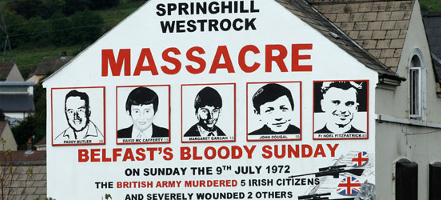
The Springhill Massacre, a shooting incident which claims five lives in the Springhill estate in west Belfast, takes place on July 9, 1972. Three civilians, including a Catholic priest, and two members of Fianna Éireann are shot dead by British Army snipers firing from a timber yard.
The Northern IrelandTroubles have been raging for three years and hundreds have already been killed by the two warring factions in Northern Ireland, unionists, including Ulster loyalists and the British Army, and Irish republicans wanting unification with the Republic of Ireland. Violence has been taking place all day and the five dead are part of ten people killed on that day.
According to a Provisional Irish Republican Army (IRA) statement on July 10, British Army snipers take up sniping positions in Corry’s timber yard and reinforced them with sandbags. Two cars pull into Springhill and the snipers fire two shots at them. One of the cars flees while the other drives a short distance and stops. The occupants get out and the snipers open fire again, seriously wounding one with a shot in the back of the head. A resident rushes to help the injured man but is immediately shot in the arm. This man’s brother and a friend run to the downed occupant, but both are shot by the snipers. At some point during this time a 13-year-old girl is fatally shot by the snipers. The parish priest, waving a white cloth, and a passer-by rush to her but a sniper kills both with a single bullet that passes through both their heads. All of the victims are unarmed.
The British Army disputes the IRA’s version of events and claims its troops were fired on first by the IRA, ending a temporary IRA ceasefire. A British Army spokesman states, “There has been a heavy exchange of fire between the IRA and troops. Some of the dead and wounded were undoubtedly caught in the crossfire.” On July 10, the British Army claims that it has killed terrorists. An open verdict is recorded at the inquest into the events.
No British soldier has been held accountable for these murders.