
seamus dubhghaill

Promoting Irish Culture and History from Little Rock, Arkansas, USA


Leave a comment

Founding of Córas Iompair Éireann

Córas Iompair Éireann (Irish for Irish Transport Company), or CIÉ, a statutory corporation of Ireland, is founded on January 1, 1945. CIÉ is answerable to the Irish Government and responsible for most public transport within the Republic of Ireland and jointly with its Northern Ireland counterpart, the Northern Ireland Transport Holding Company for the railway service between the Republic of Ireland and Northern Ireland. The company is headquartered at Heuston Station, Dublin. Its members are appointed by the Minister for Transport.

Córas Iompair Éireann is formed as a private company by the Transport Act 1944 and incorporates the Great Southern Railways Company and Dublin United Transport Company, initially adopting the logo of the latter company. Great Southern Railways (GSR) is incorporated in 1925, having been Great Southern Railway since 1924. Essentially the GSR becomes – especially as it starts to broaden its business interests into road transport – a monopoly transport operator. The Transport Act 1950 amalgamates CIÉ and the Grand Canal Company and formally nationalises CIÉ, changing its structure from that of a private limited company to a corporation under a board appointed by the Minister for Transport. The Northern Ireland Great Northern Railway Act, 1958 transfers the lines of Great Northern Railway Board south of the border to CIÉ. Until 1986 CIÉ operates as a single legal entity, although it is internally organised into rail services and two bus divisions – Dublin City Services and Provincial Services. The vast majority of services are branded CIÉ, although long-distance provincial buses are branded “Expressway” and Dublin electric trains DART. In 1987, CIÉ reorganises into a holding company and three operating companies. In 1990 it sells its nine Great Southern Hotels, including its hotel in Derry, Northern Ireland, to Aer Rianta, the airports authority.

Since the enactment of the Transport (Re-organisation of Córas Iompair Éireann) Act, 1986 CIÉ has been the holding company for Bus Éireann, Dublin Bus and Iarnród Éireann/Irish Rail, the three largest internal transport companies in Ireland. It was originally to have operated the Luas tram system in Dublin, but that project was transferred to the newly created Railway Procurement Agency.

CIÉ is responsible for the overall strategy of the group. It owns all fixed assets used by the three companies, such as railway lines and stations, the latter being dealt with through the Group Property division. It also operates an international tour division, CIÉ Tours International. CIÉ’s vast number of advertising sites are organised through Commuter Advertising Network (CAN), since the mid-1990s employing an external company (currently Exterion Media Ireland) to manage them. There are also a number of shared services provided by CIÉ to its three operating companies.

Other than in the railway sector CIÉ is not a monopoly provider of public transport services as a number of other operators exist. However, under the Transport Act, 1932, these may not compete directly on any route for which CIÉ has been granted a licence. Legislation is enacted in 2013 to provide for the tendering of 10% of routes operated by Dublin Bus and Bus Éireann. This public competition includes these two operators, along with private operators such as Go-Ahead Ireland, and is completed in January 2019.

(Pictured: “The Broken Wheel” logo introduced in 1964 and modernised in 2000)

Leave a comment

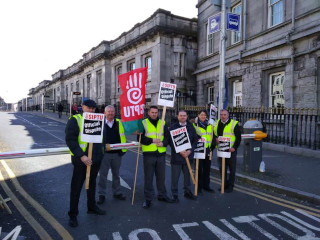
Bus Éireann Strike Over Cost-Reduction Measures

Tens of thousands of people have to make alternative travel arrangements on March 24, 2017 due to a strike at Bus Éireann over the company’s implementation of cost-reduction measures without union agreement. The bus and coach operator warns that the strike will worsen the company’s financial situation, which it describes as perilous.

Iarnród Éireann, the operator of the national railway network, says some Intercity services are affected by the dispute due to picketing. It says there is significant disruption, with some services cancelled and others curtailed. But Iarnród Éireann says special late-night trains for football fans returning from the Republic of Ireland vs. Wales match will operate to Cork, Limerick and Galway.

The Minister for Transport Shane Ross says that he will “categorically” not be intervening during the strike and calls on both sides to get back to the talks. He says an industrial relations dispute is not a matter for the minister and that both parties should go to the Workplace Relations Commission and the Labour Court for talks. He adds that the only reason people are calling on him to intervene is to pay taxpayers’ money and he says he will not be doing that. He says the company needs to reform and that can be done maturely through talks by the two sides.

Dublin Bus services operate as normal. GO-BE, the joint venture company between Bus Éireann and Go-Bus, suspends its services between Cork and Dublin and the Dublin Airport. While it is not meant to be affected by the dispute, it is understood there are issues at its base in Cork and the service is suspended. Aircoach, which has a sizable part of the market for the Cork to Dublin route, contracts ten buses from a private bus operator to meet the additional demand.

The general manager of the Irish Citylink private bus service says the company has increased their departures by 25% on the Dublin to Galway route and other services around the country to meet demands. Irish Citylink usually has 100 daily departures on services that include 14 different towns on the “off motorway route” to Dublin from Galway, but has around 25 additional buses out to meet demands.

The Services, Industrial, Professional and Technical Union (SIPTU) issues a number of steps to its members to assist in ending the strike by Bus Éireann workers. Earlier, a SIPTU official says the blame for the strike must be laid at the door of management and the Minister for Transport Shane Ross.

Divisional Organiser Willie Noone says staff had “no other choice” but to strike in an attempt to protect their livelihoods, but acknowledges that it is unfortunate for commuters. He says that the unions had worked hard to keep staff at work to this point given the anger at company proposals to cut pay.

National Bus and Rail Union General Secretary Dermot O’Leary says disputes such as that at Bus Éireann are solved by discussions sitting around a table behind closed doors and that is where his union would like to be. He acknowledges the strike will exacerbate financial problems at Bus Éireann, but says his members have demanded for many weeks this action be taken in response to what the company has done since January.

Stephen Kent, Chief Commercial Officer with Bus Éireann, apologises to customers for the “highly regrettable” inconvenience caused by the strike. He says the company has run out of time and absolutely needs to implement the cost-cutting measures it has put forward. He adds that the company is doing everything it can to minimise all non-payroll costs and has eliminated all discretionary spending and that the issues at Bus Éireann can only be resolved through discussion with the workforce but they need to deliver work practice changes that will deliver urgently needed savings.

The strike represents a serious escalation of the Bus Éireann row, which could push the company over the edge. It lost €9.4m in 2016 and a further €50,000 a day in January 2017. But each strike day will cost another half a million, which the company insists is unsustainable. Management says that it had to proceed with unilateral implementation of cuts due to the financial crisis, and because unions would not agree to any reductions in take-home pay or unnecessary overtime. However, the unions have accused the company of seeking to introduce so-called yellow-pack terms and conditions in a race to the bottom, to groom the company for privatisation.

The strike affects businesses as well as disrupts the travel plans of 110,000 passengers each day, though not all are stranded. The National Transport Authority reminds passengers that there are alternative private operators on many routes. If Bus Éireann passengers defect to them, they may never return, further damaging revenue at the State-owned company. No further talks are planned as of this date.