
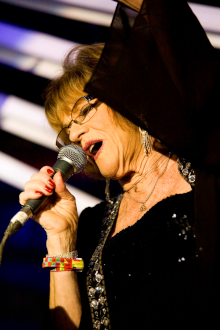
Anne Bushnell, Irish jazz and blues singer and cabaret performer, is born Anne Kavanagh in the Rotunda Hospital, Dublin, on March 28, 1939.
Bushnell is one of four children of John Kavanagh and Evelyn (née Ledwidge). Her father is a motor mechanic with a business on Arnott Street, Portobello, with the family living in Milltown. She dances on the stage of the Theatre Royal as a child and is a junior Irish champion dancer. She attends the St. Louis convent school in Rathmines, where she performs in plays and musicals and sings in the school choir. The nuns disapprove of her musical influences and try to dissuade her interest in jazz and “the music of the night.” Due to the family’s financial circumstances, she leaves school at the age of 16 and takes a job as a typist. She marries Tony Bushnell in April 1961. He is a salesman who shares her interest in music. The couple moves to Templeogue, and have a daughter, Suzanne, and a son, Paul. Paul is now a session musician based in Los Angeles, and Suzanne sings with a female vocal harmony group, Fallen Angels.
Bushnell continues to perform in amateur musicals, and from the early 1960s she sings with an Irish céilí band. With help from her husband’s musical family, she sings in Dublin jazz clubs from 1967, emerging as a well-respected jazz and blues vocalist and cabaret performer. She competes in the national song contest in 1968 singing Ballad to a Boy and becomes a resident singer in the RTÉ Light Orchestra. By the late 1960s, she is one of the busiest singers in Ireland, singing jingles for radio and TV commercials, and featuring on showband records as a backing singer. She is a regular guest on RTÉ television variety shows from 1970, including hosting Girls, girls, girls.
From 1972 to 1974, Bushnell is part of a group called Family Pride, which is a group of session musicians who record together regularly. They compete in the 1973 national song contest, playing in Dublin venues and on radio shows. The group has two top ten Irish hits. Their 1973 album, Family Pride, is not a chart success, however. She represents Ireland at a number of international contests and festivals as a solo artist, releasing a few singles and an unsuccessful album with CBS Records, Are You Ready (1977). She is a backing singer for two of Ireland’s entries to the Eurovision Song Contest in 1974 and 1980. She is a regular in stage musicals from the mid to late 1970s, in productions such as the tribute shows to Jacques Brel (1974) and Bing Crosby (1978), sometimes performing alongside her brother John Kavanagh. From the late 1970s she appears in pantomimes with Maureen Potter.
In 1984 Bushnell stars in a musical based on the life of Édith Piaf, No Regrets, written specially for her by Leland Bardwell. She is lauded for capturing Piaf’s stage presence and husky voice. The show suffers when it has to move from the Gaiety Theatre to the National Stadium. She reworks it into a successful one-woman show called The Little Sparrow and also devises a one-woman tribute to Judy Garland. Her cabaret act in the late 1980s is highly successful, featuring big numbers by Brel, Garland, and Piaf. Due to her talent at singing blues and jazz, she is awarded the freedom of New Orleans by its mayor in 1986.
Bushnell struggles with depression brought on initially by an underactive thyroid and later exacerbated by her father’s death and her husband’s unemployment in the late 1980s. Disheartened by the lack of recognition in Ireland and her family’s financial difficulties, she considers emigrating or returning to her career as a typist. To aid with her depression, she takes up painting in 1992, holding a number of exhibitions in Dublin. She continues to sing regularly until her death, often at events for charity. She is awarded the Cheshire Foundation award in 1994 for her charitable work. She also appears in the film Agnes Browne.
Bushnell dies of cancer on April 21, 2011, in Tallaght University Hospital, County Dublin, and is cremated at Mount Jerome Crematorium.

 seamus dubhghaill