The Battle of Ardnaree, a battle in the Tudor conquest of Ireland, is fought at Ardnaree, now a suburb of Ballina, County Mayo, on September 23, 1586. The result is a victory for the English over the Mac Philbins and Burkes. The conflict is a part of the political and military struggle, involving the English and occasionally the Scots, for control of northern Ireland. The anglicised version of the name Ardnaree can be translated to Árd na ríogh, meaning the hill of the kings.
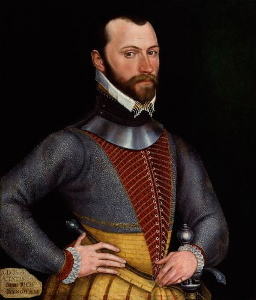
Sir Richard Bingham, governor of Connacht, follows the mercenary force to Ardnaree, where the mercenary force has camped on the east bank of the River Moy. Bingham’s forces surround the camp at night and attack the occupants. During the battle 1,000 mercenaries are killed, including Donnell Gorm MacDonnell of Carey and Alexander Carragh MacDonnell of Glenarm. Also slaughtered are some 1,000 men, women and children in the camp.
Richard Bingham goes on to hang the leaders of the Burkes, with the former lands of Mac Philbins and Mayo Burkes given to English settlers.
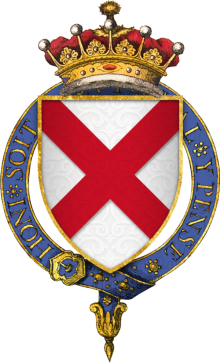
(Pictured: Sir Richard Bingham, governor of Connacht)
Ua Conchobair is born in 1153 and serves as King of Connacht from 1189 to 1199, and is re-inaugurated on the stone at Clonalis about 1201, reigning until 1224. He first succeeds his elder half brother Ruaidri‘s son Conchobar Máenmaige Ua Conchobair as ruler of Connacht. Conchobar Máenmaige’s son Cathal Carrach Ua Conchobair then rules from 1199 to 1202, with Cathal Crobhdearg back in power from then.
From his base west of the River Shannon he is forced to deal with the Norman invaders. He is a competent leader despite problems, avoiding major conflicts and winning minor skirmishes. Ua Conchobair attempts to make the best of the new situation with Ireland divided between Norman and Gaelic rulers. His long reign is perhaps a sign of relative success. He is the subject, as Cáhal Mór of the Wine Red Hand, of the poem A Vision of Connaught in the Thirteenth Century by the 19th-century Irish nationalist James Clarence Mangan.
In 1224 Ua Conchobair writes to Henry III as Lord of Ireland, asking that his son and heir Od (Aedh) be granted all of Connacht, in particular those parts, Kingdom of Breifne, owned by William Gorm de Lacy.
An account of Ua Conchobair’s inauguration has been preserved, written down by Donogh Bacach Ó Maolconaire, the son of O’Connor’s very inaugurator Tanaide Ó Maolconaire, who is also his historian.
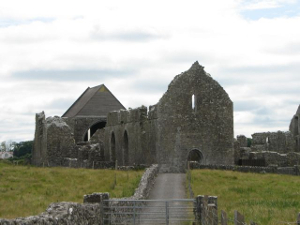
(Pictured: Ruins of the 12th century Cistercian Knockmoy Abbey which contains the burial site of King Cathal Crobhdearg Ua Conchobair)
Initially, there are two unions, both founded in 1874. The Irish Football Union has jurisdiction over clubs in Leinster, Munster, and parts of Ulster. The Northern Football Union of Ireland controls the Belfast area. The IRFU is formed in 1879 as an amalgamation of these two organisations and branches of the new IRFU are formed in Leinster, Munster, and Ulster. The Connacht Branch is formed in 1900.
The IRFU is a founding member of the International Rugby Football Board, now known as World Rugby, in 1886 with Scotland and Wales. England refuses to join until 1890.
Following the political partition of Ireland into separate national states, Ireland, originally the Irish Free State then Éire, and Northern Ireland, a political division of the United Kingdom, the then Committee of the Irish Rugby Football Union decides that it will continue to administer its affairs on the basis of the full 32 Irish counties and the traditional four provinces of Ireland – Leinster (12 counties), Ulster (9 counties), Munster (6 counties), and Connacht (5 counties).
This leads to the unusual, but not unique, situation among international rugby union teams, where the Irish representative teams are drawn from players from two separate political, national territories. To maintain the unity of Irish rugby union and the linkages between North and South, the IRFU purchase a new ground in 1923 in the Ravenhill district of Belfast at a cost of £2,300. The last full International at Ravenhill involving Ireland for more than a half-century takes place in 1953–54 against Scotland who are victorious by 2 tries (6 points) to nil. Australia plays Romania in the 1999 World Cup at the ground. The next full International played at Ravenhill is the Rugby World Cup warm-up match against Italy in August 2007 due to the temporary closure of Lansdowne Road for reconstruction.
The four provincial branches of the IRFU first run cup competitions during the 1880s. Although these tournaments still take place every year, their significance has been diminished by the advent of an All-Ireland League of 48 Senior Clubs in 1990.
The four provincial teams have played an Interprovincial Championship since the 1920s and continue to be the focal point for players aspiring to the international level. These are Munster, Leinster, Ulster, and Connacht . All four provinces play at the senior level as members of the Guinness Pro12.
There are currently approximately 95,000 rugby players in total in Ireland. There are 56 clubs affiliated to the Ulster Branch, 71 to the Leinster Branch, 59 to the Munster Branch, and 19 to the Connacht Branch. In addition, there are 246 schools playing rugby: Ulster (107), Leinster (75), Munster (41) and Connacht (23).
The IRFU also has an Exiles Branch tasked with developing “Ireland-qualified” players (i.e., eligible to play internationally for Ireland through ancestry) living in England, Scotland, and Wales. Volunteers provide coaching, administration and development under the supervision of a paid development manager.
Gerald FitzGerald becomes concerned that Ulick Burke’s attempt to gain supremacy in Connacht could simultaneously threaten the Crown’s interests in that province and his claim to be the paramount magnate in Ireland. He tries to persuade Ulick to acknowledge his authority by giving him his daughter Estacia in marriage. Ulick Burke, however, resists all attempts to have his power subordinated by the Earl of Kildare, forming an alliance with O’Brien of Thomond and the magnates of Munster. The Burkes of Mayo, on the other hand, join forces with Kildare with the aim of suppressing their dangerous neighbour.
In 1503, Ulick Burke attacks and destroys the castles of O’Kelly, Lord of Hymany, at Monivea, Garbally, and Castleblakeney. O’Kelly complains of this to the Lord Deputy.
For political and possibly for personal reasons, the Lord Deputy is eager to help O’Kelly weaken the prestige of Clanrickarde. Both sides gather a large contingent of lesser magnates and their armies. The Lord Deputy’s forces include contingents from Leinster, Ulster, and Connacht, among which are the armies of Red Hugh O’Donnell and Art Óg Ó Néill, the McDermotts and Morrisroes of Connacht, and a contingent provided by O’Kelly. Facing them are the forces of Burke and his allies – the O’Briens of Thomond, the McNamaras, the O’Kennedys, and the O’Carrolls.
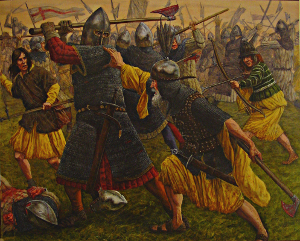
The armies meet on the slopes of Knockdoe, almost a mile to the north of Lackagh Parish Church, with heavily armed Gallowglass playing a large part on both sides. It is said that firearms are employed in the course of the battle, an early instance of their use in Ireland. The battle apparently lasts all day, with the heaviest fighting taking place along the River Clare in the townland of Ballybrone. The precise number of casualties is unknown, though contemporary observers are impressed by the extent of the slaughter. Around the summit of Knockdoe are many cairns where the dead are said to have been buried, with one in particular being pointed out as the resting place of the two sons of O’Brien of Thomond.
The Lord Deputy, though victorious, has many among the slain. His army remains the night on the field as a token of victory, then marches to Galway, looting Claregalway castle en route and taking as prisoners the two sons and daughter of Ulick Burke. They remain in Galway for a few days and then travel to Athenry.
The Clanrickarde Burkes fade into obscurity for some decades, with their rivals, the Mayo Burkes, gaining influence as a consequence.
The Second Battle of Athenry takes place on August 10, 1316. The English Colonists defeat the Irish in a very bloody battle. This is one of the most decisive battles of the Bruce campaign in Ireland (1315-1318).
The numbers involved are unknown and can only be estimated. The royal army is believed to have been as much as a few thousand, while that of Athenry is probably several hundred less. While it is doubtful that there are any more than seven thousand, the list of participants on the Irish side alone indicates that an overall figure of at least three to four thousand are involved. The English claim that they take some 1,100 heads from the Irish on that day.
Unlike the First Battle of Athenry in 1249, no account is given of the battle itself in any surviving account. Even the site of the battle itself is uncertain.
Although details of the battle are very sketchy at best, the Irish certainly meet with catastrophe. Fedlim Ó Conchobair and Tadhg Ó Cellaigh, King of Uí Maine, are among those who are killed along with numerous other kings and chieftains of the Gaels.
The personal rule of Gearóid Mór FitzGerald, 8th Earl of Kildare, is brought to an end on February 27, 1495, when he is arrested in Dublin by the Lord deputy Sir Edward Poynings and sent to the Tower of London to await trial for treason.
FitzGerald is Ireland’s premier peer and serves as Lord Deputy of Ireland from 1477 to 1494 and again from 1496 to 1513. His power is so great that he is called “the uncrowned King of Ireland.”
Gerald FitzGerald is appointed Lord Deputy in 1477 but is replaced by Lord Grey of Codnor on the supposition that an Englishman can do a better job. The Lords of the Pale set up a breakaway Parliament in protest, and Edward IV is forced to re-install FitzGerald. He inherits the title of Earl of Kildare in 1478.
FitzGerald manages to keep his position after the York dynasty in England is toppled and Henry VII becomes king, but FitzGerald blatantly disobeys King Henry on several occasions. He supports the pretender to the throne of England and the Lordship of Ireland, Lambert Simnel. However, Henry needs FitzGerald to rule in Ireland but, at the same time, he cannot control him. Simnel’s attempt to seize the throne ends in disaster at the Battle of Stoke Field and many of his supporters are killed. Henry, now secure on his throne, can afford to be merciful and pardons both Simnel and Kildare. Kildare is shrewd enough not to commit himself to the cause of the later pretender, Perkin Warbeck, despite Henry’s caustic comment that the Irish nobility would crown an ape to secure power for themselves.
FitzGerald presides over a period of near independence from English rule between 1477 and 1494. This independence is brought to an end on February 27, 1495, when his enemies in Ireland seize power and Lord deputy Sir Edward Poynings has him sent to London as a traitor. With FitzGerald’s absence, the way is cleared to end the independence of the Irish Parliament. Poynings directs the Irish Parliament, which is sitting in the town of Drogheda, to pass legislation making it subordinate to the English Parliament in Westminster. This marks the end of medieval Ireland and the commencement of the period of Tudor rule.
FitzGerald suffers another blow when his wife Alison dies soon after his arrest. He is tried in 1496 and uses the trial to convince Henry VII that the ruling factions in Ireland are “false knaves.” Henry immediately appoints him as Lord Deputy of Ireland and allows him to marry Elizabeth St. John, a distant cousin of the King. FitzGerald returns to Ireland in triumph.
He rules Ireland with an iron fist. He suppresses a rebellion in the city of Cork in 1500 by hanging the city’s mayor. He raises up an army against rebels in Connacht in 1504, defeating them at the Battle of Knockdoe. In 1512, after entering O’Neill of Clandeboye’s territory, capturing him and taking the castle of Belfast, FitzGerald proceeds through to utterly ravage the Bissett family’s lordship of the coastal Glens of Antrim.
The following year, while on an expedition against the O’Carrolls, he is mortally wounded while watering his horse in Kilkea. He is conveyed back to Kildare where he dies on or around September 3, 1513.
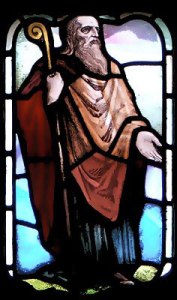
Colman is believed to have been born in Connacht, in the west of Ireland and receives his education on Iona. He is likely a nobleman of Canmaicne. He succeeds Aidan and Finan as bishop of Lindisfarne but resigns the Bishopric of Lindisfarne after the Synod of Whitby called by King Oswiu of Northumbria decides to calculate Easter using the method of the First Ecumenical Council instead of his preferred Celtic method.
Later tradition states that between the years 665 and 667 St. Colman founds several churches in Scotland before returning to Iona, but there are no seventh-century records to validate such activity by him. From Iona he sails for Ireland, settling at Inishbofin in 668 where he founds a monastery. When Colman comes to Mayo he brings with him half the relics of Lindisfarne, including bones of St. Aidan, and a part of the true cross which is reputed to be in Mayo Abbey until the Reformation in 1537, when it vanishes.
The Saxon monks are industrious and, during spring and summer, they till the land and grow the corn necessary for the survival of the community. Meanwhile, the Irish visit their kinsfolk on the mainland, returning to the island in winter where they help to consume the fruits of the Saxons’ labours. This situation inevitably leads to tensions within the community and disputes soon arise between the Saxon and Irish monks. Colman brings his Saxon followers onto the mainland and founds a monastery for them at “Magh Eó” – the Plain of Yew Trees, subsequently known as “Mayo of the Saxons.”
Colman’s last days are spent on the island of Inishbofin, where he dies in 675. His feast is celebrated on August 8.
The Night of the Big Wind (Irish: Oíche na Gaoithe Móire), a powerful European windstorm sweeps without warning across Ireland beginning in the afternoon of January 6, 1839, causing severe damage to property and several hundred deaths. As many as one quarter of the houses in north Dublin are damaged or destroyed and 42 ships are wrecked. The storm tracks eastward to the north of Ireland bringing winds gusts of over 100 knots to the south before moving across the north of England and onto the European continent where it eventually dies out. At the time, it is the most damaging Irish storm in 300 years.
The storm develops after a period of unusual weather. Heavy snow, which is rare in Ireland, falls across the country on the night of January 5, and is replaced on the morning of January 6 by an Atlantic warm front, which brings a period of complete calm with dense, motionless, cloud cover. Through the day, temperatures rise well above their seasonal average, resulting in rapid melting of the snow.
Later in the day, a deep Atlantic depression begins to move towards Ireland, forming a cold front bringing strong winds and heavy rain when it collides with the warm air over land. First reports of stormy weather come from western County Mayo around noon and the storm moves very slowly across the island through the remainder of the day, gathering strength as it progresses.
By midnight the winds reach hurricane force. It is estimated that between 250 and 300 people lose their lives in the storm. Severe property damage is caused, particularly in Connacht, but also in Ulster and northern Leinster. Much of the inland damage is caused by a storm surge that draws large quantities of sea water inland, resulting in widespread flooding.
The Night of the Big Wind has become part of Irish folk tradition. Irish folklore held that Judgement Day would occur on the Feast of the Epiphany, January 6. Such a severe storm led many to believe that the end of the world was at hand.


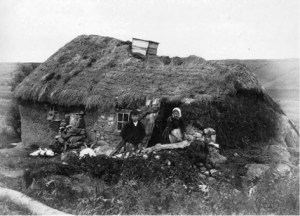 The Night of the Big Wind (Irish: Oíche na Gaoithe Móire), a powerful European windstorm sweeps without warning across Ireland beginning in the afternoon of January 6, 1839, causing severe damage to property and several hundred deaths. As many as one quarter of the houses in north Dublin are damaged or destroyed and 42 ships are wrecked. The storm tracks eastward to the north of Ireland bringing winds gusts of over 100 knots to the south before moving across the north of England and onto the European continent where it eventually dies out. At the time, it is the most damaging Irish storm in 300 years.
 seamus dubhghaill