
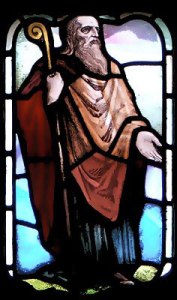
Colmán of Lindisfarne, also known as Saint Colmán, the Bishop of Lindisfarne from 661 until 664, dies on February 18, 675, of natural causes on the island of Inishbofin.
Colman is believed to have been born in Connacht, in the west of Ireland and receives his education on Iona. He is likely a nobleman of Canmaicne. He succeeds Aidan and Finan as bishop of Lindisfarne but resigns the Bishopric of Lindisfarne after the Synod of Whitby called by King Oswiu of Northumbria decides to calculate Easter using the method of the First Ecumenical Council instead of his preferred Celtic method.
Later tradition states that between the years 665 and 667 St. Colman founds several churches in Scotland before returning to Iona, but there are no seventh-century records to validate such activity by him. From Iona he sails for Ireland, settling at Inishbofin in 668 where he founds a monastery. When Colman comes to Mayo he brings with him half the relics of Lindisfarne, including bones of St. Aidan, and a part of the true cross which is reputed to be in Mayo Abbey until the Reformation in 1537, when it vanishes.
The Saxon monks are industrious and, during spring and summer, they till the land and grow the corn necessary for the survival of the community. Meanwhile, the Irish visit their kinsfolk on the mainland, returning to the island in winter where they help to consume the fruits of the Saxons’ labours. This situation inevitably leads to tensions within the community and disputes soon arise between the Saxon and Irish monks. Colman brings his Saxon followers onto the mainland and founds a monastery for them at “Magh Eó” – the Plain of Yew Trees, subsequently known as “Mayo of the Saxons.”
Colman’s last days are spent on the island of Inishbofin, where he dies in 675. His feast is celebrated on August 8.
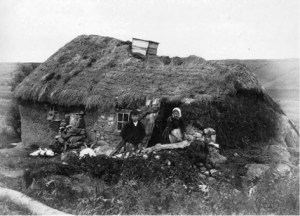 The Night of the Big Wind (Irish: Oíche na Gaoithe Móire), a powerful European windstorm sweeps without warning across Ireland beginning in the afternoon of January 6, 1839, causing severe damage to property and several hundred deaths. As many as one quarter of the houses in north Dublin are damaged or destroyed and 42 ships are wrecked. The storm tracks eastward to the north of Ireland bringing winds gusts of over 100 knots to the south before moving across the north of England and onto the European continent where it eventually dies out. At the time, it is the most damaging Irish storm in 300 years.
