seamus dubhghaill

Promoting Irish Culture and History from Little Rock, Arkansas, USA


Leave a comment

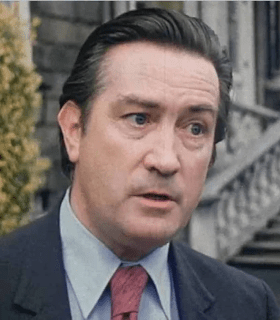
Death of Justin Keating, Politician, Broadcaster & Journalist

Justin Pascal Keating, Irish Labour Party politician, broadcaster, journalist, lecturer and veterinary surgeon, dies at Ballymore Eustace, County Kildare, on December 31, 2009. In later life he is president of the Humanist Association of Ireland.

Keating is twice elected to Dáil Éireann and serves in Liam Cosgrave‘s cabinet as Minister for Industry and Commerce from 1973 to 1977. He also gains election to Seanad Éireann and is a Member of the European Parliament (MEP). He is considered part of a “new wave” of politicians at the time of his entry to the Dáil.

Keating is born in Dublin on January 7, 1930, a son of the noted painter Seán Keating and campaigner May Keating. He is educated at Sandford Park School, and then at University College Dublin (UCD) and the University of London. He becomes a lecturer in anatomy at the UCD veterinary college from 1955 until 1960 and is senior lecturer at Trinity College Dublin from 1960 until 1965. He is RTÉ‘s head of agricultural programmes for two years before returning to Trinity College in 1967. While at RTÉ, he scripts and presents Telefís Feirme, a series for the agricultural community, for which he wins a Jacob’s Award in 1966.

In the 1950s and 1960s Keating is a member of the communist Irish Workers’ Party. He is first elected to the Dáil as a Labour Party Teachta Dála (TD) for the Dublin County North constituency at the 1969 Irish general election. From 1973 to 1977 he serves in the National Coalition government under Liam Cosgrave as Minister for Industry and Commerce. In 1973 he is appointed a Member of the European Parliament from the Oireachtas, serving on the short-lived first delegation.

During 1975 Keating introduces the first substantial legislation for the development of Ireland’s oil and gas. The legislation is modelled on international best practice and intended to ensure the Irish people would gain substantial benefit from their own oil and gas. Under his legislation the state could by right acquire a 50% stake in any viable oil and gas reserves discovered. Production royalties of between 8% and 16% with corporation tax of 50% would accrue to the state. The legislation specifies that energy companies would begin drilling within three years of the date of the issue of an exploration license.

Keating loses his Dáil seat at the 1977 Irish general election but is subsequently elected to Seanad Éireann on the Agricultural Panel, serving there until 1981. He briefly serves again in the European Parliament from February to June 1984 when he replaces Séamus Pattison.

In the aftermath of President of Iran Mahmoud Ahmadinejad‘s “World Without Zionism” speech in 2005, Keating publishes an op-ed in The Dubliner magazine, expressing his views on Israel. The article starts by claiming that “the Zionists have absolutely no right in what they call Israel.” He then proceeds to explain why he thinks Israel has no right to exist, claiming that the Ashkenazi Jews are descended from Khazars.

Keating dies at Ballymore Eustace, County Kildare, on December 31, 2009, at the age of 79, one week before his 80th birthday. Tributes come from the leaders of the Labour Party and Fine Gael at the time of his death, Eamon Gilmore and Enda Kenny, as well as former Fine Gael leader and Taoiseach John Bruton.

Leave a comment

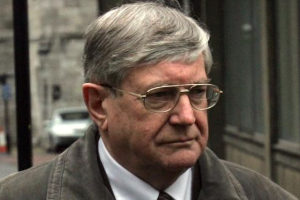
Birth of Fianna Fáil Politician Ray Burke

ray-burke

Raphael Patrick “Ray” Burke, disgraced former Fianna Fáil politician, is born on September 30, 1943, in Dublin. He is a former Teachta Dála and government minister who is convicted and imprisoned on charges arising from political corruption in office. Burke is also highly influential in decisions made by Dublin County Council.

Burke’s political career commences when he is elected to Dublin County Council for Fianna Fáil in 1967. He serves as chairman of the council from 1985 to 1987.

Burke is elected to Dáil Éireann at the 1973 general election for the Dublin County North constituency, succeeding his father Patrick J. Burke, who has held the seat for 29 years. Ray Burke represents this constituency and its successor Dublin North until his resignation almost twenty-five years later.

After Fianna Fáil’s landslide victory at the 1977 general election, Burke is appointed Minister of State at the Department of Industry and Commerce. In October 1980 Burke is promoted to Minister for the Environment, a position he holds until June 1981 and again in the short-lived Fianna Fáil government of 1982. After Fianna Fáil returns to power at the 1987 general election, Burke serves as Minister for Energy, where he makes controversial changes to the legislation governing oil and gas exploration. In 1988, he is appointed Minister for Industry, Commerce and Communications.

Following the formation of the Fianna Fáil–Progressive Democrats Coalition in 1989, he becomes Minister for Justice and Minister for Communications. When Albert Reynolds comes to power in 1992, he does not re-appoint Burke to the Cabinet. Following the 1997 general election, Fianna Fáil is back in power, and Burke is appointed Minister for Foreign Affairs by new Taoiseach Bertie Ahern.

Within months of his appointment as Minister for Foreign Affairs, allegations resurface that Burke has received IR£80,000 from a property developer regarding the former Dublin County Council. Burke denies the allegations but resigns from the Cabinet and from the Dáil on October 7, 1997, after just four months in office.

Having claimed since 1989 that Raidió Teilifís Éireann (RTÉ) is biased against him, Burke is responsible for controversial legislation that severely limits RTÉ’s ability to collect advertising revenue and allows for the establishment of a series of local radio stations and one independent national radio station, Century Radio. RTÉ is ordered to provide a national transmission service for Century Radio at a price that RTÉ complains is far below the economic cost of providing such a service. Nevertheless, Century Radio fails to gain significant audience share and closes in 1991.

In July 2004 Burke pleads guilty to making false tax returns. The charges arise from his failure to declare for tax purposes the payments that he has received from the backers of Century Radio. On January 24, 2005, he is sentenced to six months in prison for these offences, making him one of the most senior Irish politicians to serve time in prison. He is released in June 2005 after four and a half months, earning a 25% remission of sentence because of good behaviour. He serves his time in Arbour Hill Prison in Dublin.