seamus dubhghaill

Promoting Irish Culture and History from Little Rock, Arkansas, USA


Leave a comment

Birth of Eoin O’Duffy, Political Activist & Police Commissioner

Eoin O’Duffy, Irish political activist, soldier, police commissioner and organizer of the infamous Blueshirts, is born in Castleblayney, County Monaghan, on October 20, 1892.

O’Duffy does an apprenticeship as an engineer in Wexford before working as an engineer and architect in Monaghan. In 1919 he becomes an auctioneer. He is a leading member of the Gaelic Athletic Association in Ulster in the 1910s. In 1912 he is appointed secretary of the Ulster provincial council. He is also a member of Harps’ Gaelic Football Club.

O’Duffy joins the Irish Republican Army (IRA) in 1917 and is the leader of the Monaghan Brigade of the IRA during the Irish War of Independence and in this capacity becomes Chief of Staff of the IRA in 1922. He is one of the Irish activists who along with Michael Collins accepts the Anglo-Irish Treaty and fights as a general in the Irish Civil War on the pro-Treaty side.

Professionally, O’Duffy becomes the second Commissioner of the Garda Síochána, the police force of the new Irish Free State, after the Civic Guard Mutiny and the subsequent resignation of Michael Staines. He holds this post until 1933, when he is dismissed by Éamon de Valera. In his political life O’Duffy is an early member of Sinn Féin, founded by Arthur Griffith. He is elected as a Teachta Dála (TD) for his home county of Monaghan during the 1921 election.

After a split in 1923 he becomes associated with Cumann na nGaedheal and becomes head of a veteran’s group then known as the Army Comrades Association. O’Duffy changes its name to “National Guard” and begins to stage fascist-style rallies and adopts a fascist salute. Its members begin to wear blue uniform shirts and become known as the Blueshirts. When government opposition groups form Fine Gael in September 1933, he becomes its first president, reaching the apex of his political power.

Subsequently, the government bans O’Duffy’s National Guard, as well as the group he creates to replace it, the Young Ireland Association, which he in turn replaces with the League of Youth, but their blue shirts indicate its continued fascist ideology. Fine Gael’s other leaders soon tire of his inflammatory rhetoric and the frequent violent behavior of the Blueshirts but are still surprised when their opposition causes him to resign his party leadership in September 1934. He is then ousted as leader of the Blueshirts as well but does retain a small loyal following.

An anti-communist, O’Duffy is attracted to the various authoritarian nationalist movements on the Continent. In 1936, he raises the Irish Brigade to fight for Francisco Franco during the Spanish Civil War as an act of Catholic solidarity and is inspired by Benito Mussolini‘s Italy to found the National Corporate Party. He offers to Nazi Germany the prospect of raising an Irish Brigade to fight in Operation Barbarossa during World War II on the Eastern Front against the Soviet Union, but this is not taken up.

Eoin O’Duffy takes no further part in Irish politics and dies in Dublin on November 30, 1944. In spite of his later politics, he is given a state funeral for his earlier contributions to the Irish government. He is buried in Dublin’s Glasnevin Cemetery.

Leave a comment

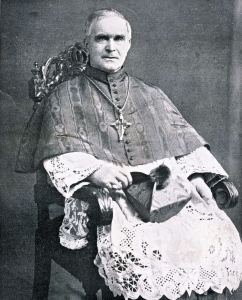
Birth of Cardinal Joseph MacRory in County Tyrone

cardinal-joseph-macrory

Joseph MacRory, an Irish Cardinal of the Roman Catholic Church who serves as Archbishop of Armagh from 1928 until his death in 1945, is born in Ballygawley, County Tyrone, on March 19, 1861.

MacRory is one of ten children of Francis MacRory, a farmer, and his wife, Rose Montague. He studies at St. Patrick’s College, Armagh, and St. Patrick’s Pontifical University, Maynooth. He is ordained to the priesthood on September 13, 1885, and serves as the first president of St. Patrick’s Academy, Dungannon from 1886 to 1887. MacRory teaches Scripture and Modern Theology at St. Mary’s College, Oscott in England until 1889, when he is appointed Professor of Scripture and Oriental Languages at his alma mater of Maynooth College. In 1906, he co-founds the Irish Theological Quarterly. In 1912, he is made Vice-President of Maynooth.

On August 9, 1915, MacRory is appointed Bishop of Down and Connor by Pope Benedict XV and receives his episcopal consecration on November 14 from Cardinal Michael Logue. During his tenure, his life is threatened repeatedly due to the turbulent atmosphere in Belfast. He is a member of the Irish Convention from 1917 to 1918.

MacRory is promoted to Archbishop of Armagh and thus Primate of All Ireland on June 22, 1928, in succession to Patrick O’Donnell. He is elevated to the cardinalate on December 16, 1929, by Pope Pius XI.

MacRory is the papal legate at the 1933 laying of the foundation stone of Liverpool Metropolitan Cathedral in England. He also serves as one of the cardinal electors who participate in the 1939 papal conclave which ultimately selects Pope Pius XII.

MacRory is a strenuous opponent of social injustice, National Socialism, Protestantism, and the Partition of Ireland. It is MacRory who suggests to Eoin O’Duffy that he raise an Irish Brigade to aid Generalissimo Francisco Franco during the Spanish Civil War. In 1940, he voices strong objections to conscription in the North.

MacRory is a supporter of the Gaelic League. Errigal Ciarán GAC, one of the most famous GAA clubs in Ireland, plays at Cardinal MacRory Park in Dunmoyle, County Tyrone, which is built in 1956 in his honour.

After a brief illness, Cardinal MacRory dies on October 13, 1945, at the age of 84 from a heart attack at Ara Coeli, the residence in Armagh. He is interred in St. Patrick’s Cathedral Cemetery, Armagh.


Leave a comment

An Garda Síochána na h-Eireann is Formed

An Garda Síochána na h-Eireann (Guardians of the Peace of Ireland), the police force of Ireland more commonly referred to as the Gardaí or “the guards,” is formed on February 21, 1922. The service, originally named the Civic Guard and headquartered in Dublin’s Phoenix Park, is headed by the Garda Commissioner who is appointed by the Irish government.

The Civic Guard is formed by the Provisional Government in February 1922 to take over the responsibility of policing the fledgling Irish Free State. It replaces the Royal Irish Constabulary (RIC) and the Irish Republican Police of 1919–22. In August 1922, the force accompanies Michael Collins when he meets the Lord Lieutenant in Dublin Castle.

The Garda Síochána (Temporary Provisions) Act 1923, enacted after the creation of the Irish Free State on August 8, 1923, provides for the creation of “a force of police to be called and known as ‘The Garda Síochána.'” Under section 22, the Civic Guard are deemed to have been established under and are to be governed by the Act. The law therefore effectively renames the existing force.

While most recruits to the Garda come from the ranks of the Irish Republican Army, which had fought against the RIC, about one hundred ex-RIC men become part of the new force. Problems become apparent when some recruits do not conceal their dislike of the ex-RIC instructors and refused to salute them. On May 15, 1922, over 1,200 recruits break ranks during Morning Parade, seize the armoury, and take over the Kildare Depot. Negotiations between the mutineers and the Provisional Government of Ireland over control of the force lasts seven weeks, during which time the Irish Civil War has begun. Commissioner Michael Staines resigns in September and is replaced by Eoin O’Duffy.

During the Irish Civil War, the new Free State sets up the Criminal Investigation Department as an armed, plain-clothed, counter-insurgency unit. It is disbanded after the end of the war in October 1923 and elements of it are absorbed into the Dublin Metropolitan Police, which was founded in 1836.

In Dublin, policing remains the responsibility of the Dublin Metropolitan Police until it merges with the Garda Síochána in 1925. Since then the Garda has been the only civil police force in the state now known as Ireland. Other police forces with limited powers are the Military Police within the Irish Defence Forces, the Airport Police Service, and Dublin Port and Dún Laoghaire Harbour police forces.

The Garda medal of honour, the Scott Medal, An Garda Síochána’s highest honour, is named after Colonel Walter Scott, the American philanthropist that endowed the fund for the original medals.