seamus dubhghaill

Promoting Irish Culture and History from Little Rock, Arkansas, USA


2 Comments

Death of Philip Woodroffe, Surgeon at Dr. Steevens’ Hospital

Philip Woodroffe, the resident surgeon at Dr. Steevens’ Hospital in Dublin for over 30 years, dies in Dublin on June 4, 1799. Several eminent surgeons are apprenticed to him. He is the president of the Royal College of Surgeons in Ireland (RCSI) in 1788.

In his history of the RCSI, physician Charles Cameron writes that he has been unable to learn anything about Woodroffe’s parents or his early life.

Woodroffe is appointed assistant-surgeon to Dr. Steevens’ Hospital in 1763, and resident surgeon from 1765, an office which he holds until his death. In 1780 he becomes surgeon to the House of Industry Hospitals in Dublin and remains so for the rest of his life. In 1769 he is living in Crow Street. He moves to Fownes Street in 1774, and in 1784 he is living in St. Andrew’s Street.

Woodroffe is one of the founding members of the Dublin Society of Surgeons that later becomes the Royal College of Surgeons in Ireland and is one of those to whom the first charter is granted in 1784. In 1786, he follows William Dease as treasurer to the college, and holds the office for eight years. He is president of the college in 1788. His appointments also include surgeon to the Blue Coat School, the Foundling Hospital, and the Hospital for Incurables, Lazar’s Hill (now Townsend Street). Several notable surgeons such as Abraham Colles are apprenticed to him. Colles takes over as resident surgeon at Dr. Steevens’ Hospital after Woodroffe’s death.

Woodroffe dies on June 4, 1799, in St. Andrew’s Street, and is interred in St. Andrew’s churchyard.

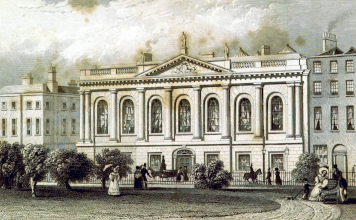
(Pictured: The College of Surgeons, Dublin, 1837)


Leave a comment

Birth of Lionel Cranfield Sackville, Lord Lieutenant of Ireland

lionel-cranfield-sackville

Lionel Cranfield Sackville, 1st Duke of Dorset, English political leader and Lord Lieutenant of Ireland, is born in Dorset, United Kingdom on January 18, 1688.

Sackville is the son of Charles Sackville, 6th Earl of Dorset and 1st Earl of Middlesex, and the former Lady Mary Compton, younger daughter of James Compton, 3rd Earl of Northampton. Styled Lord Buckhurst from birth, he succeeds his father as 7th Earl of Dorset and 2nd Earl of Middlesex in 1706 and is created Duke of Dorset in 1720.

Perhaps because he had been on a previous diplomatic mission to Hanover, Sackville is chosen to inform George I of his accession to the Crown in August 1714. George I initially favours him and numerous offices and honours are given to him: Privy Councillor, Knight of the Garter, Groom of the Stool, Lord Steward, Governor of Dover Castle and Lord Warden of the Cinque Ports. At George I’s coronation he carries the sceptre. At the coronation of George II, he is Lord High Steward and carries St. Edward’s Crown. He quarrels with the King in 1717 and is told his services are no longer required, but he is made a Duke three years later.

Sackville serves twice as Lord Lieutenant of Ireland, from 1731 to 1737 and again from 1751 to 1755. In 1739, at the foundation of the Foundling Hospital, he is one of that charity’s original governors. His first term as Lord Lieutenant is uneventful. His second takes place at a time of acute political tension between the two main factions in the Irish Government, one led by Henry Boyle, the Speaker of the Irish House of Commons, the other by George Stone, the Anglican Archbishop of Armagh. Sackville, now heavily influenced by his son George Sackville, makes the mistake of openly backing the archbishop. He is unable to oust Boyle from power and is accused of being the archbishop’s tool. He becomes extremely unpopular, leading to his eventual recall.

Sackville’s last years are uneventful, apart from a riot in 1757 caused by the passage of the Militia Act to raise an army for the Seven Years’ War, in which he narrowly escapes injury. He dies at Knole, a country house in west Kent, on October 9, 1765, and is buried at Withyham in East Sussex.

(Pictured: Oil on canvas Portrait of Lionel Sackville, 1st Duke of Dorset (1688-1765) by Godfrey Kneller (1646-1723), 1719, currently displayed at Commonwealth Secretariat, Marlborough House, London)