seamus dubhghaill

Promoting Irish Culture and History from Little Rock, Arkansas, USA


Leave a comment

Harland & Wolff Cranes Listed as Historic Monuments

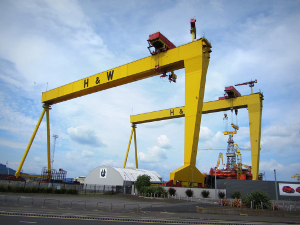
samson-and-goliathSamson and Goliath, the twin shipbuilding gantry cranes situated in the shipyard of Harland & Wolff at Queen’s Island, Belfast, are listed on October 9, 2003, as historic monuments to ensure their preservation. The cranes, which are named after the Biblical figures Samson and Goliath, dominate the Belfast skyline and are landmark structures of the city.

The cranes are constructed by the German engineering firm Krupp, with Goliath being completed in 1969 and Samson in 1974. Goliath, the smaller of the cranes, stands 315 feet tall, while Samson stands 348 feet in height. Goliath sits slightly further inland closer to Belfast City. At the time Harland & Wolff is one of the largest shipbuilders in the world. The announcement that they are to be built is an important event at the time.

Each crane has a span of 459 feet and can lift loads of up to 840 tonnes to a height of 230 feet, making a combined lifting capacity of over 1,600 tonnes, one of the largest in the world. Prior to commissioning, the cranes are tested up to 1,000 tonnes, which bends the gantry downwards by over 12 inches. The dry dock at the base of the cranes is the largest in the world measuring 1,824 feet × 305 feet.

At its height, Harland & Wolff boasts 35,000 employees and a healthy order book, but in the years following the construction of the cranes, the workforce and business declines. The last ship to be launched at the yard to date is a roll-on/roll-off ferry in March 2003. Since then the yard has restructured itself to focus less on shipbuilding and more on design and structural engineering, as well as ship repair, offshore construction projects and competing for other projects to do with metal engineering and construction. Initially there is concern that the now largely redundant cranes would be demolished. However, on October 9, 2003 they are scheduled as historic monuments under Article 3 of the Historic Monuments and Archaeological Objects (Northern Ireland) Order 1995.

Northern Ireland Office Minister of the time Angela Smith states, “These cranes are an essential part of our city, our roots and our culture.” The cranes are not, technically, “listed buildings,” but are recognised by the Northern Ireland Environment Agency as buildings of “architectural or historic interest.”

Shipbuilding has ceased in Belfast, but the cranes are retained as part of the existing dry dock facility within the restructured shipyard, situated adjacent to the Titanic Quarter, a business, light industrial, leisure, and residential development on land now surplus to the heavy industrial requirements of the shipyard on Queen’s Island. They are kept in working order and used for heavy lifting by Harland & Wolff in its other activities.

Leave a comment

Sinking of the RMS Titanic

The RMS Titanic, four days into her maiden voyage from Southampton to New York City, sinks in the north Atlantic Ocean at 2:20 AM on the morning of April 15, 1912, after striking an iceberg just before midnight on April 14.

Titanic, the largest ship afloat at the time it enters service on April 2, 1912, is the second of three Olympic class ocean liners operated by the White Star Line, and is built by the Harland & Wolff shipyard in Belfast, Northern Ireland.

Titanic‘s maiden voyage, commanded by 62-year-old Captain Edward John Smith, begins shortly after noon on April 10, 1912 when she leaves Southampton on the first leg of her journey to New York City. A few hours later she reaches Cherbourg in France, where she takes on passengers. Her next port of call is Queenstown (now Cobh) in Ireland, which she reaches around midday on April 11. After taking on more passengers and stores, Titanic departs in the afternoon with an estimated 2,224 people on board.

Titanic receives six warnings of sea ice on April 14 but is traveling near her maximum speed when her lookouts sight the iceberg. Unable to turn quickly enough, the ship suffers a glancing blow that buckles her starboard side and opens five of her sixteen compartments to the sea. Titanic has been designed to stay afloat with four of her forward compartments flooded but not more, and the crew soon realises that the ship is going to sink. They use distress flares and wireless radio messages to attract help as the passengers are put into lifeboats. However, in accordance with existing practice, Titanic‘s lifeboat system is designed to ferry passengers to nearby rescue vessels, not to hold everyone on board simultaneously. With the ship sinking quickly and help still hours away, there is no safe refuge for many of the passengers and crew. Compounding this, poor management of the evacuation means many boats are launched before they are totally full.

At about 2:15 AM, Titanic‘s angle in the water begins to increase rapidly as water pours into previously unflooded parts of the ship through deck hatches. Her suddenly increasing angle causes a giant wave to wash along the ship from the forward end of the boat deck, sweeping many people into the sea. Titanic‘s stern lifts high into the air as the ship tilts down in the water, reaching an angle of 30–45 degrees. After another minute, the ship’s lights flicker once and then permanently go out, plunging Titanic into darkness. Shortly after the lights go out, the ship splits apart at one of the weakest points in the structure, the area of the engine room hatch. The submerged bow likely remains attached to the stern by the keel for a short time, pulling the stern to a high angle before separating and leaving the stern to float for a few minutes longer. The forward part of the stern floods very rapidly, causing it to tilt and then settle briefly before sinking.

Titanic sinks with over a thousand passengers and crew still on board. Almost all those who jump or fall into the water die from hypothermia within minutes. RMS Carpathia arrives on the scene about 90 minutes after the sinking and has rescued the last of the survivors by 9:15 AM on April 15, some nine and a half hours after the collision with the iceberg.

The death toll has been put at 1,513, including many Irish, although the number of casualties remains somewhat unclear due to a number of factors, including confusion over the passenger list, which includes some names of people who cancelled their trip at the last minute, and the fact that several passengers traveled under aliases for various reasons and were double-counted on the casualty lists.

The disaster causes widespread outrage over the lack of lifeboats, lax regulations, and the unequal treatment of the three passenger classes during the evacuation. Subsequent inquiries recommend sweeping changes to maritime regulations, leading to the establishment in 1914 of the International Convention for the Safety of Life at Sea (SOLAS), which still governs maritime safety today.


Leave a comment

Birth of Edward J. Smith, Captain of the RMS Titanic

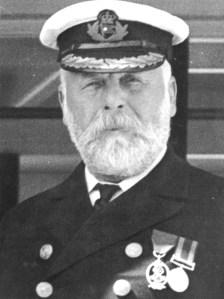
edward-john-smith

Edward John Smith, English naval reserve officer best known as the captain of the ill-fated RMS Titanic, is born on Well Street, Hanley, Staffordshire, England, on January 27, 1850.

Smith attends the Etruria British School until the age of 13, when he leaves school for a job at the Etruria Forge. In 1867, at the age of 17, he goes to Liverpool in the footsteps of his half-brother Joseph Hancock, a captain on a sailing ship. He begins his apprenticeship on Senator Weber, owned by A. Gibson & Co. of Liverpool.

Smith joins the White Star Line in March 1880 as Fourth Officer on the SS Celtic. He serves aboard the company’s liners to Australia and New York City, where he quickly rises in status. In 1887, shortly after his marriage to Sarah Eleanor Pennington, he receives his first White Star command on the SS Republic.

Beginning in 1895, Smith serves as captain of the SS Majestic for nine years. When the Second Boer War starts in 1899, Majestic is called upon to transport troops to Cape Colony. Smith makes two trips to South Africa, both without incident. From 1904 on, Smith commands the White Star Line’s newest ships on their maiden voyages, including RMS Baltic, RMS Adriatic, RMS Olympic, and RMS Titanic.

The RMS Titanic is built at the Harland & Wolff shipyard in Belfast. On April 10, 1912, Smith boards RMS Titanic at 7:00 AM to prepare for a noon departure. It’s final point of departure on the Atlantic crossing is Queenstown (now Cobh), County Cork, on April 11, 1912.

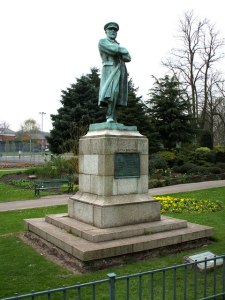
edward-john-smith-statue

The first four days of the voyage pass without incident, but shortly after 11:40 PM on April 14, Smith is informed by First Officer William McMaster Murdoch that the ship has just collided with an iceberg. It is soon apparent that the ship is seriously damaged with all of the first five watertight compartments having been breached. Smith, aware that there are not enough lifeboats for all of the passengers and crew, does everything in his power to prevent panic and assist in the evacuation. Just minutes before the ship sinks, Smith is still busy releasing Titanic‘s crew from their duties.

At 2:10 AM, Steward Edward Brown sees the captain approach with a megaphone in his hand. He is heard to say, “Well boys, do your best for the women and children, and look out for yourselves.” He then watches as Captain Smith walks onto the bridge alone. This is the last reliable sighting of Smith. Ten minutes later the ship disappears beneath the waves. His body is never recovered.

A statue, sculpted by Kathleen Scott, wife of Antarctic explorer Robert Falcon Scott, is unveiled in July 1914 at the western end of the Museum Gardens in Beacon Park, Lichfield. The pedestal is made from Cornish granite and the figure is bronze. Lichfield is chosen as the location for the monument because Smith was a Staffordshire man and Lichfield is the centre of the diocese.