
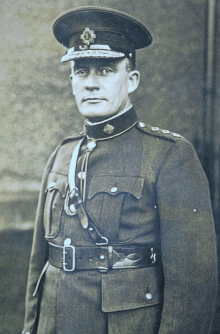
Eamon “Ned” Broy, successively a member of the Dublin Metropolitan Police (DMP), the Irish Republican Army (IRA), the National Army, and the Garda Síochána of the Irish Free State, dies in Rathgar, Dublin, on January 22, 1972. He serves as Commissioner of the Gardaí from February 1933 to June 1938. He later serves as president of the Olympic Council of Ireland for fifteen years.
Broy is born in Rathangan, County Kildare, on December 22, 1887. He joins the Royal Irish Constabulary (RIC) on August 2, 1910, and the Dublin Metropolitan Police on January 20, 1911.
Broy is a double agent within the DMP, with the rank of Detective Sergeant (DS). He works as a clerk inside G Division, the intelligence branch of the DMP. While there, he copies sensitive files for IRA leader Michael Collins and passes many of these files on to Collins through Thomas Gay, the librarian at Capel Street Library. On April 7, 1919, he smuggles Collins into G Division’s archives in Great Brunswick Street (now Pearse Street), enabling him to identify “G-Men,” six of whom are eventually killed by the IRA. He supports the Anglo-Irish Treaty of 1921 and joins the National Army during the Irish Civil War, reaching the rank of colonel. In 1925, he leaves the Army and joins the Garda Síochána.
Broy’s elevation to the post of Commissioner comes when Fianna Fáil replaces Cumann na nGaedheal as the government. Other more senior officers are passed over as being too sympathetic to the outgoing party.
In 1934, Broy oversees the creation of “The Auxiliary Special Branch” of the Garda, formed mainly of hastily trained anti-Treaty IRA veterans, who were opponents of Broy in the civil war. It is nicknamed the “Broy Harriers” by Broy’s opponents, a pun on the Bray Harriers athletics club or more likely on the Bray Harriers hunt club. It is used first against the quasi-fascist Blueshirts, and later against the diehard holdouts of the IRA, now set against former comrades. The “Broy Harriers” nickname persists into the 1940s, even though Broy himself is no longer in command, and for the bodies targeted by the unit is a highly abusive term, still applied by radical Irish republicans to the Garda Special Branch (now renamed the Special Detective Unit). The Broy Harriers engage in several controversial fatal shootings. They shoot dead a protesting farmer named Lynch in Cork, and when the matter is discussed in the Senate in 1934, the members who support Éamon de Valera‘s government walk out. They are detested by sections of the farming community. In the light of this latter history, their name is often used in reference to individuals or groups who attempt to disrupt contemporary dissident republicans, such as the remnants of the Provisional Irish Republican Army.
Broy is President of the Olympic Council of Ireland from 1935 to 1950. He is also a member of the Standing Committee of the Irish Amateur Handball Association.
Broy dies on January 22, 1972, at his residence in the Dublin suburb of Rathgar.
On September 17, 2016, a memorial to Broy is unveiled in Coolegagen Cemetery, County Offaly, close to his childhood home. His daughter Áine is in attendance, as are representatives of the government, the Air Corps, and the Garda Síochana.
Neil Jordan‘s film Michael Collins (1996) inaccurately depicts Broy (played by actor Stephen Rea) as having been arrested, tortured and killed by Secret Intelligence Service (SIS) agents. In addition, G Division was based not in Dublin Castle, as indicated in the film, but in Great Brunswick Street. Collins had a different agent in the Castle, David Neligan. Broy is also mentioned and makes an appearance in Michael Russell’s detective novel The City of Shadows, set partly in Dublin in the 1930s, published by HarperCollins in 2012.
 seamus dubhghaill