seamus dubhghaill

Promoting Irish Culture and History from Little Rock, Arkansas, USA


Leave a comment

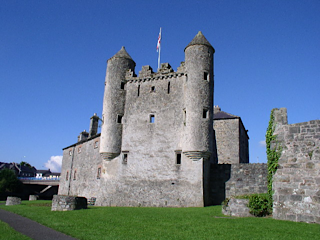
The First Siege of Enniskillen

The first siege of Enniskillen takes place at Enniskillen in Fermanagh, present day Northern Ireland, beginning on January 25, 1594, during the Nine Years’ War. In February 1594, the English have captured Enniskillen Castle from the Irish after a waterborne assault and massacre the defenders after they surrender. From May 1594, an Irish army under Hugh Maguire and Cormac MacBaron O’Neill besiege the English garrison in the castle, and in August they defeat an English relief force. A second relief force is allowed to resupply the garrison, but the castle remains cut off. Eventually, in May 1595, the English garrison surrenders to the Irish and are then massacred.

In 1593, Hugh Maguire, Chief of the Name and Lord of Fermanagh, objects to the behaviour of the newly-appointed English Crown sheriff Humphrey Willis. As he had done before being expelled by Hugh Roe O’Donnell from Tyrconnell in 1592, Willis is cattle raiding and plundering throughout Clan Maguire territory. Maguire is not strong enough to resist the sheriff, but after receiving reinforcements from Hugh O’Neill, Earl of Tyrone, Maguire expelled Willis. In May and June 1593, Maguire and Brian Oge O’Rourke of West Breifne raids lands held by the English Lord President of ConnaughtRichard Bingham. They destroy the town around Ballymote Castle. This is part of a proxy war waged to distract the Crown while Hugh O’Neill strengthens his position in Ulster. As hoped for, the Crown responds by sending an army under Sir Henry Bagenal and Gaelic leader Hugh O’Neill, Earl of Tyrone (outwardly still loyal to the Crown), who defeats Maguire’s force at the Battle of Belleek in October 1593. However, Maguire’s main force remains unscathed.

Enniskillen Castle sits on the River Erne and commands the strategic bottleneck between Upper and Lower Lough Erne. On January 25, 1594, English Captain John Dowdall arrives at Enniskillen by boat with three infantry companies. They dig trenches in which they place light cannons and musketeers, but the cannons are too small to make much of an impact on the castle walls. On January 30, Captain George Bingham arrives with 300 men.

They launch a waterborne assault on the castle. While musketeers in boats and artillery on land fire at the castle, a large boat holding 67 men anchors at a vulnerable part of the walls. They make a breach in the wall with pickaxes, forcing the Irish to take shelter in the keep. Dowdall threatens to destroy the castle with gunpowder if the garrison does not surrender. An Irish witness claims there are 36 fighting men and 40 women and children in the castle, while Dowdall claims there are 200. After they surrender, Dowdall has them put to the sword and claims to have killed 150. Captain Thomas Lee, who is present, describes this as a great dishonor to the Queen as the defenders had surrendered “uppon composicion, And your majesties worde being past to the poore beggars that kept it, they were all notwithstandinge dishonourably putt to the sworde in a most miserable state.”

Dowdall writes on February 2 to the Lord Deputy of Ireland that he has captured the castle from the “rebel” Hugh Maguire. An English garrison is left in place. A detailed coloured illustration of the siege was made shortly after.

A second siege begins on May 17, 1594. Now acting with the covert support of Hugh O’Neill, Hugh Maguire and Cormac MacBaron O’Neill lay siege to Enniskillen which is now isolated in hostile country. This siege ends on August 30 when Lord Deputy William Russell’s beleaguered garrison withdraws. Following this, there is a truce, but “subterfuge and deception were the hallmarks of this stage of the war.”

A third siege begins when Maguire raises the clan and attacks the castle again in January 1595. In May 1595 the garrison agrees to surrender Enniskillen to the Irish in exchange for their lives. However, the entire garrison is then massacred.


Leave a comment

The Second Siege of Enniskillen

The siege of Enniskillen takes place at Enniskillen in Fermanagh, present day Northern Ireland, in 1594 and 1595, during the Nine Years’ War. In February 1594, the English had captured Enniskillen Castle from the Irish after a waterborne assault and massacred the defenders after they surrendered. From May 1594, an Irish army under Hugh Maguire and Cormac MacBaron O’Neill besiege the English garrison in the castle, and in August they defeat an English relief force. A second relief force is allowed to resupply the garrison, but the castle remains cut off. Eventually, in May 1595, the English garrison surrenders to the Irish and are then massacred.

In 1593, Hugh Maguire, Chief of the Name and Lord of Fermanagh, had objected to the behaviour of the newly-appointed English Crown sheriff Humphrey Willis. As he had done before being expelled by Hugh Roe O’Donnell from Tyrconnell in 1592, Willis is cattle raiding and plundering throughout Clan Maguire territory. Maguire is not strong enough to resist the sheriff, but after receiving reinforcements from Hugh O’Neill, Earl of Tyrone, Maguire expels Willis. In May and June 1593, Maguire and Brian Oge O’Rourke of West Breifne raid lands held by the English Lord President of ConnaughtRichard Bingham. They destroy the town around Ballymote Castle. This is part of a proxy war waged to distract the Crown while Tyrone strengthens his position in Ulster. As hoped for, the Crown responds by sending an army under Sir Henry Bagenal and Gaelic leader Hugh O’Neill, Earl of Tyrone (outwardly still loyal to the Crown), who defeat Maguire’s force at the Battle of Belleek in October 1593. However, Maguire’s main force remains unscathed.

On May 17, 1594, now acting with the covert support of Tyrone, Hugh Maguire and Cormac MacBaron O’Neill lay siege to Enniskillen which is now isolated in hostile country. Their army consists of 1,400 foot soldiers and 600 horsemen. It quickly grows with support arriving from Hugh Roe O’Donnell. The English commander, James Eccarsall, has only 50 foot soldiers and 24 horsemen to defend the castle, along with some light artillery. Eccarsall launches a sortie by boat but has to retreat under heavy fire. Irish fortifications cut off access by river and the castle is attacked nightly. Many of the garrison fall sick due to food shortages and exhaustion brought on by incessant skirmishing with the Irish.

On August 7, Maguire and his allies defeat an English relief force for Enniskillen at the Battle of the Ford of the Biscuits. A second relief force commanded by the Lord Deputy William Russell is sent by another route. Although it is not attacked by the Irish, none of Russell’s scouts or messengers reach the castle nor return. Russell relieves the beleaguered garrison by August 30 with six months supplies, then withdraws. Following this, there is a truce, but “subterfuge and deception were the hallmarks of this stage of the war.”


Leave a comment

The Battle of Clontibret

The Battle of Clontibret is fought in County Monaghan in May 1595 during the Nine Years’ War, between the crown forces of England‘s Queen Elizabeth I and the Irish army of Hugh O’Neill, Earl of Tyrone. It ends in victory for Tyrone on May 27, 1595, and is the first severe setback suffered by the English during the war.

The Nine Years War begins with a conflict over English efforts to maintain a string of garrisons along the southern border of Tyrone’s territory in Ulster. The Irish leader promptly besieges the English garrison at Monaghan Castle, and Sir Henry Bagenal, commander of the English forces, marches out to its relief on May 25 from Dundalk, via Newry. His army is made up of 1,750 troops, including some veterans and certain companies newly arrived from the Spanish campaign in Brittany, but there are many recruits in the ranks. Bagenal’s men are predominantly infantry, armed with muskets and pikes. There is also a small number of horsemen raised in the Pale.

The Battle of Clontibret is essentially a two day running battle, as Bagenal’s column is ambushed on its way to and from the castle at Monaghan town. The Irish fight sharply along the roads about Crossdall, around 4 miles from Monaghan, firing on the English column with calivers from the surrounding woodland. With the loss of 12 dead and 30 wounded the English reach the castle, which is re-supplied and reinforced with one company. Bagenal has misgivings about his supply of powder and lead, much of which had been used on the way, and can afford little for the garrison before he starts back.

Two days later, on May 27, Bagenal sets out for Newry in a column, but by another route, past the townland of Clontibret. The route lay through drumlin country, which abounds with hills, bogs and woods, making it ideal for an ambush. The column comes under fire from the outset, and then falls into a major ambush at a pass near Clontibret. Tyrone’s army, about 4,000 strong, consists of contingents from the O’Neill, MacMahon and Maguire clans, as well as Scottish mercenaries. The Irish also deploy a greatly enlarged force of cavalry and caliver-men. To Bagenal’s puzzlement, the caliver-men are turned out in red coats and acquitted themselves with expertise. Fire from the flanks is heavy, and many English troops are killed or wounded while the Irish cavalry plays around the fringes. Tyrone himself is almost killed in hand-to-hand combat with a Palesman named Seagrave, who leads a cavalry charge on the Irish position. Seagrave has his arm chopped off by Tyrone’s standard bearer O’Cahan, and is killed by Tyrone with a dagger thrust to the groin. Bagenal’s column is slowed to a crawl and, as night falls in the wilderness, the commander calls his men to a halt and camps at the hilltop of Ballymacowen. It seems that hundreds are missing, and there is fear that the Irish will renew the attack under cover of darkness. There is no further attack and, a little after first light, reinforcements from Newry arrive to relieve the column.

According to intelligence received in the days following, Tyrone’s failure to follow up is caused by a lack of powder, ironic given the state of Bagenal’s own supplies. The overall sense in government is of disquiet, and a bad job is made of hushing up the casualty figures. This gives fuel to the rumours of a severe defeat, and many people set greater store on the numbers put about by confederate supporters.

Sir Ralph Lane, the muster-master-general, informs the queen’s principal secretary, William Cecil, 1st Baron Burghley, that “more men were hurt and killed in that late service than was convenient to declare.” The casualty figures for both sides vary depending on sources. Bagenal admits only 31 killed and 109 wounded on the second day of fighting, but his losses are almost certainly higher. The Irish annals claimed up to 700 English killed. Estimates of the confederate losses vary between 100 to 400 killed. Three years later, Bagenal leads an army into another ambush by Tyrone, at the Battle of the Yellow Ford. The English general is killed and his troops are routed with heavy losses.

(From: “Battle of Clontibret,” wikia.org, https://military.wikia.org | Pictured: The marker stone on the northern edge of the battlefield commemorating the Irish victory at Clontibret, 1595)


Leave a comment

The Battle of the Yellow Ford

battle-of-the-yellow-ford

The Battle of the Yellow Ford is fought in western County Armagh, near the River Blackwater on August 14, 1598, during the Nine Years War. It is fought between the Gaelic native Irish army under Hugh O’Neill, Earl of Tyrone, and Hugh Roe O’Donnell and a crown expeditionary force from Dublin under Henry Bagenal. The crown forces are marching from Armagh to resupply a besieged fort on the Blackwater when they fall into an ambush and are routed with heavy losses.

The crown forces are organized in six regiments — two forward, two centre, and two rear, and with cavalry at centre. As soon as they leave Armagh garrison, they are all harassed with gunfire from rebel forces concealed in the woods. As a result, the different regiments become separated from one another as they pause to deal with the hit and run attacks. The problem is accentuated when one of their ox-drawn artillery pieces becomes stuck in the bog with a damaged wheel and a rear regiment stays behind to guard it as it is slowly coaxed through the bog. The regiment at the front of the march encounters a mile-long trench, 4 feet wide and 5 feet deep. The regiment succeeds in crossing the trench but then comes under heavy attack from large forces and decides to retreat back across the trench, suffering significant losses during the retreat. This regiment then merges into the ranks of the other forward regiment.

At this point, Henry Bagenal is killed by a shot through the head. Command of the army is assumed by Thomas Maria Wingfield. Further demoralising the crown troops and causing chaos, their gunpowder store explodes, apparently ignited accidentally by the fuse of a matchlock musket. Daunted, Wingfield decides to retreat to Armagh. The commander of the forward part either doesn’t get the command or refuses to obey it or is unable to execute an orderly retreat and judges it necessary to maintain his forward position. Seeing their enemy in confusion, the O’Neill cavalry rushes at the head of the forward part, followed by swordsmen on foot. Crown troops in this part of the field are cut to pieces and any wounded left on the field after the battle are slain as well. The rest of the crown forces have to struggle their way back to the Armagh garrison. They reach it largely intact but are harried all the way by the Irish.

Crown forces lose approximately 1,500 men in the battle, including 18 “captains” or officers. Three hundred soldiers desert to the rebels including two English recruits. Out of 4,000 soldiers who set out from Armagh, just over 2,000 reach the town after the battle and become virtual prisoners inside. The cavalry breaks out and dashes south escaping the Irish.

After three days of negotiations, it is agreed that the crown troops can leave Armagh as long as they leave their arms and ammunition behind and that the garrison of the Blackwater Fort surrenders. O’Neill’s forces suffer perhaps 200 to 300 casualties in the battle, though sources for the number lost on O’Neill’s side are very scanty. In light of the battle’s outcome, the court at London greatly and rapidly increase its military forces in Ireland. Simultaneously, many in Ireland who have been neutral on the sidelines begin to support the rebellion. Thus, the ultimate outcome of the battle is an escalation of the war.