seamus dubhghaill

Promoting Irish Culture and History from Little Rock, Arkansas, USA


Leave a comment

Death of Australian Explorer Robert O’Hara Burke

Robert O’Hara Burke, Irish soldier and police officer who achieves fame as an Australian explorer, dies of starvation on June 28, 1861, in Cooper Creek, Queensland, Australia, while exploring the continent. He is the leader of the ill-fated Burke and Wills expedition which is the first expedition to cross Australia from south to north.

Burke is born in St. Clerens, County Galway on May 6, 1821, the second of three sons of James Hardiman Burke, an officer in the British Army 7th Royal Fusiliers, and Anne Louisa Burke (nee O’Hara).

Burke enters the Royal Military Academy, Woolwich in May 1835. In December 1836 he fails his probationary exam and goes to Belgium to further his education. In 1841, he enters the Imperial Austrian Army and spends most of his time posted to northern Italy. Towards the end of 1847 he suffers health problems and ultimately resigns from the Austrian army in June 1848.

After returning to Ireland in 1848, he joins the Irish Constabulary (later the Royal Irish Constabulary). He does his cadet training at Phoenix Park Depot in Dublin between November 1849 and January 1850. At the end of 1850 he transfers to the Mounted Police in Dublin.

Burke emigrates to Australia, arriving in Hobart, Tasmania on February 12, 1853, and promptly sails for Melbourne. On April 1, 1853, he joins the recently established Victoria Police force.

After the South Australian explorer John McDouall Stuart reaches the centre of Australia, the South Australian parliament offers a reward of £2,000 for the promotion of an expedition to cross the continent from south to north, generally following Stuart’s route. In June 1860, Burke is appointed to lead the Victorian Exploring Expedition with William John Wills, his third-in-command, as surveyor and astronomical observer.

The expedition leaves Melbourne on August 20, 1860, with a total of 19 men, 27 camels and 23 horses. They reach Menindee on September 23, 1860, where several people resign.

Cooper Creek, 400 miles further on, is reached on November 11, 1860, by the advance group, the remainder being intended to catch up. After a break, Burke decides to make a dash to the Gulf of Carpentaria, leaving on December 16, 1860. William Brahe is left in charge of the remaining party. The small team of Burke, William Wills, John King and Charley Gray reach the mangroves on the estuary of the Flinders River, near where the town of Normanton now stands, on February 9, 1861. They never see open ocean due to flooding rains and swamps.

Already weakened by starvation and exposure, progress on the return journey is slow and hampered by the tropical monsoon downpours of the wet season. Gray dies four days before they reach the rendezvous at Cooper Creek. The other three rest for a day when they bury him. They eventually reach the rendezvous point on April 21, 1861, nine hours after the rest of the party had given up waiting and left, leaving a note and some food, as they had not been relieved by the party supposed to be returning from Menindee.

Burke’s party attempts to reach Mount Hopeless, the furthest outpost of pastoral settlement in South Australia, which is closer than Menindee, but fail and return to Cooper Creek. While waiting for rescue Wills dies of exhaustion and starvation. Soon after, Burke also dies, at a place now called Burke’s Waterhole on Cooper Creek in South Australia. The exact date of Burke’s death is uncertain but has generally been accepted to be June 28, 1861.

King survives with the help of Aborigines until he is rescued in September by Alfred William Howitt. Howitt buries Burke and Wills before returning to Melbourne. In 1862, Howitt returns to Cooper Creek and disinters Burke and Wills, taking them first to Adelaide and then by steamer to Melbourne where they are laid in state for two weeks. On January 23, 1863, Burke and Wills receive a State Funeral and are buried in Melbourne General Cemetery. Ironically, on that same day John McDouall Stuart and his companions, having successfully completed the south-north crossing, are received back at a large ceremony in Adelaide.

Leave a comment

Birth of Morgan O’Connell, Soldier & Politician

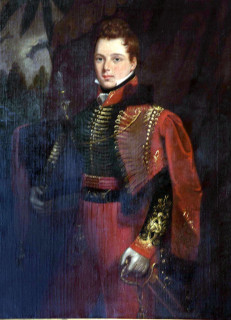
Morgan O’Connell, soldier, politician and son of the Irish Nationalist leader Daniel O’Connell, the Liberator of Ireland, is born in Dublin on October 31, 1804. He serves in the Irish South American legion and the Imperial Austrian Army. He is MP for Meath from 1832 until 1840 and afterwards assistant registrar of deeds for Ireland from 1840 until 1868.

O’Connell, one of seven children (and the second of four sons) of Daniel and Mary O’Connell, is born at 30 Merrion Square, Dublin. His brothers Maurice, John and Daniel are also MPs.

In 1819, self-styled General John Devereux comes to Dublin to enlist military aid for Simón Bolívar‘s army to liberate Venezuela from Spanish rule. He succeeds in forming an Irish Legion, to be part of Bolivar’s British Legions. O’Connell, encouraged by his father, is one of the officers who purchases a commission in it even though he is only 15 years old. The enterprise is mismanaged; there is no commissariat organisation on board the ships, and a part of the force die on the voyage. The remainder are disembarked on the Spanish Main at Margarita Island, where many deaths take place from starvation eight days after the Irish mutineers leave for Jamaica.

Bolivar, who had noted his pleasure at the departure of “these vile mercenaries,” is too astute a diplomat to offend the son of his Irish counterpart. O’Connell is accorded the appropriate privileges of his rank, and toasts are drunk to the health of his father, the “most enlightened man in all Europe.” A portion of the expedition, under Francis O’ Connor, effects an alliance with Bolivar, and to the energy of these allies the republican successes are chiefly due.

Bolivar makes sure that the untrained Irish lad stays out of danger. “I have numberless hardships to go through,” said Bolivar, “which I would not bring him into, for the character of his father is well known to me.” But ceremonial duties soon bore the restless young Irishman. After a year at Bolivar’s headquarters Morgan leaves for Ireland.

If South America did not satisfy O’Connell’s taste for adventure, he has more than his fill on the return journey. He survives a bout of tropical fever and is shipwrecked twice in succession, ending up stranded in Cuba. A schooner captain, who turns out to be a long-lost Irish cousin, rescues him. After the captain is killed in a fight with his boatswain, he hitches a ride to Jamaica on a Danish ship commanded by a skipper from Cork. From Jamaica, another Irish officer offers Morgan passage home.

Arriving in January 1822, O’Connell is greeted by his proud father as a prodigal son returned. His South American adventure, declares Daniel O’Connell, has made a man of Morgan. Otherwise, said O’Connell, “it would have been difficult to tame him down to the sobriety of business.” After his return to Ireland, he again seeks foreign service in the Austrian army.

On December 19, 1832, O’Connell enters parliament in the Liberal interest, as one of the members for Meath, and continues to represent that constituency until January 1840, when he is appointed first assistant-registrar of deeds for Ireland, at a salary of £1,200 a year, a position he holds until 1868. In politics he is never in perfect accord with his father, and his retirement from parliament is probably caused by his inability to accept the Repeal movement.

During his parliamentary career O’Connell fights a duel with Lord William Arden, 2nd Baron Alvanley, a captain in the British Army, at Chalk Farm, on May 4, 1835. A challenge had been sent by Alvanley to O’Connell’s father, who, in accordance with a vow he had made after shooting John D’Esterre, declines the meeting. The younger O’Connell thereupon takes up the challenge on his father’s account. Two shots each are exchanged, but no one is hurt. Afterwards, in December 1835, he receives a challenge from Benjamin Disraeli, in consequence of an attack made on Disraeli by O’Connell’s father. He declines to meet Disraeli.

On July 23, 1840, O’Connell marries Kate Mary, youngest daughter of Michael Balfe of South Park, County Roscommon.

Morgan O’Connell dies at 12 St. Stephen’s Green, Dublin, on January 20, 1885. He is buried in Glasnevin Cemetery in Dublin on January 23.

(Pictured: Morgan O’Connell, oil on canvas, artist unknown, c. 1819/20)