seamus dubhghaill

Promoting Irish Culture and History from Little Rock, Arkansas, USA


1 Comment

6th Louisiana Infantry Regiment Organized into Confederate Service

A lesser-known Irish Brigade of the American Civil War, the 6th Louisiana Infantry Regiment, is mustered into Confederate service at Camp Moore on June 4, 1861. It is part of the Louisiana Tigers. At a time when an estimated 20,000 Irish live in New Orleans, it is not surprising that the 6th Louisiana comprises a high percentage of Irish soldiers. It begins its service with 916 men and ends with 52 after surrendering after the Battle of Appomattox Court House in April 1865.

The regiment’s 916 men are organized into 10 companies designated with the letters A–I and K. Most of the companies are organized in Orleans Parish, although Company D is from Tensas Parish, Company C from St. Landry Parish, and Company A from Union Parish and Sabine Parish. The unit’s first colonel is Isaac Seymour, its first lieutenant colonel is Louis Lay, and its first major is Samuel L. James. Over half of the unit’s men with known places of birth are born outside of the United States, primarily from Ireland. In its early days, the unit has a reputation for being disorderly and hard to control. Seymour has to publicly rebuke several officers in late 1861 for drunkenness.

Sent to the fighting in Virginia and stationed at Centreville, the regiment guards supplies and is not involved in the First Battle of Bull Run on July 21, 1861. In August, it is added to a brigade commanded by William H. T. Walker consisting of the 7th Louisiana Infantry Regiment, the 8th Louisiana Infantry Regiment, the 9th Louisiana Infantry Regiment, and the 1st Louisiana Special Battalion. The brigade spends the next winter in the vicinity of Centreville, and Orange Court House before being transferred to the Shenandoah Valley in early 1862, where it fights under Stonewall Jackson. James resigns on December 1, 1861, and is replaced by George W. Christy, who is dropped from the regiment’s rolls on May 9, 1862, and replaced with Arthur MacArthur. Lay resigns on February 13 and is replaced by Henry B. Strong.

On May 23, 1862, the regiment sees action in the Battle of Front Royal and captures two Union battle flags in a skirmish at Middletown the next day. May 25 sees the regiment engage in the First Battle of Winchester, where MacArthur is killed, and on June 9 it fights in the Battle of Port Republic, in which 66 of its men are killed or wounded. MacArthur’s role as major is then filled by Nathaniel G. Offutt. After Port Republic, Jackson’s men are transferred to the Virginia Peninsula to take part in the Seven Days Battles, and the 6th Louisiana skirmishes at Hundley’s Corner on June 26 before fighting in the Battle of Gaines’ Mill the next day. Seymour leads the brigade at Gaines’ Mill, since Richard Taylor is ill. The Louisianans, known as the Louisiana Tigers, become bogged down in Boatswain’s Swamp, are repulsed with loss, and withdraw from the battle. Seymour is killed during the charge and is replaced by Strong. Offutt takes over Strong’s position as lieutenant colonel, and William Monaghan becomes colonel.

Moving north with Jackson in August, the regiment fights in the Manassas Station Operations at Bristoe Station, Virginia on August 26 and Kettle Run, Virginia the following day. At Kettle Run, the regiment holds off a Union advance while the 8th Louisiana burns a bridge, and then the two regiments, joined by the 60th Georgia Infantry Regiment and the 5th Louisiana Infantry Regiment, fight against the Union Army‘s Excelsior Brigade and the brigade of Colonel Joseph Bradford Carr. It then fights in the Second Battle of Bull Run on August 29-30, 1862. At Second Bull Run, it is part of the brigade of Colonel Henry Forno. On the first day of the battle, Forno’s brigade helps repulse James Nagle‘s Union brigade. On the morning on 30 August 30, it is sent to the rear for supplies and does not rejoin the fighting that day.

After Second Bull Run, the 6th Louisiana fights in the Battle of Chantilly on September 1, 1862, where the Louisiana brigade is routed with the 5th, 6th, 8th, and 14th Louisiana regiments suffering the heaviest casualties in the Confederate army, and on September 17 sees action in the Battle of Antietam. At Antietam, the regiment is part of Harry T. Hays‘s brigade. During the fighting, Hays’s brigade charges toward the Miller’s Cornfield and is cut to pieces, with the brigade suffering 61 percent casualties. The 6th Louisiana loses 52 men killed or wounded, including Colonel Strong, who is killed and replaced with Offutt. All 12 officers of the 6th Louisiana that see action at Antietam are killed or wounded. Monaghan becomes lieutenant colonel and is replaced as major by Joseph Hanlon. Offutt in turn resigns on November 7 and is replaced by Monaghan. Hanlon becomes lieutenant colonel, and Manning is promoted to major. The regiment is held in reserve at the Battle of Fredericksburg on December 13, 1862, and is not directly engaged, although it does come under Union artillery fire.

An inspection in January 1863 rates the 6th Louisiana as having “poor” discipline and moderately good at performance in drills. Along with the 5th Louisiana Infantry, the regiment contests a Union crossing of the Rappahannock River on April 29, 1863. Union troops are able to force a crossing, and the 6th Louisiana has 7 men killed, 12 wounded, and 78 captured. It then fights in the Second Battle of Fredericksburg on May 3, 1863, where 27 of the unit’s men are captured. While part of the regiment is captured, most of the unit is able to withdraw from the field in better condition than the other Confederate units positioned near it. It then fights at the Battle of Salem Church the next day. Altogether, the 6th Louisiana Infantry sustains losses of 14 killed, 68 wounded, and 99 captured at the Battle of Chancellorsville. It next sees combat on June 14, 1863, in the Second Battle of Winchester, where it joins its brigade of other Louisiana units in capturing a Union fort.,

At the Battle of Gettysburg on July 1-3, 1863, the 6th Louisiana is still in Hays’ brigade. On July 1, the brigade is part of a Confederate charge that sweeps the Union XI Corps from the field, although it is less heavily engaged than some of the other participating Confederate brigades. Entering the town of Gettysburg, the brigade captures large numbers of disorganized Union troops. On the evening of the following day, the brigade is part of a failed attack against the Union position on Cemetery Hill. It then spends July 3, the final day of the battle, skirmishing. The Confederates, who are defeated at Gettysburg, withdraw from the field on July 4. The regiment takes 232 men into the fighting at Gettysburg and suffers 61 casualties.

Back in Virginia, the 6th Louisiana fights in the Bristoe campaign in October 1863 and is overrun in the Second Battle of Rappahannock Station on November 7, losing 89 men captured. In the spring of 1864, it fights in Ulysses S. Grant‘s Overland Campaign. On May 5, 1864, in the Battle of the Wilderness, the regiment helps repulse a Union attack, after Hays’ brigade had been repulsed and badly bloodied earlier in the battle. It then fights in the Battle of Spotsylvania Court House on May 9-19, 1864. On May 12, the regiment is part of its brigade’s fighting at the Mule Shoe. The brigade is badly wrecked at the Mule Shoe, and only 60 men are present at the 6th Louisiana’s roll call the next morning. From June through October, it is detached as part of Jubal Early‘s command to fight in the Valley campaigns of 1864. Monaghan is killed in battle in late August and is not replaced as colonel. At the Battle of Cedar Creek in October 1864, one company of the 6th Louisiana sees both men present shot. After the battle, the 5th, 6th, and 7th are consolidated into a single company when the brigade is reorganized due to severe losses. Taking part in the Siege of Petersburg, the 6th Louisiana’s survivors fight at the Battle of Hatcher’s Run on February 6, 1865, and at the Battle of Fort Stedman on March 25.

The 6th Louisiana’s remnants end their military service when Robert E. Lee‘s Confederate army surrenders on April 9, after the Battle of Appomattox Court House. At the time of the surrender, the 6th Louisiana has been reduced to 52 officers and men. Over the course of its existence, 1,146 men serve in the unit. Of that total, 219 are combat deaths, 104 die of disease, one man drowns, five die accidentally, one man is executed, and at least 232 desert. Desertions are particularly heavy in three companies that primary consist of men born outside of the United States.

(Pictured: National colors of the “Orleans Rifles” or Company H, Sixth Louisiana Infantry Regiment during the American Civil War)
Leave a comment

The Battle of Chantilly

The predominately Irish 6th Louisiana Infantry Regiment fights at the Battle of Chantilly (or Ox Hill, the Confederate name), which takes place on September 1, 1862, in Fairfax County, Virginia, as the concluding battle of the northern Virginia campaign of the American Civil War. Thomas J. “Stonewall” Jackson‘s corps of the Army of Northern Virginia attempts to cut off the line of retreat of the Union Army of Virginia following the Second Battle of Bull Run but is attacked by two Union divisions. During the ensuing battle, Union division commanders Isaac Stevens and Philip Kearny are both killed, but the Union attack halts Jackson’s advance.

On the morning of September 1, 1862, Union Maj. Gen. John Pope orders Maj. Gen. Edwin Vose Sumner of the II Corps, Army of the Potomac, to send a brigade north to reconnoiter. The army’s cavalry is too exhausted for the mission. But at the same time, he continues his movement in the direction of Washington, D.C., sending Maj. Gen. Irvin McDowell‘s III Corps to Germantown (on the western border of modern-day Fairfax, Virginia), where it can protect the important intersection of Warrenton Pike and Little River Turnpike that the army needs for the retreat. He also sends two brigades from Maj. Gen. Jesse L. Reno‘s IX Corps, under the command of Brig. Gen. Isaac Stevens, to block Jackson. Maj. Gen. Philip Kearny’s division from the III Corps follows later that afternoon.

Jackson resumes his march to the south, but his troops are tired and hungry and make poor progress as the rain continues. They march only three miles and occupy Ox Hill, southeast of Chantilly Plantation, and halt, while Jackson himself takes a nap. All during the morning, Confederate cavalry skirmish with Union infantry and cavalry. At about 3:00 PM, Stevens’s division arrives at Ox Hill. Despite being outnumbered, Stevens chooses to attack across a grassy field against Brig. Gen. Alexander Lawton‘s division in the Confederate center. The Union attack is initially successful, routing the brigade of Colonel Henry Strong and driving in the flank of Captain William Brown, with Brown killed during the fighting. The Union division is driven back following a counterattack by Brig. Gen. Jubal Early‘s brigade. Stevens is killed during this attack at about 5:00 PM by a shot through his temple.

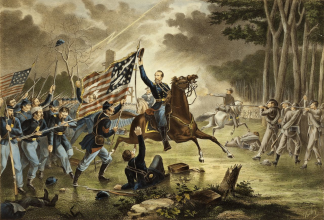
A severe thunderstorm erupts about this time, resulting in limited visibility and an increased dependence on the bayonet, as the rain soaks the ammunition of the infantry and makes it useless. Kearny arrives about this time with his division to find Stevens’s units disorganized. Perceiving a gap in the line he deploys Brig. Gen. David B. Birney‘s brigade on Stevens’s left, ordering it to attack across the field. Birney manages to maneuver close to the Confederate line but his attack stalls in hand-to-hand combat with Maj. Gen. A.P. Hill‘s division. Kearny mistakenly rides into the Confederate lines during the battle and is killed. As Kearny’s other two brigades arrive on the field, Birney uses the reinforcements as a rear guard as he withdraws the remainder of the Union force to the southern side of the farm fields, ending the battle.

That night, Maj. Gen. James Longstreet arrives to relieve Jackson’s troops and to renew the battle the following morning. The lines are so close that some soldiers accidentally stumble into the camps of the opposing army. The Union army withdraws to Germantown and Fairfax Court House that night, followed over the next few days by retreating to the defenses of Washington D.C. The Confederate cavalry attempts a pursuit but fails to cause significant damage to the Union army.

The fighting is tactically inconclusive. Although Jackson’s turning movement is foiled and he is unable to block the Union retreat or destroy Pope’s army, National Park Service historians count Chantilly as a strategic Confederate victory because it neutralizes any threat from Pope’s army and clears the way for Lee to begin his Maryland campaign. The Confederates claim a tactical victory as well because they hold the field after the battle. Two Union generals are killed, while one Confederate brigade commander is killed. Pope, recognizing the attack as an indication of continued danger to his army, continues his retreat to the fortifications around Washington, D.C. Lee begins the Maryland Campaign, which culminates in the Battle of Antietam, after Pope retreats from Virginia. The Army of the Potomac, under Maj. Gen. George B. McClellan, absorbs the forces of Pope’s Army of Virginia, which is disbanded as a separate army.

The site of the battle, once rural farmland, is now surrounded by suburban development in Fairfax County. A 4.8-acre (19,000 m²) memorial park, the Ox Hill Battlefield Park, is located off of State Route 608 (West Ox Road) and lies adjacent to the Fairfax Towne Center shopping area and includes most of the Gen. Isaac Stevens portion of the battle, about 1.5% of the total ground. The park is under the jurisdiction of the Fairfax County Park Authority. In January 2005, the Authority approves a General Management Plan and Conceptual Development Plan that sets forth a detailed history and future management framework for the site.

A small yard located within the nearby Fairfax Towne Center has been preserved to mark the area crossed by Confederate troops to get to the Ox Hill battlefield.

(Pictured: Color lithograph “General Kearney’s gallant charge,” published by John Smith, 804 Market St., Philadelphia. From the Library of Congress.)


Leave a comment

Death of James A. Mulligan, Union Army Colonel

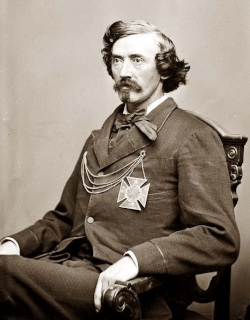
James Adelbert Mulligan, a colonel of the 23rd Illinois Infantry Regiment in the Union Army during the American Civil War, dies on July 26, 1864, of wounds sustains at the Second Battle of Kernstown three days earlier.

Mulligan is born on June 30, 1830, in Utica, New York. His parents had immigrated from Ireland and his father died when he was a child. His mother remarries a Michael Lantry of Chicago, Illinois, and moves there with her son, who later attends the St. Mary’s on the Lake College of North Chicago. From 1852–54 he reads law in the offices of Isaac N. Arnold, U.S. Representative from the city. He is admitted to the bar in 1856 and commissioned a second lieutenant in the “Chicago Shield Guards.”

At the onset of the American Civil War, Mulligan raises the 23rd Illinois Infantry Regiment in 1861, which is locally known as the “Irish Brigade” (not to be confused with a New York unit by the same name). This unit includes the Chicago Shield Guards. In September 1861, he leads his troops toward Lexington, Missouri, as word had been received that this vital river town will be attacked by the pro-Confederate Missouri State Guard under Major General Sterling Price.

The First Battle of Lexington, often referred to as the Battle of the Hemp Bales, commences on September 13, 1861, when 12,500 soldiers of the Missouri State Guard begin a siege of Mulligan’s diminutive command, entrenched around the town’s old Masonic College. On September 18, Price’s army mounts an all-out assault on Mulligan’s works, which fails. Cannon fire continues through September 19. On the 20th, units of Price’s army use hemp bales soaked in the Missouri River as a moving breastwork to work their way up the river bluffs toward Mulligan’s headquarters. By 2:00 PM, Mulligan has surrendered. Combined casualties are 64 dead, and 192 wounded. Price is reportedly so impressed by Mulligan’s demeanor and conduct during and after the battle that he offers him his own horse and buggy and orders him safely escorted to Union lines.

Mulligan is commander of Camp Douglas, a prisoner of war camp in Chicago, from February 25, 1862, to June 14, 1862. The camp had been constructed as a short-term training camp for Union soldiers but is converted to a prisoner of war camp for captured Confederate soldiers after the fall of Fort Donelson.

Mulligan and his regiment are assigned to the Railroad Division of the Middle Department between December 17, 1862, and March 27, 1863. Then they are assigned to 5th Brigade, 1st Division, VIII Corps in the Middle Department between March 27, 1863, and June 26, 1863.

Between August and December 1863, Mulligan oversees the construction of Fort Mulligan, an earthworks fortification located in Grant County, West Virginia. This fort remains one of the best-preserved Civil War fortifications in West Virginia and has become a local tourist attraction.

On July 3, 1864, only three weeks before his death, Mulligan distinguishes himself in the Battle of Leetown, fought in and around Leetown, Virginia. Federal troops are retreating in the face of Major General Jubal Early‘s relentless Confederate advance down the Shenandoah Valley during the Second Valley Campaign. Hoping to buy time to concentrate Union forces and supplies, Major General Franz Sigel orders him to hold Leetown for as long as possible and then conduct a fighting retreat as slowly as possible to cover the other withdrawing Union units. He manages to hold Leetown for the entire day before being compelled to retreat, albeit very slowly. He continues to battle Early’s troops all the way from Leetown to Martinsburg, West Virginia, buying valuable time for Union commanders to concentrate their forces in the Valley.

On July 24, 1864, Mulligan leads his troops into the Second Battle of Kernstown, near Winchester, Virginia. Late in the afternoon, Major General John B. Gordon’s Confederate force attacks Mulligan’s 1,800 soldiers from ground beyond Opequon Church. Mulligan briefly holds off Gordon’s units, but Confederate Major General John C. Breckinridge leads a devastating flank attack against the Irishmen from the east side of the Valley Pike. Sharpshooters then attack his right flank from the west. Now encompassed on three sides, the Union battle line falls apart.

With Confederates closing from all around, Mulligan orders his troops to withdraw. As he stands up in his saddle to spur his men on, Confederate sharpshooters concealed in a nearby stream bed manage to hit the Union commander. His soldiers endeavor to carry him to safety, but the unyielding Confederate fire make this an impossible task. He is well aware of his situation, and the danger his men are in, and so he famously orders, “Lay me down and save the flag.” His men reluctantly comply. Confederate soldiers capture him and carry the mortally wounded colonel into a nearby home, where he dies two days later on July 26, 1864. He is buried in Calvary Cemetery, Evanston, Illinois.

On February 20, 1865, the United States Senate confirms the posthumous appointment of Mulligan to the rank of brevet brigadier general of U.S. Volunteers to rank from July 23, 1864, the day before he is mortally wounded at the Second Battle of Kernstown.


Leave a comment

The Second Battle of Fredericksburg

The 6th Louisiana Infantry, a largely Irish Confederate regiment, fights at the Second Battle of Fredericksburg, also known as the Second Battle of Marye’s Heights, on May 3, 1863, in Fredericksburg, Virginia, as part of the Chancellorsville Campaign of the American Civil War. With its ranks filled with Irishmen from New Orleans and roundabouts, the 6th fights in nearly every major battle of the Eastern Theater, from First Battle of Bull Run to the Battle of Appomattox Court House.

Confederate General Robert E. Lee leaves Major General Jubal Anderson Early to hold Fredericksburg on May 1, while he marches west with the rest of the Army of Northern Virginia to deal with Union Army Major General Joseph Hooker‘s main thrust at Chancellorsville with four corps of the Army of the Potomac. Early has his own division, along with William Barksdale‘s brigade from McLaws’ division and cannons from the artillery reserve. Early is assisted by Brigadier General William Pendleton of the artillery reserve. Cadmus Wilcox‘s brigade arrives on May 3, increasing Early’s strength to 12,000 men and 45 cannons. Most of the Confederate force is deployed south of Fredericksburg.

Early is ordered by Lee to watch the remaining Union force near Fredericksburg. If he is attacked and defeated, he is to retreat southward to protect the Confederate supply lines. If the Union force moves to reinforce Hooker, then Early is to leave a covering force and rejoin Lee with the remainder of his troops. On May 2, misunderstanding his orders, Early leaves one brigade at Fredericksburg and starts the rest of his force towards Chancellorsville. Lee corrects the misunderstanding and Early then returns to his positions that night before Major General John Sedgwick of the Union Army discovers the Confederate retreat.

Sedgwick is left near Fredericksburg with the VI Corps, the I Corps, and the II Corps division of Brigadier General John Gibbon. Hooker’s plan calls for Sedgwick to demonstrate near the city in order to deceive Lee about the Union plan. The VI and II Corps seize control of several crossings on April 29, laying down pontoon bridges in the early morning hours, and the divisions of William T. H. Brooks and James S. Wadsworth cross the river. The I Corps is ordered to reinforce the main army at Chancellorsville during the night of May 1. During the evening of May 2, Sedgwick receives orders to attack Early with his remaining forces.

Sedgwick moves his forces into Fredericksburg during dawn on May 3, uniting with Gibbon’s division which had crossed the river just before dawn. Sedgwick originally plans to attack the ends of Marye’s Heights, but a canal and a stream block the Union forces. He then decides to launch an attack on the Confederate center on the heights, which is manned by Barksdale’s brigade, with John Newton’s division. This attack is defeated. Colonel Thomas M. Griffin of the 18th Mississippi Infantry grants the Union forces a truce in order to gather in their wounded. During this truce, the Union commanders notice that the flank of Barksdale’s left regiment is unprotected.

Sedgwick launches another attack against this flank and Barksdale’s front using elements from all three VI Corps divisions, which pushes the Confederate forces off the ridge, capturing some artillery. The first men to mount the stone wall are from the 5th Wisconsin and the 6th Maine Infantry regiments. Barksdale retreats to Lee’s Hill, where he attempts to make another stand but is again forced to retreat southward.

Confederate casualties total 700 men and four cannons. Early withdraws with his division two miles to the south, while Wilcox withdraws westward, slowing Sedgwick’s advance. When he learns of the Confederate defeat, Lee starts moving two divisions east to stop Sedgwick. Following the campaign, Early becomes embroiled in an argument with Barksdale over what Barksdale considered a slight to his brigade in a newspaper letter that Early had written. The exchange continues until Lee orders the two generals to cease.

Sedgwick loses 1,100 men during the engagement. At first, he starts to pursue Early’s division but then follows the orders he received the previous day and starts west along the Plank Road towards Hooker’s army at Chancellorsville. Gibbon’s division is left in Fredericksburg to guard the city.

(Pictured: Three men in a tree on Stafford Heights watching distant fighting on Marye’s Heights during the Second Battle of Fredericksburg, 1863. Smoke from the battle is possibly visible in the distance which would make it one of the earliest combat photographs of a land battle. The destroyed railroad bridge over the Rappahannock River is in the middle ground of the photo. Source: National Park Service via the Western Reserve Historical Society)


Leave a comment

The Second Battle of Rappahannock Station

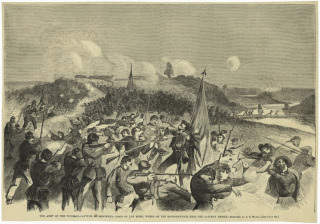
The Irish 6th Louisiana fights at the Second Battle of Rappahannock Station on November 7, 1863, near the village of Rappahannock Station (now Remington, Virginia), on the Orange and Alexandria Railroad. The battle is between Confederate forces under Maj. Gen. Jubal Early and Union forces under Maj. Gen. John Sedgwick as part of the Bristoe campaign of the American Civil War. The battle results in a victory for the Union.

Following the Battle of Gettysburg in July 1863, the Union and Confederate armies drift south and for three months spar with one another on the rolling plains of northern Virginia. In late October, General Robert E. Lee withdraws his Confederate army behind the Rappahannock River, a line he hopes to maintain throughout the winter. A single pontoon bridge at the town of Rappahannock Station is the only connection Lee retains with the northern bank of the river.

The Union Army of the Potomac‘s commander, Maj. Gen. George G. Meade, divides his forces just as Lee expects. He orders Maj. Gen. John Sedgwick to attack the Confederate position at Rappahannock Station while Maj. Gen. William H. French forces a crossing five miles downstream at Kelly’s Ford. Once both Sedgwick and French are safely across the river, the reunited army is to proceed to Brandy Station.

The operation goes according to plan. Shortly after noon on November 7, French drives back Confederate defenders at Kelly’s Ford and crosses the river. As he does so, Sedgwick advances toward Rappahannock Station. Lee learns of these developments sometime after noon and immediately puts his troops in motion to meet the enemy. His plan is to resist Sedgwick with a small force at Rappahannock Station while attacking French at Kelly’s Ford with the larger part of his army. The success of the plan depends on his ability to maintain the Rappahannock Station bridgehead until French is defeated.

Sedgwick first engages the Confederates at 3:00 PM when Maj. Gen. Albion P. Howe‘s division of the VI Corps drives in Confederate skirmishers and seizes a range of high ground three-quarters of a mile from the river. Howe places Union batteries on these hills that pound the enemy earthworks with a “rapid and vigorous” fire. Confederate guns across the river return the fire, but with little effect.

Maj. Gen. Jubal Early’s division occupies the bridgehead defenses that day. Early posts Brig. Gen. Harry T. Hays‘s Louisiana brigade and Captain Charles A. Green’s four-gun Louisiana Guard Artillery in the works and at 4:30 PM reinforces them with three North Carolina regiments led by Colonel Archibald C. Godwin. The addition of Godwin’s troops increases the number of Confederate defenders at the bridgehead to nearly 2,000.

Sedgwick continues shelling the Confederates throughout the late afternoon, but otherwise he shows no disposition to attack. As the day draws to a close, Lee becomes convinced that the movement against the bridgehead is merely a feint to cover French’s crossing farther downstream. He is mistaken. At dusk the shelling stops, and Sedgwick’s infantry rushes suddenly upon the works. Col. Peter Ellmaker’s brigade advances adjacent to the railroad, precedes by skirmishers of the 6th Maine Volunteer Infantry. At the command “Forward, double-quick!” they surge over the Confederate works and engage Hays’s men in hand-to-hand combat. Without assistance, the 6th Maine breaches the Confederate line and plants its flags on the parapet of the easternmost redoubt. Moments later the 5th Wisconsin Infantry Regiment swarms over the walls of the western redoubt, likewise, wresting it from Confederate control.

On the right, Union forces achieve comparable success. Just minutes after Ellmaker’s brigade penetrates Hays’s line, Col. Emory Upton‘s brigade overruns Godwin’s position. Upton reforms his lines inside the Confederate works and sends a portion of the 121st New York Volunteer Infantry to seize the pontoon bridge, while the rest of his command wheels right to attack the confused Confederate horde now massed at the lower end of the bridgehead.

Confederate resistance dissolves as hundreds of soldiers throw down their arms and surrender. Others seek to gain the opposite shore by swimming the icy river or by running the gauntlet of Union rifle fire at the bridge. Confederate troops south of the Rappahannock look on hopelessly as Union soldiers herd their comrades to the rear as prisoners of war.

In all, 1,670 Confederates are killed, wounded, or captured in the brief struggle, more than eighty percent of those engaged. Union casualty figures, by contrast, are small: 419 in all. The battle is as humiliating for the South as it is glorious for the North. Two of the Confederacy’s finest brigades, sheltered behind entrenchments and well supported by artillery, are routed and captured by an enemy force of equal size.

The Civil War Trust and its partners have acquired and preserved 856 acres of the battlefield where the First and Second Battles of Rappahannock Station were fought. The battleground for both battles is located along the Rappahannock River at Remington, VA and features visible earthworks as well as bridge and mill ruins. The earthworks at Remington are no longer there and more than 75% of the battlefield has been developed over.