
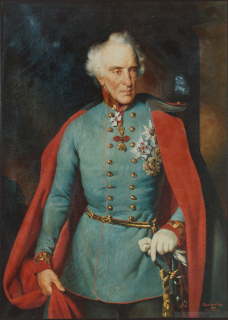
Laval Graf Nugent von Westmeath, Field Marshal in the Austrian army and a soldier of Irish birth who fights in the armies of Austria and the Two Sicilies, dies on August 21, 1862, in the Bosiljevo Castle near Karlovac, in what is now Croatia.
Nugent is born in Ballinacor, a townland in the civil parish of Killare, County Westmeath, on November 3, 1777. He is the son of Count Michael Anton Nugent von Westmeath, Governor of Prague.
In 1793, Nugent joins the Austrian Army, becoming Colonel in 1807, and Chief of Staff of the Army Corps of Archduke John of Austria in 1809. In 1813, he leads the campaign against Viceroy Eugène de Beauharnais, separating French units in Dalmatia and simultaneously joining the British fleet, thus conquering Croatia, Istria and the Po Valley. In 1815, during the Neapolitan War, he commands the right wing of the Austrian Army in Italy, liberates Rome, and defeats Joachim Murat at the Battle of Ceprano and the Battle of San Germano.
In 1816, Nugent is given the title of prince by Pope Pius VII. In 1817, he enters the service of King Ferdinand I of the Two Sicilies. He marries Countess Giovannina Riario-Sforza who owns property in the small town of Montepeloso (now called Irsina), in Basilicata. After the outbreak of the Carbonari rebellion in 1820, he returns to serve in the Austrian Army. In 1848, he leads an Army Corps under Joseph Radetzky von Radetz against the Piedmontese, in the course of the First Italian War of Independence, and also against the Hungarian Revolution of 1848. He receives the title of Field Marshal in 1849.
In recognition of his achievements, Nugent is created in addition to a Roman Prince, an Austrian Imperial Count and a Knight of the Golden Fleece. Later, in 1860, he is appointed titular Prior of Ireland of the Sovereign Military Order of St. John of Jerusalem of Rhodes of Malta.
Nugent dies on August 21, 1862, in the Bosiljevo Castle, near Karlovac, and his body is later transferred to a sarcophagus in the Doric temple “Peace for the Hero,” in Trsat above Rijeka, next to the sarcophagus of his wife.
An exhibition of Nugent’s life in terms of his art collecting as well as his military career is curated at the University of Galway in 2019.

 seamus dubhghaill