seamus dubhghaill

Promoting Irish Culture and History from Little Rock, Arkansas, USA


Leave a comment

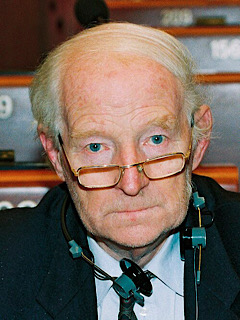
Death of T. J. Maher, Irish Politician & Farmers’ Leader

Thomas Joseph “T. J.” Maher, farmers’ leader and public representative, dies on April 19, 2002, at St. Vincent’s Hospital, Dublin, following a short illness.

Maher is born on April 29, 1922, at Castlemoyle, Boherlahan, Cashel, County Tipperary, the seventh child of Thomas Maher, farmer, and his wife Julianne Maher. Raised on the family’s forty-five-acre holding and educated locally at Ardmayle national school and at the Christian Brothers school and VEC school in Cashel, he takes over the farm in 1948 when ill health forces his father into retirement. He subsequently enlarges it to 120 acres. Mechanically adept, a talented sportsman, and a member of Cashel Dramatic Society, he joins Macra na Feirme and is a founder member of the National Farmers’ Association (NFA) in January 1955.

Maher is a member and chairman of the dairy committee of the NFA before coming to national attention through his participation in the historic farmers’ rights march to Dublin led by Rickard Deasy (October 7-19, 1966), part of the militant campaign for fairer agricultural prices and for reform of taxation and rates on farmland. His part in the subsequent three-week sit-down protest and meeting with incoming minister Neil Blaney, at the Department of Agriculture, confirms his reputation as a tenacious campaigner for agricultural causes. In August 1967, shortly after 100 farmers have served prison sentences for withholding rates, he succeeds Deasy as NFA president. Charismatic, articulate, and decisive, he also has a strong sense of personal responsibility, which governs his expectations of colleagues and associates. With exhausting rounds of travel and meetings, he is impossible to ignore and grist to the media mill, with his apparently impromptu but, in reality, carefully rehearsed speeches criticising politicians, parties, bureaucracy, and tardy national policy. He warns of national economic failure unless government and public services take radical modernising initiatives. He is at once nationalist, internationalist, and a revolutionary campaigner for change, an idealistic firebrand who is essentially conservative in social matters.

Maher’s campaign for agriculture is tempered by a wider interest in the social and economic future of Ireland ahead of crucial negotiations for membership of the European Economic Community (EEC). He becomes a household name, gadfly of bureaucrats and hero of farmers. In November 1967 he attends the European Congress of the International Federation of Agricultural Producers in Rome as an advance action prior to taking part in the subsequent negotiations leading to Ireland’s “entry to Europe” in January 1973. He is re-elected president of the NFA in 1970.

Amalgamating the NFA with several of the agricultural producers’ organisations, Maher oversees its reemergence as the Irish Farmers’ Association (IFA) in January 1971 and remains president until 1976. Strengthened by his pro-European leadership, the IFA withstands the counter-propaganda which, in the referendum of May 1972, urges rejection of the EEC on economic, social, and religious grounds. Despite his own moderately conservative social views and unequivocal opposition to abortion in Ireland, his commitment to European integration is not in question.

Maher is a director of prestigious state-sponsored bodies including Bord Bainne, the Irish Sugar Company, and the B & I shipping line. He also serves six terms between 1976 and 1983 as president of the Irish Co-operative Organisation Society (ICOS). Such relative sinecures are balanced by adherence to humanitarian causes that occupy most of his subsequent life. Passionate about practical support for developing countries, he becomes a founder and chairman of Bóthar, the Irish self-help relief agency for supply of livestock overseas. He urges prison reform and supports Amnesty International in its prisoners’ rights campaigns. Running as an independent candidate, he is elected Member of the European Parliament (MEP) for Munster in 1979, beating the strong Fine Gael candidate Alan Dukes. Describing himself as a public representative rather than a politician, he sits in the Liberal and Democratic parliamentary group and continues to fly agricultural and other kites as a non-party deputy. Typically, he criticises the scale of Irish embassies abroad, suggesting alternative teams of trade and tourism personnel. He advocates fairer agricultural policies towards developing countries in spite of prevailing European attitudes of self-interest, and urges the transfer of Northern Ireland from British jurisdiction to European protectorate status. At home he seeks all-party consensus on economic recovery from the depressed condition of the mid 1980s, well intentioned and lonely causes that fail to draw significant political support.

Maher’s habit of traveling with tools to unlock sealed hotel windows is an example of his sometimes eccentric practicality. His unsuccessful attempt to win a Dáil seat for Tipperary South in the 1981 Irish general election postpones his return to Ireland, although he is twice reelected an MEP before retiring in 1994. During his time in Strasbourg he is a quaestor of the European Parliament and a member of its committees on rural development, regions and petitions. He advocates decentralisation of power in Ireland while also criticising local authorities for laxity in their commitment to environmental protection.

For all his outspokenness, Maher is widely respected for the courageous positions he adopts. When time permits, he is an avid reader of history. He maintains his rural pastimes, especially attendance at Gaelic sports, where he can test the political pulse of his constituents. Following a short illness, he dies on April 19, 2002, aged 79, at St. Vincent’s Hospital, Dublin. He is buried at Boherlahan cemetery following a Requiem Mass, celebrated by his surviving brother, the Rev. Michael Maher CSSp (a former veterinary surgeon), and his cousin Denis.

Maher marries Elizabeth (Betty) Kennedy from Bansha, near Cashel, on January 8, 1958. They live at Castlemoyle and have one daughter, Julianne, and two sons, Thomas and Denis. His brother James (Jamesie), who predeceases him in October 1975, had been a medical consultant at St. Vincent’s and consultant surgeon to the Irish Rugby Football Union (IRFU).

(From: “Maher, Thomas Joseph” by Patrick Long, Dictionary of Irish Biography, http://www.dib.ie, October 2009)


Leave a comment

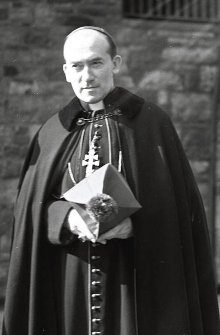
Death of John Charles McQuaid, Archbishop of Dublin

John Charles McQuaidC.S.Sp., the Catholic Primate of Ireland and Archbishop of Dublin between December 1940 and January 1972, dies in LoughlinstownCounty Dublin, on April 7, 1973. He is known for the unusual amount of influence he has over successive governments.

McQuaid is born on July 28, 1895, in CootehillCounty Cavan, the eldest son of Eugene McQuaid and Jennie Corry McQuaid. He comes from a medical family, with his father, paternal uncle, sister and half-brother all being doctors. He is educated at St. Patrick’s College, Cavan, followed by Blackrock College in Blackrock, Dublin, which is run by the Holy Ghost Fathers, and the Jesuit Clongowes Wood College. He enters the Holy Ghost novitiate at Kimmage, Dublin, in 1913 and is professed in 1914. He graduates from the University College Dublin (UCD) in 1917 with first-class honors in classics. He continues his postgraduate studies at UCD with a master’s degree and a teaching diploma and subsequently earns a doctorate in theology at the Pontifical Gregorian University in Rome.

Ordained in 1924, the theology in which McQuaid is trained is conservative — strongly neo-scholastic and hostile to modernism and liberalism. His hatred of the French Revolution is expressed in several pastorals and speeches throughout his career. He also regards Protestantism as a fundamental error from which Irish Catholics should be quarantined as much as possible.

Appointed Dean of Studies at Blackrock College, McQuaid becomes a prominent figure in Catholic education and chairs the Catholic Headmasters’ Association for several years. In 1931 he is appointed president of Blackrock College, in which capacity he becomes acquainted with Éamon de Valera, the future Irish Taoiseach whose sons attend the school. In 1936, while drafting a new Irish constitution, de Valera consults McQuaid, although he rejects McQuaid’s draft “One, True Church” clause which states, among other things, that the Catholic Church is the one true church in Ireland.

When McQuaid is appointed Archbishop of Dublin in 1940, the appointment of a priest from the regular clergy causes considerable surprise. Irish government archives reveal that de Valera, as is suspected at the time, presses McQuaid’s claims at the Vatican. However, it is doubtful whether the Vatican needs much persuasion. There is a dearth of potential episcopal talent and McQuaid has an outstanding reputation as a Catholic educationalist.

Once appointed, McQuaid proves to be one of the ablest administrators in the history of the Irish Church. In the first two years of his episcopate, he sets up the Catholic Social Service Conference to alleviate the poverty and distress in Dublin which is aggravated by the war, and the Catholic Social Welfare Bureau to help the thousands of Irish emigrants going to Britain for war work. These two organizations fill a much-needed gap and continue to exist after the war. The expansion of Dublin city and its suburbs during his episcopate requires the building of new churches, schools, and hospitals. Meeting these demands also necessitates a considerable increase in the number of clergies, secular and regular, whose numbers more than double in the period from 1941 to 1972.

Given his previous career, the importance McQuaid assigns to education is not surprising. He is critical of the low priority accorded to education by successive governments and is particularly critical of the poor and pay conditions of teachers. His intervention in the primary teachers’ strike in 1946 is poorly received by the government and marks the souring of his relationship with de Valera. During his episcopate the number of primary schools increases by a third while the number of secondary schools more than double but, as with social welfare, the government increasingly assumes a dominant role in education from the 1960s onwards. Almost immediately after his appointment in 1940, he takes a hardline stand against the attendance of Catholic students at Trinity College Dublin (TCD). The ban lasts until 1970, when the increase in student numbers renders it untenable and he accedes reluctantly.

McQuaid has a formidable list of achievements in health care, especially maternity and pediatric services, physical and mental handicap services, and the treatment of alcoholism. It is ironic, therefore, that the most controversial episode of his career occurs in this area — the Irish hierarchy’s rejection in 1951 of a free mother-and-child health service. This leads to the resignation of the Minister for Health, Dr. Noël Browne, and is a watershed in Church-State relations in Ireland. With Irish tuberculosis and infant mortality statistics ranking among the highest in the world, the hierarchy, and particularly McQuaid, lose considerable support by lining up with the conservative medical establishment to resist efforts at socialized medicine.

From various pastorals that McQuaid issues at the time, it is clear that he does not see the need for the Second Vatican Council. As its deliberations proceed, his unease grows, and he becomes increasingly preoccupied with the issue of episcopal power and independence that he believes are being threatened by the Council. In the areas of liturgical reform, greater lay participation, and ecumenism, he is slow in implementing the Vatican II reforms. His views on ecumenism had always been lukewarm and had led to allegations that he was anti-Protestant. His personality and policies are criticized by a more assertive Dublin laity, but being a shy, reserved man who increasingly feels the isolation of office, he never responds to such comments. In 1968 the reaction to Humanae vitae causes open rebellion in the Dublin diocese, the force of which catches him unaware. His last pastoral as archbishop in 1971 betrays his anger and bemusement at the response to Humanae vitae in Dublin.

At the age of 75, McQuaid submits his resignation to the Vatican, and it is accepted. His resignation is announced in January 1972, when he is replaced by Dermot Ryan. McQuaid dies in Loughlinstown, County Dublin, the following year on April 7, 1973. He is buried in St. Mary’s Pro-Cathedral in Dublin, the seat of the Roman Catholic Archdiocese of Dublin.

McQuaid’s substantial archives are released by the Dublin Diocesan Archives in the late 1990s. In 1999 journalist John Cooney publishes a hostile biography of McQuaid, which makes controversial allegations of sexual abuse against McQuaid. The allegations are based on tenuous evidence gathered by McQuaid’s nemesis from the 1951 Mother and Child controversy, Dr. Noël Browne, who had died in 1997. No corroborating evidence is produced or has since emerged.


Leave a comment

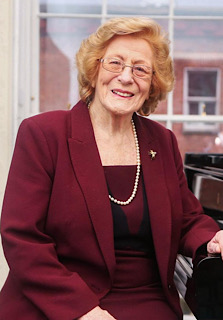
Death of Veronica Dunne, Operatic Soprano & Voice Teacher

Veronica Dunne, Irish operatic soprano and voice teacher also known as Ronnie Dunne, who is described as “an Irish national treasure,” dies on April 5, 2021. After a successful operatic career at the Dublin Opera and the Royal Opera House in London, she focuses on voice teaching in Dublin, where she trains future international singers. The triennial Veronica Dunne International Singing Competition is established in 1995. She receives the National Concert Hall Lifetime Achievement Award in 2014.

Dunne is born in Dublin on August 20, 1927. She is the youngest of three children of a well-to-do family. Her father works as a master builder whose construction firm builds the church in Foxrock, Dublin, in the early 1930s. She begins singing when she is 11 years old. She studies initially in Dublin with Hubert Rooney. She then sells her pony for £125 in order to fund her dream of studying music in Italy. She goes to Rome in 1946 to study with Soldini Calcagni and Francesco Calcatelli. Her family meets with Sarsfield Hogan, the secretary of the Department of Finance at the time, to discuss the issue of her monthly allowance, which would breach foreign exchange controls. Sarsfield permits her to receive the money on the condition that she return to Ireland in the future and teach her young compatriots to sing.

Dunne makes her operatic debut in Dublin in 1948 as Micaëla in Georges Bizet‘s Carmen with the Dublin Grand Opera Society, and appears there in 1949 as Marguerite in Charles Gounod‘s Faust. She wins the Concorso Lirico Milano in 1952, which brings her the role of Mimì in Ruggero Leoncavallo‘s La bohème at the Teatro Nuovo in Milan, which in turn brings her a contract from the Royal Opera House in London, where she first appears as Sophie in Der Rosenkavalier by Richard Strauss. She performs at the house alongside Joan Sutherland and Kathleen Ferrier. In 1958, she appears as Blanche in the first performance at the house of Francis Poulenc‘s Dialogues of the Carmelites. She also performs with the Welsh National OperaScottish Opera, and Wexford Festival Opera. She returns to the stage in 2002 to appear as Countess in Pyotr Ilyich Tchaikovsky‘s The Queen of Spades at the Gaiety Theatre in Dublin.

Dunne gives a number of world premieres of works by contemporary Irish composers including Never to Have Lived is Best (1965) by Seóirse Bodley, as well as Irish Songs (1971) and The Táin (1970) by James Wilson.

Dunne is appointed a voice teacher at the then Dublin College of Music (today Technical University Conservatory of Music and Drama) in 1962. She is awarded an honorific doctorate in 1987. She retires in 1992, but continues to teach at the Leinster School of Music and the Royal Irish Academy of Music. Her students include Patricia Bardon, Orla Boylan, Mary Brennan, Tara Erraught, Lynda Lee, Colette McGahon, Anthony KearnsSuzanne Murphy, and Finbar Wright, who have all sung in the major international opera houses. In 2014, at the age of 87, she continues to teach 39 hours per week.

The triennial Veronica Dunne International Singing Competition, established by the Friends of the Vocal Arts in Ireland in 1995, awards bursaries in her name. Recipients included Orla Boylan, Sarah-Jane Brandon, Tara Erraught, Pumeza Matshikiza and Simon O’Neill. She receives the National Concert Hall Lifetime Achievement Award in 2014.

Dunne marries Peter McCarthy in 1953. The couple has two children.

Dunne dies at the age of 93, on April 5, 2021. Irish President Michael D. Higgins pays tribute to Dunne, saying that she “captivated millions with her singing” and adding, “The legacy she leaves lies in the talents of those scores of others whose talents and performances she unlocked with her enthusiasm, energy and commitment as a teacher and friend.”


Leave a comment

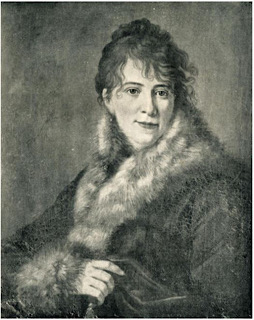
Death of Katherine Wilmot, Irish Traveler & Diarist

Katherine Wilmot, Irish traveler and diarist, dies in Paris, France, on March 28, 1824. She makes a Grand Tour from 1801 to 1803 and documents her experiences through letters, including encounters with notable figures like Napoleon Bonaparte. She later travels to Russia to join her sister Martha Wilmot and lives there from 1805 to 1807. She later moves to France and dies in Paris in 1824. Her writings, letters, and diaries provide insight into the Napoleonic era, on Russian society and on travel in the 19th century. Her works also include her sister’s transcript of the memoirs of Princess Yekaterina Vorontsova-Dashkova.

Wilmot is born around 1773 in DroghedaCounty Louth, to Edward and Martha Wilmot (née Moore). She is the eldest daughter of six daughters and three sons. Her father is the port surveyor in Drogheda, having previously served as captain in the 40th Regiment of Foot. He is transferred to a similar post in County Cork in 1775, where Wilmot is raised. The family settles in Glanmire, near the seat of the Earl Mount Cashell in Moore Park. The earl’s family uses the surname Moore.

Wilmot is friendly with Lady Mountcashell, formerly Margaret King, an early and eager pupil of Mary Wollstonecraft. She is invited to accompany the party of Stephen Moore, 2nd Earl Mount Cashell, and his wife on a grand tour of the continent. Her letters from the time survive, in France from November 1801 to October 1802, and in Italy until July 1803. The Mount Cashells entertain lavishly, especially during the first nine months in Paris, and through them she meets Napoleon Bonaparte, and becomes friends with the Austrian painter Angelica Kauffman. She also meets the French diplomat and politician Charles Maurice de Talleyrand-Périgord, and the Irish republican Robert Emmet fleetingly. She recounts her meeting in Rome with the English aristocrat Frederick Augustus Hervey, and her audience with Pope Pius VII. She returns to London from Italy in October 1803, via Germany and Denmark, after England and France resume hostilities.

Wilmot then goes to Russia to bring home her sister Martha, and ends up spending two years there. Martha is in the country as a favourite of Princess Dashkova, one of the key figures of the Russian Enlightenment and a close friend of Catherine the Great. Martha is living at the Princess’s estate in Troitskoe on the Oka River, about 100 km from Moscow. Wilmot arrives on August 4, 1805, having set out from Cork on June 5. Her writings from this time record the Russian aristocracy‘s opulence and attitudes to the servile classes (the serfs). The sisters come to know the customs of the Russian elite, as well as the festivals and religious rites of the country people. She leaves Moscow on July 4, 1807, a combination of passport problems, wars and storms at sea, resulting in delays and in her reaching Yarmouth on September 7, 1807, and returning to Ireland in October 1807.

Wilmot moves to France to live in a warmer, drier climate than Ireland. Her health declines when she moves to Paris, and she dies there on March 28, 1824. Her nephew by Martha, Wilmot Henry Bradford, lives to be “Father of the Army.”

Wilmot had taken Martha’s transcript of the memoirs of the Princess Dashkova when she left Russia. These are published by Martha in 1840, as she had burned the original manuscript before her departure from Russia in 1808.

Wilmot’s letters are published a century later, and have been described as a unique portrayal of the Napoleonic period. They describe the social scene, as well as the experience of traveling by coach and ship at that time. The family makes transcriptions of the letters. The collection belonging to Martha is donated to the library of the Royal Irish Academy by Elisabeth van Dedem Lecky, the historian and writer. Among these Russian letters are a number written by Eleanor Cavanagh, who describes the lives of servants. Wilmot’s diaries are published in 1920 by Thomas Sadleir, and later by H. Montgomery Hyde and Edith Vane-Tempest-Stewart, Marchioness of Londonderry.

  • The Grand Tours of Katherine Wilmot, France 1801-1803, and Russia 1805-07(Weidenfeld & Nicolson, 1992)
  • An Irish Peer on the Continent, 1801-03 (1920)
  • The Russian Journals of Martha and Catherine Wilmot (1934)
  • More letters from Martha Wilmot; Vienna 1819-29 (1935)


Leave a comment

Death of Nicholas Callan, Priest & Scientist

Father Nicholas Joseph Callan, Catholic priest and physicist, dies in Maynooth, County Kildare, on January 10, 1864. He is Professor of Natural Philosophy in Maynooth College in Maynooth from 1834, and is best known for his work on the induction coil.

Callan is born on December 22, 1799, in Darver, County Louth. He attends school at an academy in Dundalk. His local parish priest, Father Andrew Levins, then takes him in hand as an altar boy and Mass server and sees him start the priesthood at Navan seminary. He enters Maynooth College in 1816. In his third year at Maynooth, he studies natural and experimental philosophy under Dr. Cornelius Denvir. He introduces the experimental method into his teaching and has an interest in electricity and magnetism.

Callan is ordained a priest in 1823 and goes to Rome to study at Sapienza University, obtaining a doctorate in divinity in 1826. While in Rome he becomes acquainted with the work of the pioneers in electricity such as Luigi Galvani (1737–98), who is a pioneer in bioelectricity, and Alessandro Volta (1745–1827), who is known especially for the development of the electric battery. In 1826, he returns to Maynooth as the new Professor of Natural Philosophy (now called physics), where he also begins working with electricity in his basement laboratory at the college.

Influenced by William Sturgeon and Michael Faraday, Callan begins work on the idea of the induction coil in 1834. He invents the first induction coil in 1836. An induction coil produces an intermittent high voltage alternating current from a low voltage direct current supply. It has a primary coil consisting of a few turns of thick wire wound around an iron core and subjected to a low voltage (usually from a battery). Wound on top of this is a secondary coil made up of many turns of thin wire. An iron armature and make-and-break mechanism repeatedly interrupts the current to the primary coil, producing a high voltage, rapidly alternating current in the secondary circuit.

Callan invents the induction coil because he needs to generate a higher level of electricity than currently available. He takes a bar of soft iron, about 2 feet long, and wraps it around with two lengths of copper wire, each about 200 feet long. He connects the beginning of the first coil to the beginning of the second. Finally, he connects a battery, much smaller than the enormous contrivance just described, to the beginning and end of winding one. He finds that when the battery contact is broken, a shock can be felt between the first terminal of the first coil and the second terminal of the second coil.

Further experimentation shows how the coil device can bring the shock from a small battery up the strength level of a big battery. So Callan tries making a bigger coil. With a battery of only 14 seven-inch plates, the device produces power enough for an electric shock “so strong that a person who took it felt the effects of it for several days.” He thinks of his creation as a kind of electromagnet, but what he actually makes is a primitive induction transformer.

Callan’s induction coil also uses an interrupter that consists of a rocking wire that repeatedly dips into a small cup of mercury (similar to the interrupters used by Charles Grafton Page). Because of the action of the interrupter, which can make and break the current going into the coil, he calls his device the “repeater.” Actually, this device is the world’s first transformer. He induces a high voltage in the second wire, starting with a low voltage in the adjacent first wire. The faster he interrupts the current, the bigger the spark. In 1837 he produces his giant induction machine using a mechanism from a clock to interrupt the current 20 times a second. It generates 15-inch sparks, an estimated 60,000 volts and the largest artificial bolt of electricity then seen.

Callan experiments with designing batteries after he finds the models available to him at the time to be insufficient for research in electromagnetism. Some previous batteries had used rare metals such as platinum or unresponsive materials like carbon and zinc. He finds that he can use inexpensive cast iron instead of platinum or carbon. For his Maynooth battery he uses iron casting for the outer casing and places a zinc plate in a porous pot (a pot that had an inside and outside chamber for holding two different types of acid) in the centre. Using a single fluid cell, he disposes of the porous pot and two different fluids. He is able to build a battery with just a single solution.

While experimenting with batteries, Callan also builds the world’s largest battery at that time. To construct this battery, he joins together 577 individual batteries (“cells“), which use over 30 gallons of acid. Since instruments for measuring current or voltages have not yet been invented, he measures the strength of a battery by measuring how much weight his electromagnet can lift when powered by the battery. Using his giant battery, his electromagnet lifts 2 tons. The Maynooth battery goes into commercial production in London. He also discovers an early form of galvanisation to protect iron from rusting when he is experimenting on battery design, and he patents the idea.

Callan dies at the age of 64 in Maynooth, County Kildare, on January 10, 1864. He is buried in the cemetery in St. Patrick’s College, Maynooth.

The Callan Building on the north campus of Maynooth University, a university which is part of St. Patrick’s College until 1997, is named in his honour. In addition, Callan Hall in the south campus, is used through the 1990s for first year science lectures including experimental & mathematical physics, chemistry and biology. The Nicholas Callan Memorial Prize is an annual prize awarded to the best final year student in Experimental Physics.


Leave a comment

Birth of John Magee, Bishop Emeritus of Cloyne

John Magee SPS, a Roman Catholic bishop emeritus in Ireland, is born in Newry, County DownNorthern Ireland, in the Roman Catholic Diocese of Dromore, on September 24, 1936. He is Bishop of Cloyne from 1987 to 2010. Following scandal he resigns from that position on March 24, 2010, becoming a bishop emeritus. He is the only person to have been private secretary to three popes.

Magee’s father is a dairy farmer. He is educated at St. Colman’s College in Newry and enters the St Patrick’s Missionary Society at KilteganCounty Wicklow, in 1954. He also attends University College Cork (UCC) where he obtains a degree in philosophy before going to study theology in Rome, where he is ordained priest on March 17, 1962.

Magee serves as a missionary priest in Nigeria for almost six years before being appointed Procurator General of St. Patrick’s Society in Rome. In 1969, he is an official of the Congregation for the Evangelization of Peoples in Rome, when he is chosen by Pope Paul VI to be one of his private secretaries. On Pope Paul’s death he remains in service as a private secretary to his successor, Pope John Paul I and Pope John Paul II. He is the only man to hold the position of private secretary to three Popes in Vatican history. He also acts as chaplain to the Vatican’s Swiss Guard.

Magee is appointed papal Master of Pontifical Liturgical Celebrations in 1982, and is appointed Bishop of the Diocese of Cloyne on February 17, 1987. He is consecrated bishop on March 17, 1987, Saint Patrick’s Day, by Pope John Paul II at St. Peter’s Basilica in the Vatican.

On April 28, 1981, Magee travels, without the knowledge or approval of the Vatican’s Secretariat of State, to the Long Kesh Detention Centre outside Belfast to meet with Irish Republican Army (IRA) hunger striker Bobby Sands. He seeks, unsuccessfully, to convince Sands to end his hunger strike. Sands dies the following week.

Magee plays a role in the Irish Catholic Bishops’ Conference where he is featured in the modernisation of the liturgy in Ireland. His pastoral approach places heavy emphasis on the promotion of vocations to the priesthood but, after some initial success, the number of vocations in the diocese of Cloyne declines, a trend reflected across the island of Ireland. He appoints Ireland’s first female “faith developer” and entrusts her with the task of transforming an Irish rural diocese into a cosmopolitan pastoral model using techniques borrowed from several urban dioceses in the United States.

Magee involves himself in a dispute with the Friends of St. Colman’s Cathedral, a local conservationist group in Cobh which organises an effective and professional opposition to the Bishop’s plans to re-order the interior of the cathedral, plans similar to previous re-orderings in KillarneyCork and Limerick cathedrals. In an oral hearing conducted by An Bord Pleanála, the Irish Planning Board, it emerges that irregularities have occurred in the planning application that are traced to Cobh Town Council, which accommodates the Bishop’s plans to modify the Victorian interior designed by E. W. Pugin and George Ashlin. On June 2, 2006, when Bishop Magee was in Lourdes, An Bord Pleanála directs Cobh Town Council to refuse the Bishop’s application.

On July 25, 2006, Magee publishes a pastoral letter stating: “As a result of An Bord Pleanála’s decision, the situation concerning the temporary plywood altar still remains unresolved and needs to be addressed. The Diocese will initiate discussions with the planning authorities in an attempt to find a solution, which would be acceptable from both the liturgical and heritage points of view.”

A diocesan official explains that the bishop does not wish to institute a judicial review in the Irish High Court because of the financial implications of such an action and because of the bishop’s desire to avoid a Church-State clash.

Claims that the decision of An Bord Pleanála infringes the constitutional property rights of religious bodies are dismissed when it is revealed that the cathedral is the property of a secular trust established in Irish law. It is estimated that Bishop Magee spent over €200,000 in his bid to re-order the cathedral. The controversy is reported even outside Ireland.

A February 2006 article by Kieron Wood in The Sunday Business Post claims that Magee does not have the backing of the Vatican in his proposals for St. Colman’s. At the oral hearing of An Bord Pleanála he is requested to provide a copy of the letter from the Vatican in which he claims he has been given approval for the modernising of the cathedral. The letter that he produces is a congratulatory message dated December 9, 2003 to the team of architects who worked on the cathedral project from Cardinal Francis Arinze, Prefect of the Dicastery for Divine Worship and the Discipline of the Sacraments. The whole text of this letter is then reproduced in a publication called Conserving Cobh Cathedral: The Case Stated pp. 108–109.

At a meeting of his liturgical advisers and diocesan clergy in November 2006, Bishop Magee speaks of his conversation with the Pope in the course of that ad limina visit at the end of the previous month. He mentions that he has been closely questioned on several aspects of his proposals to re-order St. Colman’s Cathedral. It is obvious, he says, that the Pope has been kept well informed of the entire issue.

Bishop Magee’s contribution to the ad limina visit concerns not only his diocese of Cloyne but also ceremonial matters on behalf of the Conference. He also facilitates the broadcasting, in coincidence with the visit, of a life of Pope John Paul I prepared some months earlier by Italian state television (RAI). In an interview published on the Italian Catholic daily Avvenire on October 26, 2006, Cardinal Secretary of State Tarcisio Bertone criticises the image that the programme presents of Pope John Paul I.

After the ad limina visit, Bishop Magee represents the Irish bishops at a meeting in Rome of the International Commission for Eucharistic Congresses.

In 2007, for the third year in succession, Magee fails to complete his personal schedule of confirmations in Cloyne diocese. On May 12, 2007, he is admitted to the Bon Secours Hospital in Cork to undergo a knee replacement operation. All official engagements are cancelled for the next ten weeks to allow him to recuperate, after which he resumes work.

In December 2008, Magee is at the centre of a controversy concerning his handling of child sexual abuse cases by clergy in the diocese of Cloyne. Calls for his resignation follow. On March 7, 2009, he announces that, at his request, the Pope has placed the running of the diocese in the hands of Dermot Clifford, metropolitan archbishop of the Archdiocese of Cashel and Emly, to whose ecclesiastical province the diocese of Cloyne belongs. Magee remains Bishop of Cloyne, but withdraws from administration in order, he says, to dedicate his full-time to the matter of the inquiry. On March 24, 2010, the Holy See announces that Magee has formally resigned from his duties as Bishop of Cloyne. He is eventually succeeded by Canon William Crean whose appointment comes on November 25, 2012.

The subsequent report of the Irish government judicial inquiry, The Cloyne Report, published on July 13, 2011, finds that Bishop Magee’s second in command, Monsignor Denis O’Callaghan, then the parish priest of Mallow, had falsely told the Government and the HSE in a previous inquiry that the diocese was reporting all allegations of clerical child sexual abuse to the civil authorities.

The inquiry into Cloyne – the fourth examination of clerical abuse in the Church in Ireland – finds the greatest flaw in the diocese is repeated failure to report all complaints. It finds nine allegations out of 15 were not passed on to the Garda.

Speaking in August 2011, Magee says that he felt “horrified and ashamed” by abuse in his diocese. He says he accepts “full responsibility” for the findings. “I feel ashamed that this happened under my watch – it shouldn’t have and I truly apologise,” he says. “I did endeavour and I hoped that those guidelines that I issued in a booklet form to every person in the diocese were being implemented but I discovered they were not and that is my responsibility.”

Magee also offers to meet abuse victims and apologise “on bended knee.” He says he had been “truly horrified” when he read the full extent of the abuse in the report. However, a victim says apologies would “never go far enough.” “It’s too late for us now, the only thing it’s not too late for is that maybe there will be a future where people will be more enlightened, more aware and protect their children better,” she says. Asked about restitution for victims, Magee says it is a matter for the Cloyne Diocese.


Leave a comment

Birth of Patrick Francis Moran, Third Archbishop of Sydney

Patrick Francis Moran, a prelate of the Catholic Church, the first cardinal appointed from Australia and the third Archbishop of Sydney, is born at LeighlinbridgeCounty Carlow, on September 16, 1830. Before his promotion to Archbishop, his scholarly research into the lives and times of the Irish Catholic Martyrs leads to the publication of many primary sources for the first time. These publications have since been used in recent beatifications and at least one canonization.

Moran’s parents are Patrick and Alicia Cullen Moran. Of his three sisters, two become nuns, one of whom dies nursing cholera patients. His parents die by the time he is 11 years old. In 1842, at the age of twelve, he leaves Ireland in the company of his uncle, Paul Cullen, rector of the Pontifical Irish College in Rome. There he studies for the priesthood, first at the minor seminary and then at the major seminary.

Moran is considered so intellectually bright that he gains his doctorate by acclamation. By The age of 25 he speaks ten languages, ancient and modern. He focuses on finding and editing important documents and manuscripts related to Irish ecclesiastical history. Some editions of his works remain important source materials to this day.

Moran is appointed vice-rector at the Pontifical Irish College and also takes the chair of Hebrew at Congregation for the Evangelization of Peoples (CEP). He is also some-time vice-rector of the Scots College in Rome. In 1866, he is appointed secretary to his mother’s half-brother, Cardinal Paul Cullen of Dublin. He is also appointed professor of scripture at Holy Cross College, Dublin. He founds the Irish Ecclesiastical Record (on which he later models the Australasian Catholic Record).

In 1869, Moran accompanies Cardinal Cullen to the First Vatican Council, a council also attended by Melbourne‘s then-first archbishop, James Alipius Goold. According to Michael Daniel, it is generally agreed that the definition of the Catholic doctrine of papal infallibility is based on Cullen’s proposal, and Ayres suggests that there is strong evidence that Cullen’s proposal is largely drafted by Moran. While in Rome and Ireland he is very active politically in opposing English Benedictine plans for monastic foundations undergirding the Catholic Church in Australia.

Moran is appointed coadjutor bishop of Ossory on December 22, 1871, and is consecrated on March 5, 1872 in Dublin by his uncle, Cardinal Paul Cullen. On the death of Bishop Edward Walsh, he succeeds as Bishop of Ossory on August 11, 1872. He champions Home Rule and is consulted by William Ewart Gladstone prior to the introduction of his Home Rule Bills.

Moran is personally chosen and promoted by Pope Leo XIII to head the Archdiocese of Sydney – a clear policy departure from the previous English Benedictine incumbents, John Bede Polding and Roger Vaughan, who were experiencing tension leading the predominantly Irish Australian Catholics. In the archbishop’s farewell audience with Leo XIII, it is evident that the intrigues of parties, the interference of government agencies and the influence of high ecclesiastics had made the matter almost impossible to decide by Propaganda. In the presence of others, the Pope says clearly: “We took the selection into our own hands. You are our personal appointment.” Moran is appointed to Australia on January 25, 1884, and arrives on September 8, 1884. He is created cardinal-priest on July 27, 1885, with the title of St. Susanna. The new Irish Australian cardinal makes it his business to make his presence and leadership felt.

Moran begins transforming the Sydney Saint Patrick’s Day festivities by inaugurating the celebration of a Solemn Mass at St. Mary’s Cathedral on Saint Patrick’s Day 1885. Over time the day’s events change from an Irish nationalist and political day into an occasion “for the demonstration of Irish Catholic power and respectable assimilation” as well as “for the affirmation of Irish Catholic solidarity.”

In 1886, it is estimated that Moran travels 2,500 miles over land and sea, visiting all the dioceses of New Zealand. In 1887, he travels 6,000 miles to consecrate fellow Irishman Matthew Gibney at Perth. He also travels to BallaratBathurstBendigoHobartGoulburnLismore, Melbourne and Rockhampton for the consecration of their cathedrals. Following the 1891 encyclical Rerum Novarum, he supports the right of labourers to better their conditions.

During his episcopate, Moran consecrates 14 bishops (he is the principal consecrator of William WalshMichael VerdonPatrick Vincent DwyerArmand Olier and also assists in consecrating Patrick Clune, among others). He ordains nearly 500 priests, dedicates more than 5,000 churches and professes more than 500 nuns. He makes five journeys to Rome on church business between 1885 and 1903, but does not participate in the papal conclave of 1903 because of the relatively short notice and the distance, making it impossible for him to reach Rome within 10 days of the death of Pope Leo.

Moran is a strong supporter of Federation, and in November 1896 attends the People’s Federal Convention in Bathurst. In March 1897, he stands as a candidate election of ten delegates from New South Wales to the Australasian Federal Convention. Although he states he will not attend the Convention in any official capacity, but in a solely individual one, his candidacy sparks a sectarian reaction. Twenty-nine per cent of voters give one of their ten votes to Moran, but he comes only thirteenth in number of total votes and is not elected.

From 1900 to 1901, Moran’s leadership survives a crisis when his personal secretary, Denis O’Haran, is named as co-respondent in the divorce case of the cricketer Arthur Coningham. Moran vigorously defends O’Haran and a jury finds in his favour.

Moran dies in Manly, Sydney, on August 16, 1911, aged 80. A quarter of a million people, the largest crowd ever to gather in Australia prior to that date, witness his funeral procession through the centre of Sydney. He is buried in St. Mary’s Cathedral, Sydney.


Leave a comment

Birth of Anthony Farquhar, Auxiliary Bishop Emeritus of Down & Connor

Anthony J. FarquharIrish Catholic prelate who is the Auxiliary Bishop of the Roman Catholic Diocese of Down and Connor, is born in South BelfastNorthern Ireland, on September 6, 1940.

Farquhar is educated at St. Malachy’s College. He later studies classics at Queen’s University, Belfast. He is then sent to study theology at the Pontifical Lateran UniversityRome. He is ordained to the priesthood at the age of 24 on March 13, 1965.

Farquhar is assistant priest at Dunsford and Ardglass Parish. He is a hospital chaplain in 1966. He is later assigned to teach Latin at St. MacNissi’s College, Garron Tower, where he stays as a teacher from 1966 to 1970. From 1970 to 1975 he is assistant chaplain, along with Ambrose Macaulay, to Queen’s University Belfast, and finally as Chaplain/Lecturer at the University of Ulster from 1975 to 1983.

Farquhar’s main outside interests are folk music and football, particularly student football. He is president of Queen’s University Belfast A.F.C. and also serves as patron of the Irish Universities Football Union.

On April 6, 1983, aged 42, Farquhar is appointed Titular Bishop of Hermiana and, with Patrick Walsh, as Auxiliary Bishop of Down and Connor. The principal consecrator is the Bishop of Down and Connor, Cahal Daly, (later Cardinal Archbishop of the Archdiocese of Armagh) and principal co-consecrators are Archbishop Gaetano Alibrandi, the Apostolic Nuncio to Ireland and William J. Philbin (Bishop Emeritus of Down and Connor). During the ordination ceremony, the assistant Priests to Bishop Farquhar are his priest uncles, Canon Walter Larkin and Fr. Thomas Aquinas Larkin O.C.D.

Farquhar’s episcopal motto is “Sapientia Proficere” (“to increase in wisdom”) from Luke 2:52. He takes an active and ongoing interest in interchurch relations and serves as Chairman of the Irish Catholic Bishops’ Conference on Ecumenism.

Farquhar travels to Rome for the quinquennial visit ad limina visit in October 2006.

In December 2007, he officiates at the dedication of the new altar in the Church of the Good Shepherd in his native parish of the Most Holy Rosary, Belfast, following the renovation programme.

A book titled Inter-Church Relations: Developments and Perspectives, published by Veritas Communications to mark the 25th anniversary of Farquhar’s ordination as a bishop, contains contributions by a number of people praising Farquhar’s work. Seán Brady notes he was “engaged actively in promoting bonds of friendship and understanding at times when it has been far from easy to do so.”

On December 3, 2015, Pope Francis accepts Farquhar’s resignation on the grounds of age. He is at the time the longest serving bishop in Ireland.

Farquhar dies in Belfast on November 18, 2023, at the age of 83. His funeral requiem mass is celebrated in the Church of the Good Shepherd, Ormeau Road, Belfast, on November 23 followed by interment in the adjoining cemetery.


Leave a comment

Death of Malachi Martin, Irish American Catholic Priest

Malachi Brendan Martin, also known under the pseudonym of Michael Serafian, Irish-born American Traditionalist Catholic priestbiblical archaeologistexorcistpalaeographerprofessor, and writer on the Catholic Church, dies in New York City on July 27, 1999.

Martin is born on July 23, 1921, in BallylongfordCounty Kerry, to a middle-class family in which the children are raised speaking Irish at the dinner table. His parents, Conor and Katherine Fitzmaurice Martin, have five sons and five daughters. Four of the five sons become priests, including his younger brother, Francis Xavier Martin.

Martin attends Belvedere College in Dublin, then studies philosophy for three years at University College Dublin (UCD). On September 6, 1939, he becomes a novice with the Society of Jesus. He teaches for three years, spending four years at Milltown Park, Dublin, and is ordained in August 1954.

Upon completion of his degree course in Dublin, Martin is sent to the Catholic University of Leuven in Belgium, where he takes a doctorate in archaeologyOriental history, and Semitic languages. He starts postgraduate studies at both the Hebrew University of Jerusalem and at the University of Oxford. He specializes in intertestamentary studiesJesus in Jewish and Islamic sources, Ancient Hebrew and Arabic manuscripts. He undertakes additional study in rational psychologyexperimental psychologyphysics, and anthropology.

Martin participates in the research on the Dead Sea Scrolls and publishes 24 articles on Semitic palaeography. He does archaeological research and works extensively on the Byblos syllabary in Byblos, in Tyre, and in the Sinai Peninsula. He assists in his first exorcism while working in Egypt for archaeological research. In 1958, he publishes a work in two volumes, The Scribal Character of the Dead Sea Scrolls.

Martin’s years in Rome coincide with the beginning of the Second Vatican Council (1962–65), which is to transform the Catholic Church in a way that the initially liberal Martin begins to find distressing. He becomes friends with Monsignor George Gilmary Higgins and Father John Courtney Murray.

In Rome, Martin becomes a professor at the Pontifical Biblical Institute, where he teaches Aramaic, Hebrew, palaeography, and Sacred Scripture. He also teaches theology, part-time, at Loyola University Chicago‘s John Felice Rome Center. He works as a translator for the Eastern Orthodox Churches and Ancient Oriental Churches Division of the Secretariat for Promoting Christian Unity under Bea. He becomes acquainted with Jewish leaders, such as Rabbi Abraham Joshua Heschel, in 1961 and 1962. He accompanies Pope Paul VI on a trip to Jordan in January 1964. He resigned his position at the Pontifical Institute in June 1964.

In 1964, Martin requests a release from his vows and from the Jesuit Order. He receives a provisional release in May 1965 and a dispensation from his vows of poverty and obedience on June 30, 1965. Even if dispensed from his religious vow of chastity, he remains under the obligation of chastity if still an ordained secular priest. He maintains that he remains a priest, saying that he had received a dispensation from Paul VI to that effect.

Martin moves to New York City in 1966, working as a dishwasher, a waiter, and taxi driver, while continuing to write. He co-founds an antiques firm and is active in communications and media for the rest of his life.

In 1967, Martin receives his first Guggenheim Fellowship. In 1970, he publishes the book The Encounter: Religion in Crisis, winning the Choice Book Award of the American Library Association. He then publishes Three Popes and the Cardinal: The Church of Pius, John and Paul in its Encounter with Human History (1972) and Jesus Now (1973). In 1970, he becomes a naturalized U.S. citizen.

In 1969, Martin receives a second Guggenheim Fellowship, allowing him to write his first of four bestsellersHostage to the Devil: The Possession and Exorcism of Five Living Americans (1976). In the book, he calls himself an exorcist, claiming he assisted in several exorcisms. According to McManus Darraugh, William Peter Blatty “wrote a tirade against Malachi, saying his 1976 book was a fantasy, and he was just trying to cash in.” Darraugh also says that Martin became “an iconic person in the paranormal world.”

Martin serves as religious editor for the National Review from 1972 to 1978. He is interviewed twice by William F. Buckley, Jr. for Firing Line on PBS. He is an editor for the Encyclopædia Britannica.

Martin is a periodic guest on Art Bell‘s radio program, Coast to Coast AM, between 1996 and 1998. The show continues to play tapes of his interviews on Halloween.

Martin’s The Keys of This Blood: The Struggle for World Dominion between Pope John Paul II, Mikhail Gorbachev, and the Capitalist West is published in 1990. It is followed in 1996 by Windswept House: A Vatican Novel.

The Vatican restores Martin’s faculty to celebrate Mass in 1989, at his request. He is strongly supported by some Traditionalist Catholic sources and severely criticized by other sources, such as the National Catholic Reporter. He serves as a guest commentator for CNN during the live coverage of the visit of Pope John Paul II to the United States in October 1995.

On July 27, 1999, Martin dies in Manhattan of an intracerebral haemorrhage, four days after his 78th birthday. It is caused by a fall in his Manhattan apartment. The documentary Hostage to the Devil claims that Martin says he was pushed from a stool by a demonic force.

Martin’s funeral takes place in St. Anthony of Padua Catholic Church in West Orange, New Jersey, before burial at Gate of Heaven Cemetery, in Hawthorne, New York.


Leave a comment

Birth of Dermot Ryan, Roman Catholic Archbishop of Dublin

Dermot Joseph Ryan, the Roman Catholic Archbishop of Dublin from 1972 until 1984, is born on June 26, 1924, in ClondalkinDublin.

Ryan is born to Andrew Ryan, a medical doctor, and Therese (née McKenna). In 1932, he goes to Belvedere College, Dublin. In 1942 he enters Holy Cross CollegeDrumcondra, and graduates with a first in Hebrew and Aramaic at University College Dublin in 1945. He spends a year at St. Patrick’s College, Maynooth before attending the Pontifical Irish College in Rome gaining his BD in 1948 at the Pontifical Lateran University, Rome. He returns to Clonliffe to complete his formation, and where he is ordained a priest on May 28, 1950. He returns to Rome to study at the Pontifical Gregorian University, gaining a Licentiate in Sacred Theology in 1952. In 1954 he is awarded an MA in Semitic Languages from the National University of Ireland (NUI), followed by a licentiate in sacred scripture at the Pontifical Biblical Institute.

Ryan is Professor of Oriental Languages at University College Dublin before his appointment by Pope Paul VI as Archbishop of Dublin and Primate of Ireland on December 29, 1971. Maintaining his connection and interest in oriental studies, he serves as chairman of the trustees of the Chester Beatty Library from 1978 to 1984.

Ryan is ordained a bishop by Pope Paul VI in Rome, assisted by Cardinals Bernardus Johannes Alfrink and William Conway (Archbishop of Armagh and Primate of All Ireland), on February 13, 1972. At the time of his appointment, he is seen as a liberal and a reformer in the Church.

During his term, Ryan consolidates much of the expansion of the archdiocese which had taken place during the term of his predecessor. He also oversees the fuller implementation of the reforms of Vatican II. He is particularly interested in liturgical reform.

Seen as a Liberal, following the episcopacy of John Charles McQuaid, in November 1972, Ryan becomes the first Roman Catholic archbishop to attend a Church of Ireland service in Christ Church Cathedral, Dublin, and holds an interdenominational service in St. Mary’s Pro-Cathedral. He also supports “Ballymascanlon talks,” an inter-church initiative to try to bring communities together and bring peace to Northern Ireland.

Ryan also takes a traditional stand on social issues, including poverty, family life and opposition to abortion. He strongly promotes the Eighth Amendment of the Constitution of Ireland in 1983, granting the equal right to life to mother and unborn.

As Archbishop, Ryan gives the people of Dublin a public park on a site earmarked by his predecessors for a proposed cathedral. It is named “Archbishop Ryan Park” in his honour. The land, at Merrion Square, is a gift from the archbishop to the city of Dublin.

Ryan dies at the age of 60 in Rome on February 21, 1985, following a heart attack. He is buried in St. Mary’s Pro-Cathedral.