seamus dubhghaill

Promoting Irish Culture and History from Little Rock, Arkansas, USA


Leave a comment

Irish Battalion of St. Patrick Fights Piedmontese Force at Spoleto

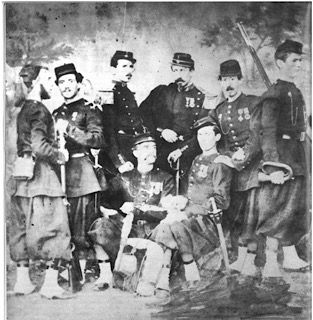
On September 17, 1860, units of the Irish Battalion of St. Patrick of the Papal army, commanded by Captain Myles O’Reilly from County Louth, fights a Piedmontese force under General Brignone at Spoleto, Italy.

By 1860, the Papal States are under threat from King Victor Emmanuel II of Piedmont and Giuseppe Garibaldi’s “Redshirts” during the Wars of Italian Unification. Pope Pius IX has called for Catholic volunteers from Europe, and within weeks over 1,000 Irishmen have enlisted, forming the Irish Battalion. They are poorly equipped and inexperienced, but their morale is high.

The Irish are stationed at Spoleto, a walled city south of Florence with the fortress of Rocca on a hill. On September 16, Brignone’s forces arrive and demand surrender. O’Reilly refuses, and on the following day the Piedmontese launch an assault.

The Irish are tasked with defending the North Wall and the Gate House of the Castle Albornozian. The attackers endure prolonged artillery fire from the fortress walls. When the famed Bersaglieri advance, they are met with a withering musket and rifle fire from the Irish, halting the attack. The Irish hold their ground for fourteen hours under constant bombardment.

Despite their resistance, the bishop of Spoleto, alarmed by the destruction and loss of life, arranges a ceasefire. O’Reilly, nearly out of ammunition, sends a Papal representative to Brignone. Terms are agreed: the Irish can march out as prisoners, with officers retaining their swords.

Brignone praises O’Reilly as “both honourable and brave.” Each officer and enlisted man receives a Medaglia di Pro Petri Sede (“Medal for the Seat of Saint Peter”), and all are declared “meritorious of the Catholic Church, the Holy See and all human society.”

The battle is part of the short 1860 war in which the Papal army, including the Irish Battalion, fight at Ancona, Perugia, Spoleto, and Castelfidardo. Though ultimately defeated, the Irish earn high praise for their courage and discipline.

(Pictured: The Company of Saint Patrick in the Papal Army, 1860)


Leave a comment

The Battle of Castelfidardo

Elements of the St. Patrick’s Battalion of the Papal army fight in the Battle of Castelfidardo on September 18, 1860.

The battle takes place at Castelfidardo, a small town in the Marche region of Italy. It is fought between the Sardinian army, acting as the driving force in the war for Italian unification, against the Papal States.

On September 7, Camillo Benso, Prime Minister of Piedmont, sends an ultimatum to the Pope Pius IX demanding that he dismisses his foreign troops. When he fails to do this, 35,000 troops cross the border on September 11, with General Enrico Cialdini advancing along the Adriatic coast and General Enrico Morozzo Della Rocca leading another troop across Umbria. Papal troops are caught by surprise and thrown into confusion. Some of the Papal troops surrender the same day and some retreat to Ancona, which falls on September 29, 1860, after a short siege.

As a result of this battle, the Marches and Umbria enter in the Kingdom of Italy and the extent of the Papal States is reduced to the area of what is today known as Lazio.

The battle is remembered for being bloody and for the highly disparate numbers of troops — less than 10,000 papal soldiers to 39,000 Sardinians. The papal army is composed of volunteers from many European countries, amongst whom the French and Belgian nationals constitute a Franco-Belgian battalion. Among the French volunteers are a notable number of nobles from western France. After the battle, while consulting the list of dead and wounded members of the papal army, the Sardinian general Cialdini is reported to say in an example of rather black humor, “You would think this was a list of invites for a ball given by Louis XIV!”

The Franco-Belgian, Austrian and Irish battalions later join the Papal Zouaves corps, an infantry regiment of international composition that pledges to aid Pope Pius IX in the protection of the Papacy for the remainder of the Italian unificationist Risorgimento. The battle is commemorated by the Italian ironclad Castelfidardo, built in the 1860s and the 26th Bersaglieri Battalion “Castelfidardo.”